What the Press Is Worth
My brother could triple the value of our worn press with a stroke of the notary's pen. That number might win the leather for our largest order. Valencia, 1953: if it was false, the new law would leave both of us personally answerable.
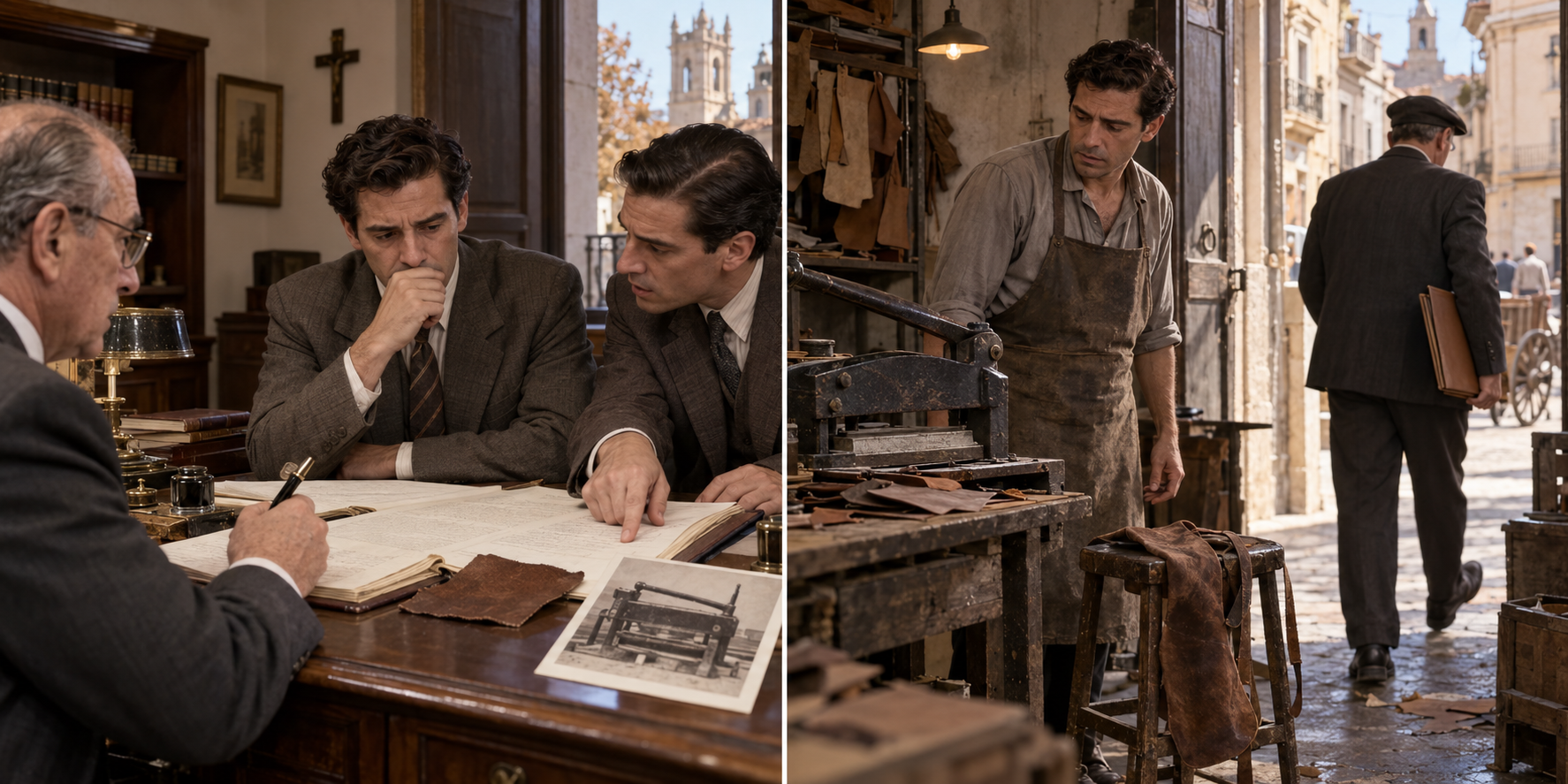
The notary reviews the press's valuation.
A wholesaler wanted four hundred pairs of work boots before winter. I had the patterns and a young apprentice who could cut a sole as cleanly as I could. We did not have enough leather. The merchant would supply it on credit if the capital in our new company's deed satisfied him. Otherwise, he wanted my signature on the bill.
I had signed such bills before. If the shop could not pay, I owed the rest myself. My brother and I wanted to trade through a small limited company instead. Men had made those companies in Spain for years; that summer they finally had a law of their own. We took our savings and a photograph of our cutting press to the notary.
The press was old, but it worked. My brother named a value high enough to make our company look substantial to the leather merchant. The notary put down his pen. Every peseta of capital in our deed had to be contributed from the start, he said. And if we gave the press a value it did not have, we founders would answer together for the difference to the company and its creditors.
My brother looked at me. I could hear the apprentice striking soles downstairs. A bigger order meant I could keep him through winter. It might mean a new press by spring.
"The wheel slips," I said. "You have to set it by hand."
My brother said the merchant would never come to inspect the wheel. He was probably right. I asked the notary to write down what we could honestly get for the machine. My brother watched the larger figure disappear from the page.
After our company was entered in the Mercantile Register, the merchant studied its deed. He tapped the capital figure, then held out a second bill for me to sign in my own name. I thought of our apartment above the workshop. I gave the pen back.
He took his leather to another shoemaker. On Friday I paid the apprentice and told him I could not promise work on Monday. He folded his apron over the empty stool beside the press. After he left, my brother turned its slipping wheel once, slowly, and neither of us spoke.