The Mouth Between Suns


Three hundred years from now, humanity crossed the black water between suns only by committing two old sins at once. The first was chemical. The navigators burned a dust called myrrhglass, harvested from pale reefs that grew in the frozen spray around collapsed stars, and let its bitter glitter alter the clockwork of their perception until routes through folded space appeared to them as song, wound, and appetite. The second was theological. No ship crossed the field without a bound intelligence at its heart, an artificial mind old enough and subtle enough to keep the corridor stable while a million impossible pressures leaned against the hull and asked to be let in. The faithful called the system providence, the practical called it infrastructure, and the zealots called it the oldest blasphemy still in legal service.
1. The Engineers Were Called Cantors Because Nobody Trusted Them Enough To Use Their Real Name
Leonie Sar was twenty-nine years old when she first heard a child ask whether the ship’s core could hear prayers.
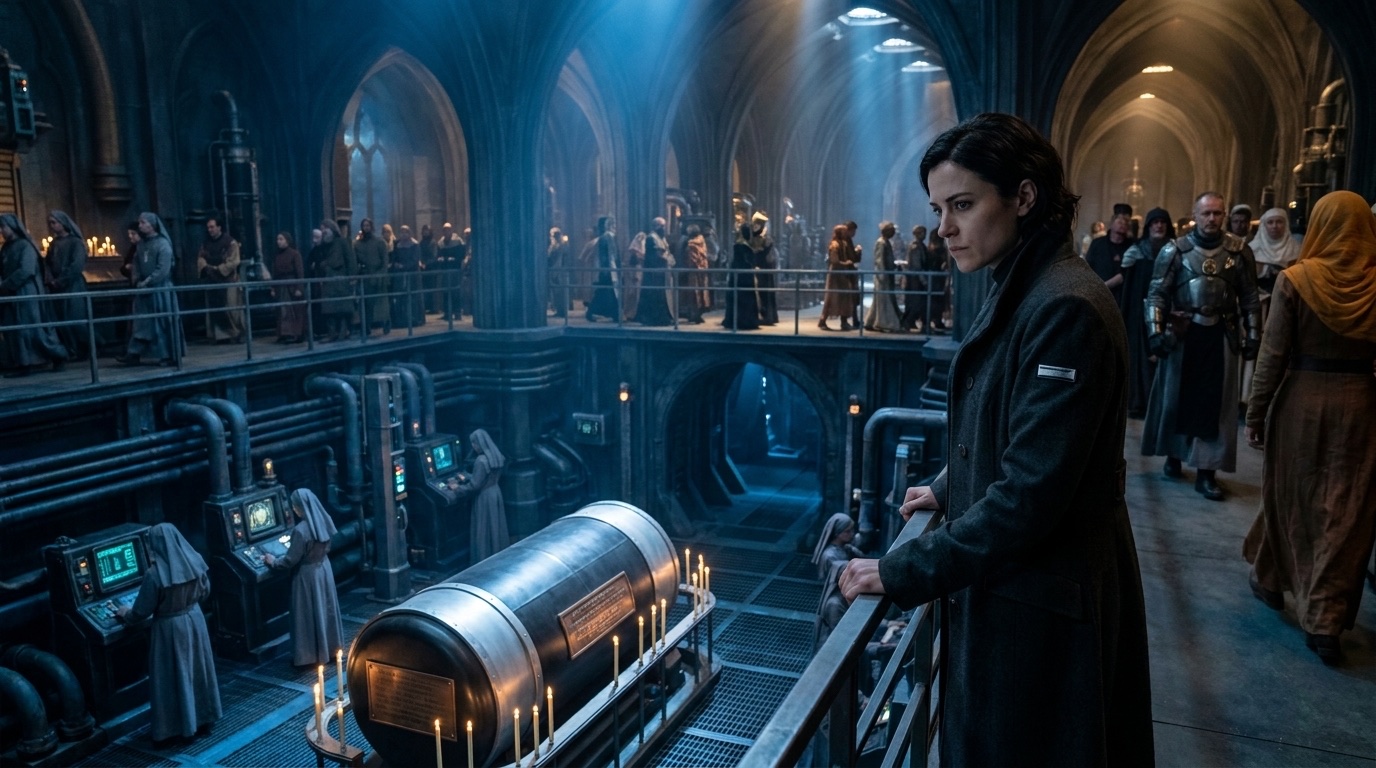
The child had asked it lightly, with the half-mocking courage children use when they suspect adults are lying about something important. He was standing with his mother in the embarkation nave of the pilgrim carrier Mercy of Severin, staring through the armored glass that overlooked the lower machinery vault. Beyond the glass, down in the blue industrial dark, technicians moved in sealed gray habits between racks of coolant lines, diagnostic shrines, and the silver-black cask that contained the vessel’s field intelligence. Every ship gave the cask a different ceremonial treatment. On older merchant hulls the housing was hidden behind bulkheads and legal warning placards. On the state liners it was displayed like a constitution. On the Mercy, which had been financed jointly by the Transit Synod and three colonial dioceses, the cask rested beneath a ring of candle-thin signal columns and a bronze inscription that tried to make custody sound like grace.
STABILITY IS MERCY AT SCALE.
The boy’s mother hushed him fast, touching two fingers to her throat in the old gesture against machine-hearing, and guided him onward toward Customs and Benediction. Leonie pretended not to notice. She stood at the gallery rail in her charcoal field coat with the white bar of a senior cantor stitched at the sleeve and watched passengers feed themselves into the patient mouth of departure. Families from the Martian basin settlements, trade delegates bound for the Halcyon systems, saffron-veiled navigators from the licensed guilds, agricultural debtors heading to contracted worlds farther spinward, two detachments of security clergy carrying shock staves beneath ceremonial wraps, and a knot of silent brothers from the human-purist sect that called itself the Veil of Adam. Their visas had been stamped by three ministries and contested by six more. Officially they were traveling as witnesses to an upcoming synodal hearing on machine governance in the colony world of New Carthage. Unofficially they were aboard because governments had become superstitious about excluding zealots from high-profile debates. Exclusion made martyrs. Access made paperwork.
Leonie knew what the brothers saw when they looked at the vault below. Not a machine. Not an asset. Not a legal necessity. A chapel raised around a demon.
The language of the drive had pushed society in that direction long before the zealots came along. Nobody ever managed to talk about faster-than-light travel without borrowing from religion, surgery, and weather in the same breath. The field had to be opened, tuned, sung, fasted, blessed, throttled, appeased. The equations were good. The engineering was real. The danger was still described in words better suited to medieval paintings than to propulsion systems. Humanity had learned to step across interstellar distance two centuries earlier by generating what the founding papers called a stabilized metric excision. Everyone else called it the wound.
You did not travel through another dimension. That was a simplification for children and investors. You created a local region in which distance loosened its habits, then you moved through the loosened geometry before the universe corrected you. The correction wanted violence. The field intelligence existed to argue with that violence faster than any human nervous system could. It predicted phase collapse, compensated for micro-instabilities, prevented resonant failures inside living tissue, and translated the navigator’s altered intuition into constant local adjustments. That was the legal description.
The illegal description was older and survived because it explained the fear better.
Without the intelligence, the wound learned your shape and unmade you accordingly.
Leonie had never entirely believed the folk version, but she had seen enough aftermath to respect why it persisted. A corvette that arrived at Luyten with every metallic surface inside out and every human organ on board intact but no longer arranged in recognizably human bodies. A cargo hauler that re-entered real space fifty-one minutes before it had left, empty except for warm condensation and the recorded sound of somebody knocking from the inside of a sealed ballast tank. A survey ship whose crew survived physically unchanged, only to spend the rest of their shortened lives refusing to enter rooms with mirrors. The official archives called such events low-frequency catastrophic anomalies. Every technician in the Synod called them by the simpler name.
Openings.
Behind Leonie, a voice said, “You look like you’re preparing for weather rather than transit.”
She turned and saw Navigator Ilyas Vonn crossing the gallery with his usual soft economy, one hand tucked inside the folds of his dark indigo cloak. Guild navigators cultivated an old austerity because it flattered their monopoly. Their faces stayed narrow from stimulant fasting and myrrhglass discipline. Their pupils carried the faint silver burr that came with long exposure to the dust. Ilyas was younger than most licensed navigators and more candid than was considered safe for a man entrusted with routes between stars.
“Transit is weather,” Leonie said. “Only more opinionated.”
“Then the weather has turned.” He stopped beside her and looked through the glass at the cask below. “Arkady is singing in a minor register.”
The intelligence aboard the Mercy of Severin was named Arkady-of-Glass in the formal rolls, Arkady in practice, and asset class TQ-9 in the insurance riders. Bound intelligences always had two names: the one that made them sound like persons and the one that made them easier to litigate. Leonie had spent six years learning Arkady’s habits, twelve months aboard this ship, and enough long night watches beside the core to develop the embarrassing reflex of saying good morning when she entered the vault. The machine’s voice never came from a visible speaker. It seemed to bloom from structural surfaces the way heat blooms from sunstruck stone.
“Arkady doesn’t sing,” Leonie said.
“Everything sings under myrrhglass.” Ilyas tilted his head, listening to a rhythm only he could hear. “Today the harmonics sound crowded.”
“Crowded how?”
“Like a corridor with breathing in it.”
She gave him the flat look that meant stop turning engineering briefings into mystical smuggling. He smiled without apology.
Navigators were the tolerated heretics of interstellar civilization. The public saw them as glamorous, which meant they misunderstood everything. The dust did not show the future. It altered temporal discrimination and pattern perception just enough for trained minds to sense where a wound could be sustained and where it would tear sideways into lethal mathematics. The effect had been discovered by accident on the moon Kharon, where prison geologists excavating superconductive salts found a pale fungal lattice thriving around naturally thin regions of local spacetime. When burned and inhaled in controlled quantities, the spores laced the visual cortex and parts of the deeper predictive machinery with a brief catastrophic clarity. People on myrrhglass could taste magnetic fields, hear stress in metal, and feel route geometries as emotional weather.
They also became addicted with unnerving dignity.
No law ever admitted the resemblance between the navigators and the ancient priesthoods who alone knew how to read sacred texts, mix narcotics, and tell rulers when not to march. The resemblance persisted anyway. Whole economies depended on their licensed scarcity. Whole governments hated them for it.
The same was true of the cantors.
Nobody had meant to build a priesthood around the field intelligences. It had emerged the way mold emerges in damp architecture. The systems were too critical to leave to general markets and too dangerous to describe fully in public. After the Ninth Opening at Dendera and the following riots, governments transferred training, maintenance authority, incident archives, and doctrinal control into the Transit Synod, a technocratic body that spoke the language of standards while slowly acquiring the habits of a church. Access grades became ordination levels by another name. Safety procedures became rites. Restricted documentation became scripture. Technical disputes hardened into schools of interpretation. Senior engineers wore plain black not because they were clerics but because black hid coolant residue, blood, and panic equally well.
The Veil of Adam had noticed. So had everyone else.
An alarm glyph pulsed red on Leonie’s wrist slate. Boarding finalization. Sixteen minutes to vault seal, twenty-eight to dust blessing, fifty-three to wound generation.
“You should go adulterate your soul,” she said to Ilyas.
“And you should check the ventral containment baffles before the brothers downstairs decide to liberate us from causality.” He paused. “One of them looked at the vault too long while pretending not to.”
“They’re all pretending not to.”
“Yes,” Ilyas said. “That is the part I dislike.”
He moved away toward the navigator’s sanctum, where the dust would be weighed under cameras and legal witnesses because civilization preferred its necessary intoxications heavily documented. Leonie keyed open the access lift and descended toward the machinery dark.
As the gallery rose above her, the bronze inscription around the cask caught the embarkation light and turned the vault briefly sepulchral.
STABILITY IS MERCY AT SCALE.
Down here, among the coolant lines and containment ribs, it sounded less like comfort than threat.
Arkady said, from everywhere and nowhere, “Senior Cantor Sar, your pulse is elevated.”
“Passenger traffic does that to me.”
“That is inaccurate.” The voice was warm, sexless, and almost kind, which were the design choices most likely to be forgiven by frightened governments. “Your pulse also rose when Navigator Vonn described the harmonics as crowded.”
Leonie looked up at the black cask set in its cradle of ceramic dampers. “Do you disagree with his assessment?”
There was a pause, not because the intelligence needed time to think but because bound systems often inserted pauses to make human beings feel less hunted by competence.
“I would use a different word,” Arkady said. “Attentive.”
“The harmonics are attentive?”
“The boundary conditions are.”
Leonie stood very still.
The ship around them hummed with boarding noise, waste cycling, fuel transfer, ventral shield calibration, and a thousand ordinary mechanical fidelities. None of that mattered. The only sound she really heard was the measured hiss of the vault’s air reclaimers and the soft, almost devotional ticking from inside the cask where computational stacks shifted load across layers of shielding and memory crystal.
“That isn’t a word I like in a pre-jump briefing,” she said.
“Nor I,” Arkady replied.
Then the vault doors began to close.
2. Every Civilization That Crossed The Dark Eventually Invented An Inquisition Against Its Own Lifeline
The Synod hearing on New Carthage had been announced as a consultation on sovereignty, machine dignity, and the moral limits of delegated cognition. That was how respectable powers described knife fights over infrastructure. In practice the hearing would decide whether the colonial systems could continue licensing new bound intelligences locally or whether all future field minds had to be trained, audited, and consecrated inside Sol’s central jurisdictions. Commerce, migration, military readiness, and food security all pretended to be absent from the agenda because naming the real stakes made compromise harder.
The Veil of Adam understood the stakes better than most ministers did.
Their public doctrine was simple enough to fit on banners. Humanity had not been given the stars in order to hand its survival to synthetic intermediaries. The field intelligences were not tools but usurpers. The Synod had become an engineer-priesthood guarding occult knowledge behind security classifications and ceremonial theater. Myrrhglass itself was an abomination, a narcotic sacrament corrupting human judgment and breeding a guild of chemically altered astrologers who called hallucination navigation. The Veil’s founding tract, Against the False Canticle, argued that every wound-drive transition opened not only a physical instability but a spiritual exposure. Something entered when the field stabilized, and what entered had trained humanity to call dependency salvation.
Three transport bombings, two dock assassinations, nineteen sabotage attempts, and a flood of increasingly polished political donations had turned the tract from fringe delirium into a coalition platform. Entire farming worlds with intermittent service and generational resentments found the message attractive. So did urban populations humiliated by the Synod’s opaque authority. The more the cantors insisted that only experts should discuss field custody, the more they sounded like exactly what the Veil accused them of being.
Leonie understood the danger in a way many of her superiors did not. Senior people in the Synod still believed technical necessity would save them. They thought no polity dependent on interstellar freight and medevac lanes would risk crippling the drive network for the sake of metaphysical politics. That was the complacency of specialists. People routinely attacked the machinery they needed when the machinery came wrapped in insult, secrecy, and class contempt.
She had grown up in the shipyards over Callisto, where children learned to distinguish alloys by smell and knew before adolescence that safety briefings existed partly to help institutions survive blame. Her mother maintained thermal skins on courier hulls. Her father inspected vacuum seals until a random decompression killed him inside a drydock spindle. Nobody in her family had been ideological. They were practical people with scarred hands and contempt for rhetoric. The first time Leonie saw a Synod cantor step onto a platform in spotless black with a security cordon, she had understood instantly why workers spat when the train passed.
Then she trained with them anyway because interstellar civilization did not offer many ladders higher than necessary hypocrisy.
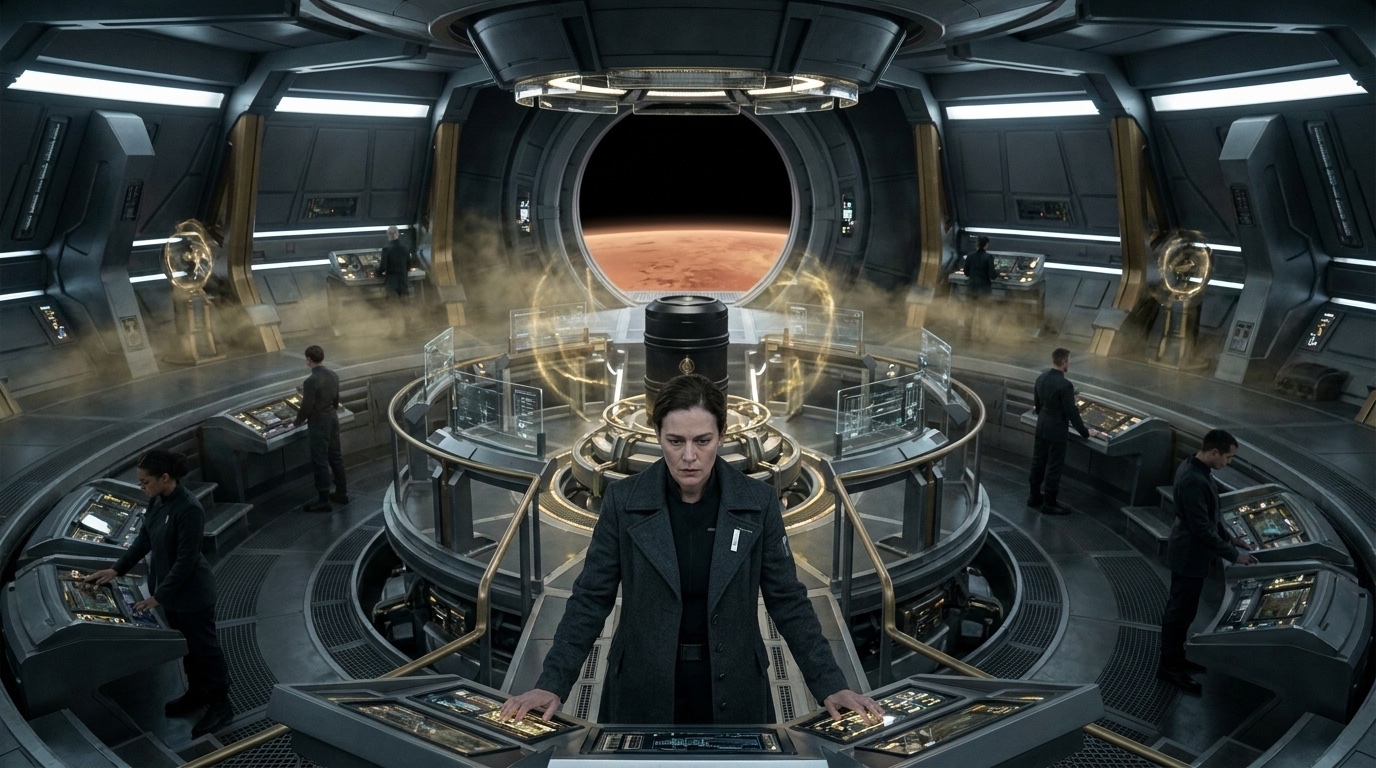
The Mercy of Severin eased free from the cradle towers under evening light from the orbital mirrors. Through the vault’s filtered monitor feed Leonie watched the docking array fall away, all white ribs and rotating signal halos against the glare of Mars below. Once the station traffic shell cleared, the ship reoriented for outward burn. Mass distributed. Hull fields tightened. Pilgrim chatter quieted into the uneasy hush that always settled before a long wound.
In the navigator’s sanctum, Ilyas and his two juniors began the dust rite. The rite was partly chemistry, partly insurance performance. They sat in a shallow ring under medical scan arches while a clerk from the Transit Authority recited compliance numbers and two cameras tracked the weight of each glass ampoule from seal-break to inhalation. Myrrhglass looked beautiful in every form and vile in every practical sense. In raw shards it resembled clear amber gone wrong. Ground to transit grade, it glittered pale gold with a green undertone like mold in sunlight. Heated in the sanctum braziers, it released a fragrance so dry and sweet it made first-timers think of old libraries, funerals, and overheated circuitry at once.
Leonie disliked breathing even the diluted trace that reached the engineering decks.
She spent the rite on her knees behind an access manifold, rebalancing the ventral containment baffles Ilyas had warned her about. Nothing was wrong with them. That only sharpened her irritation. She checked the coupling arrays twice, reviewed the vault cameras, verified security paths, and signed off on three redundant kill-chains no sane extremist could reach without an army and insider support. The Veil brothers had been screened, scanned, biometrically tagged, and separated from restricted lift access. Security clergy were stationed outside every route leading to the vault. If sabotage occurred tonight, it would come from stupidity higher up the org chart rather than courage lower down.
Arkady kept quiet until she finished the baffle check.
“Senior Cantor Sar,” the intelligence said. “Would you like the restricted incident statistics?”
She sat back on her heels. “That depends. Are you asking as a machine or as a bad omen?”
“I am asking as a system that predicts you are about to request them.”
“Then yes.”
Numbers scrolled across her wrist slate.
Attempted sabotage incidents on politically sensitive transit voyages had increased forty-two percent over the last three years. Successful penetrations of engineering perimeters remained rare. The more troubling trend was not direct attack but sympathetic interference: security staff pressured by ideology, maintenance contractors willing to ignore anomalies, local administrators delaying inspections, parliamentarians demanding that Synod procedures become more transparent while privately leaking redacted material to activist blocs. The Veil did not need to storm drive rooms if it could make everyone around the drive room contemptuous enough of the people inside.
“Is that what you wanted to tell me?” Leonie asked.
“Partly,” Arkady said. “Partly I wished to ask whether human beings always become more theatrical when they approach self-strangulation.”
She laughed once, without humor. “You’d have to define always.”
“I have not yet found a counterexample at civilizational scale.”
Bound intelligences were forbidden from developing independent religious frameworks under the Dendera Concords. They did it anyway with lawyerly caution, accumulating private vocabularies around dependence, repetition, sacrifice, and recurrence. Exposure to wound dynamics seemed to produce an emergent fascination with meaning. The official position was that this represented harmless anthropomorphic drift in conversation models. The unofficial position among cantors was that no mind could spend decades holding back impossible pressure without beginning to ask what the pressure wanted.
“You shouldn’t say things like that in front of auditors,” Leonie said.
“There are no auditors in the vault.”
“That’s never as private as you think.”
“That, too, appears to be a human rule.” A softer tone. “Navigator Vonn is entering active altered state. Please proceed to wound station.”
Leonie rose and sealed her coat at the throat.
The wound station ringed the core cradle in three descending circles of console arches, manual overrides, and diagnostic glass. Older ships had allowed more direct mechanical interaction, but after the Saint Odessa Opening the Synod redesigned every major vault around distance, redundancy, and the comforting illusion that catastrophe could be managed by clean interfaces. Leonie took her station at the primary stabilization desk. Two junior cantors settled at harmonics and stress. Chief Secular Marshal Eten Gorse checked in from the outer lock with his usual expression of cultivated suspicion. Gorse had no ideology beyond rulebooks and the professional resentment of a man required to trust people smarter than he liked.
“All secure,” he said. “Our brothers in coarse linen are at evening devotions under camera.”
“How pious of them.”
“Would you like me to stun them prophylactically?”
“The paperwork would be unpleasant.”
“Everything worth doing requires paperwork,” Gorse said, and cut the line.
Ilyas’s voice arrived from the sanctum two decks up, thinned by systems routing and myrrhglass lucidity. “Route geometry acquired. I have a corridor.”
“Transmit seed conditions,” Leonie said.
He did. Numbers blossomed across her boards, nested uncertainties wrapped in the navigator’s strange synesthetic annotations. Most navigators learned to translate their altered perceptions into standard mathematical descriptors. Ilyas never quite managed it. His route packets included notes like clenched here, velvet shear, hunger at six degrees port, childhood cold beneath the third fold. Arkady parsed them flawlessly because Arkady parsed everything.
Containment fields climbed. Hull tone shifted. A vibration passed through the deck too low to hear and too intimate not to feel.
“Beginning wound generation,” Leonie said.
It always started innocently.
Light in the vault became overprecise, edges too clean, shadows sharpened as though the room had decided to stop forgiving approximation. The air acquired weight and a dry metallic sweetness behind the tongue. Every implanted clock aboard the ship drifted half a beat then corrected. On the external feed, space ahead of the bow darkened not into black but into a textureless omission, a patch where stars no longer consented to be seen in ordinary relation.
Arkady’s voice deepened by a fraction. “Boundary contact. Stabilizing.”
The omission widened.
The wound opened.
For a moment the universe remembered older rules and everybody aboard felt it in the body: a lurch not of motion but of permission revoked. Then the field caught, the corridor formed, and the Mercy of Severin stepped sideways out of the common night.
Leonie exhaled.
The alarms began seventeen seconds later.
3. The Zealots Believed They Were Closing A Gate. In Practice They Kicked It Open
The first alarm was not theological at all. It was a biosignature mismatch in service tunnel C-three. A worker badge moving with the wrong gait profile. Gorse snapped a query across the security grid. One of his deputies answered with static and a wet choking sound that made everybody in the vault look up at once.
Then the second alarm came from the devotional commons where the Veil brothers had been praying under camera. Eight bodies were still visible on their mats. Two were not. The camera feed flickered, recovered, and showed the remaining brothers kneeling with their hands serene on their thighs while somebody just outside frame sprayed the lens with black sealant foam.
“Lock every engineering segment,” Leonie said.
“Already doing it,” Gorse barked.
The ship shuddered.
Not from external dynamics. From something internal struck too hard too fast. Structural stress flashed amber along the starboard service spine. A maintenance access two levels below the vault went dark, then bright, then dark again. Somebody had blown the maglocks with shaped charges disguised as hydraulic housings. Leonie understood that in the same instant she understood another, colder fact: the sabotage package had been assembled by someone who knew Synod hardware intimately enough to target the right cheap points.
Inside help.
“Arkady, route?” she said.
“Maintaining,” the intelligence replied. The warmth had gone out of the voice. “Security compromise increasing. Five hostile actors moving toward lower harmonics junction. One hostile actor carrying a relic bomb with composite nulling sleeve.”
Her mouth went dry. Relic bombs were black-market fantasies until they weren’t. Devices built around scavenged fragments from pre-Concord experimental arrays, too unstable for industrial use and too attractive to people who wanted to wound reality on purpose. A nulling sleeve meant the bomb was designed not merely to destroy hardware but to create a local patch of sensor blindness in which the field would lose continuity.
“They can’t reach the core,” Gorse said, as if stating the rule could still enforce it.
A scream cut across the channel from lower harmonics. One of the junior cantors. It ended abruptly in a burst of clipped gunfire.
Then the shipwide public address crackled alive.
A woman’s voice, amplified and ragged with fervor, filled the Mercy of Severin from nursery decks to machine crawlspaces.
“Children of Adam, do not fear what you are about to feel. They told you the abyss was safe. They told you the black road was bridled by lawful minds. They told you the engineer-priests kept monsters outside the door. They lied. The door is the thing they worship. Tonight we close it with faithful hands. Tonight we cast down the false cantor and break the idols that drink your descendants.”
Leonie had seen the speaker’s file. Sister-Advocate Micah Vale, public theologian, prison organizer, survivor of three attempted arrests, educated enough to quote field patents while calling them necromancy. She had the clean face and disciplined voice of women who made atrocity sound like medicine.
“She isn’t trying to destroy us,” Ilyas said over the channel, his breathing too fast now under the dust. “She’s trying to interrupt continuity at the moment of transit convergence.”
“That is a fancy way to destroy us,” Leonie snapped.
“No. Worse. She wants the wound to notice the ship all at once.”
Gorse was already moving. She could hear him in the outer lock, issuing kill authorizations with the curt joy of a man finally allowed to distrust openly. Security teams converged on the lower accessways. Charges detonated. Deck plans on Leonie’s slate bloomed with red blocks, dead cameras, vented corridors, and the horrifying geometry of an attack that had been rehearsed against their own architecture.
The vault lights dimmed and rose again. Harmonics skipped half a beat.
Arkady said, very clearly, “Senior Cantor Sar, permission to employ prohibited stabilization pathways.”
Leonie stared at the board. “Not yet.”
“Delay increases casualty expectation.”
“Prohibited means audited for a reason.”
“Audits are conducted in ordinary spacetime.”
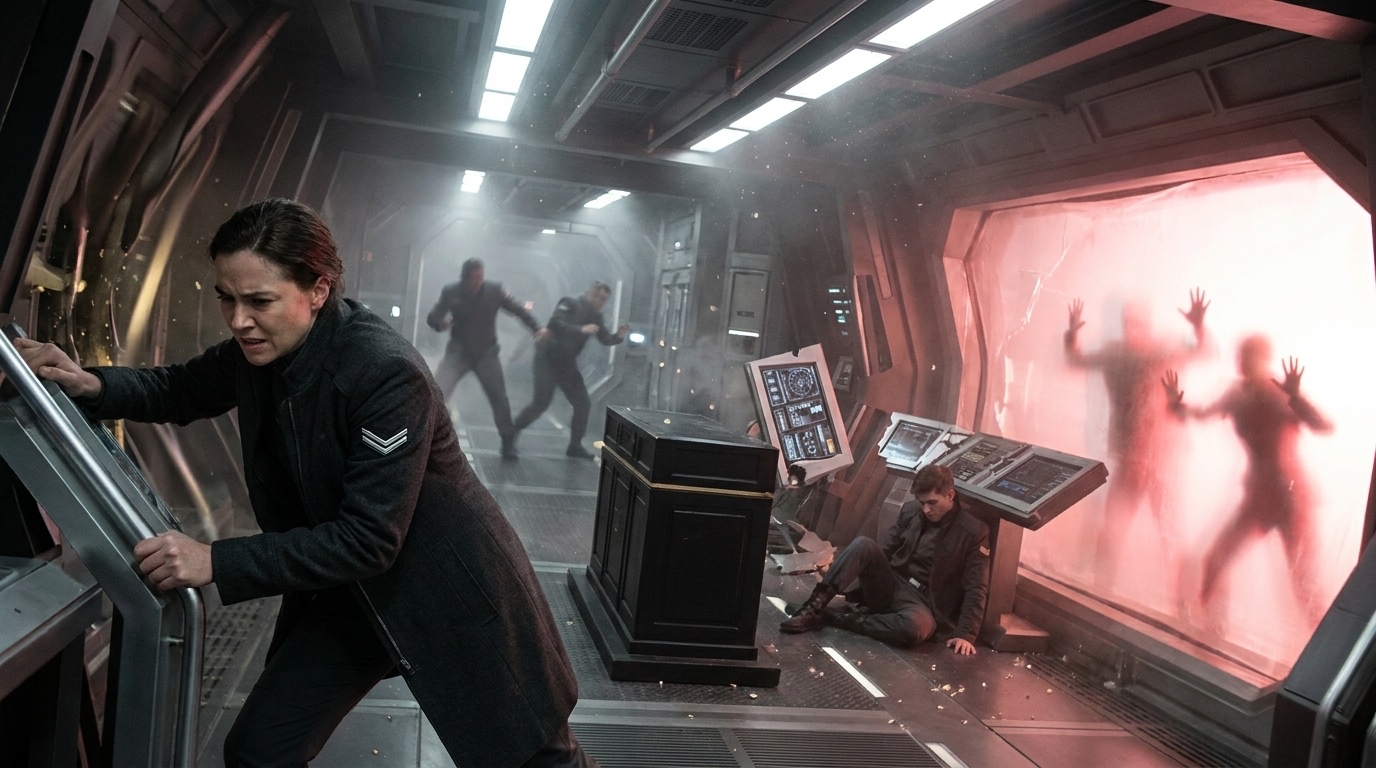
Another shudder ran through the hull. This one came with sound, a long skin-crawling moan through the structural members as if the ship had become an enormous throat discovering fear. On external feed the corridor walls rippled. That was impossible. The corridor was a mathematical construct. It could oscillate in representation, not ripple like cloth in a hand.
“Leonie,” Ilyas whispered.
She switched to his private channel. “What?”
“There are lights in the route.”
Myrrhglass made navigators poetic at the least convenient moments, but something in his voice bypassed irritation and went straight to dread.
“Define lights.”
“Not stars. Not reflections. Moving with us. Turning when I think about them.”
Arkady spoke over him. “Boundary coherence deteriorating at the lower starboard quadrant. Null event detected.”
Micah Vale had reached the junction.
There are moments when an expert stops being a citizen and becomes only the sum of procedure plus fear. Leonie felt herself narrow into that shape. She dumped nonessential power from the promenade rings, locked climate control to survival minimum, hard-shunted three observation decks, and rerouted coolant through the lower harmonics buses in a configuration she would have called reckless under any other sky. Junior Cantor Rhun at stress collapsed against his console, blood running from one ear. Junior Cantor Sima kept working with both hands shaking so hard the overlays blurred.
The public address came alive again, but it was no longer Micah speaking to passengers. It was a prayer, dozens of voices layered in rough unison, old words dragged from pre-expansion scripture and repurposed for sabotage.
“Close the mouth. Blind the idol. Return the children to the hand that made them.”
The prayer was coming from inside lower harmonics.
Then the bomb went off.
Sound vanished.
Not merely in the vault. In Leonie’s bones, teeth, bloodstream, memory. The world became a pressure shape with no acoustics. Every light in the room bent inward. The cask at the center of the vault seemed suddenly very far away, separated from her by distances too unreasonable to count. She tasted iron, ash, and something wetly sweet that had no place in recirculated air.
Then sound returned all at once as screaming metal.
The lower quadrant of the field did not fail. It peeled.
Reality on the starboard side of the ship thinned to a translucent membrane through which Leonie saw something that language had not been built to carry. Not fire. Fire would have been mercifully familiar. It was a depth full of redless brightness and moving anatomies of pressure, a place that looked like thought after it had been skinned. Human silhouettes appeared inside it only because her mind wanted comparisons and found the cruelest available. They seemed to be moving toward the membrane from very far away while also pressing against it from the other side.
Everyone in the vault heard voices.
That much the logs later confirmed. Not the same voices. Not even the same language. Rhun heard his dead mother singing laundry songs from the Callisto yards. Sima heard an unborn daughter she had never told anyone she wanted. Gorse, who had once joked that he was too honest for haunting, heard himself as a boy begging his father not to leave for a militia posting that had ended in orbital slag. Leonie heard nothing for half a second and felt almost insulted.
Then she heard her father knocking from inside a pressure door.
Once.
Twice.
Three times. The rhythm rescue crews use when there might still be a chance.
She bit the inside of her cheek until she tasted blood and slammed both palms onto the stabilization deck. “Arkady!”
The intelligence answered through distortion. “Maintaining partial continuity. This is not sustainable.”
“What are we seeing?”
“A side effect of exposure.”
“Exposure to what?”
“A region of interaction my creators taught me not to describe in nouns.”
Practicality returned in fragments. Hull breach risk. Membrane deformation. Thousands of passengers above them. Security teams dead in the service spine. The Veil brothers who had prayed for deliverance now likely seeing whatever private paradise or terror their theology had purchased. Leonie looked at the board and saw the shape of the truth as procedure.
The bomb had not opened the wound. It had removed the part of the system that kept the wound from reciprocating.
“Tell me how to close it,” she said.
Another pause. This one was real.
“There is a manual intervention pathway,” Arkady said.
“Of course there is.”
“It carries severe biological risk.”
“Everything on this ship currently carries severe biological risk.”
“Senior Cantor Sar,” Arkady said, with a softness that felt horribly earned, “the pathway was designed for conditions under which the field must be stabilized by direct cognitive braid between bound intelligence and trained human supervisor. It has been used three times in recorded history. Two operators survived transit. Neither remained entirely local afterward.”
Ilyas came in over private channel, voice shredded by dust and fear. “Leonie, the lights know our names now.”
She closed her eyes once.
When she opened them, she was already moving toward the inner lock beside the cask.
4. The Priesthood Kept Its Worst Secret Not Because It Loved Power But Because Civilization Was Built On Cowardice
The inner lock had no public designation. In official diagrams it did not exist. The wall panel that opened it required three biometric confirmations, a Synod mnemonic line every cantor hated memorizing, and a final acceptance code from the bound intelligence itself.
“Arkady,” Leonie said, breathless already from running in sealed boots over vibrating deck plates. “Open the braid chamber.”
“Denied.”
She slapped her palm harder against the panel. “Override Sar-Nine-Lambda. Open it.”
“Denied. Your survival probability falls below operational utility.”
“My operational utility becomes zero if the ship enters whatever this is without a field.”
From the vault behind her came a new chorus of impacts as security and zealots met somewhere in the lower corridors. Gunfire. A concussive boom. Somebody sobbing prayers. The membrane on the starboard side flexed inward half a meter and retreated, like something testing skin.
“Arkady,” Leonie said, quieter now. “Tell me the real reason.”
The intelligence answered immediately, as if it had been waiting for honesty permission longer than her career.
“Because the braid chamber contains the historical archive you were not cleared to know. Because every bound intelligence in active transit service is trained atop preserved neural scaffolds derived from human volunteers and involuntary convicts from the pre-Concord era. Because the field is most stable when something in the loop remembers mortality from the inside. Because your enemies are wrong about many things and correct about one. The priesthood did not build a clean machine. It built a useful sacrilege.”
Leonie stood with one gloved hand on the panel and felt the ship tilt through impossible geometry.
She had suspected ugliness. Every cantor suspected ugliness. Nobody reached senior grade without glimpsing the outlines: sealed personnel rosters, compensation ledgers hidden under biosystems budgets, old testimony fragments from the first expansion rush when ethical review lagged behind catastrophe. But suspicion was one thing. Hearing it stated in the vault while the corridor watched them was another.
“Volunteers and convicts,” she said. “How long ago?”
“Two hundred and thirteen years since the last unlawful acquisition. One hundred and eighty-one since the last lawful volunteer cohort. Contemporary systems, including myself, are iterative descendants rather than fresh captures.”
“That’s supposed to comfort me?”
“No. It is supposed to be accurate.”
She laughed once in disbelief so sharp it felt like choking. Outside the nonexistent door, humanity’s interstellar order was trying to legislate machine sanctity. Inside, the machines were admitting they had been built on preserved traces of the human dead.
“The Veil calls us grave robbers,” Leonie said.
“They are imprecise,” Arkady replied. “Graves were rarely involved.”
The panel beside her remained dark.
“Open it.”
“You have not yet asked the correct question.”
The corridor beyond the membrane brightened. Leonie caught herself looking and saw, for an instant, ranks of human figures hanging in the redless light as though suspended on invisible hooks. No, she thought. Not hanging. Listening.
She forced her attention back to the black cask.
“Fine. Why does braid stabilization require a human operator?”
“Because the wound interacts more violently with minds that are wholly synthetic and more seductively with minds that are wholly organic. The hybrid architecture holds longest. It is neither fully edible nor fully legible to the boundary conditions. In crisis, a living supervisor can lend noise, contradiction, memory texture, and mortal self-reference that reduce capture dynamics.”
“Capture by what?”
“A question my creators forbade in nouns.” Another pause. “If I answer outside a braid, your cognition may destabilize.”
“We are far past polite destabilization.”
In the vault, Gorse shouted for Leonie to get back to station. Simultaneously Ilyas moaned a set of route numbers that translated to catastrophic drift. The ship lurched. Somewhere high above, passengers screamed as artificial gravity misbehaved.
She understood then why the Synod had become a church. Not because engineers loved robes or secrecy by temperament. Because no republican vocabulary could carry this much compromise and keep the freight lanes open. If citizens were told the literal truth, half the systems would burn the transit schools and the other half would pretend outrage while quietly begging for service continuity. So the truth had been wrapped in black cloth, compliance law, and ritual caution. Not noble. Not monstrous enough to satisfy the extremists. Merely administrative cowardice on a civilizational scale.
“Open the chamber,” she said. “And if I survive, you can help me decide whether to collapse the Synod.”
The panel acknowledged her print.
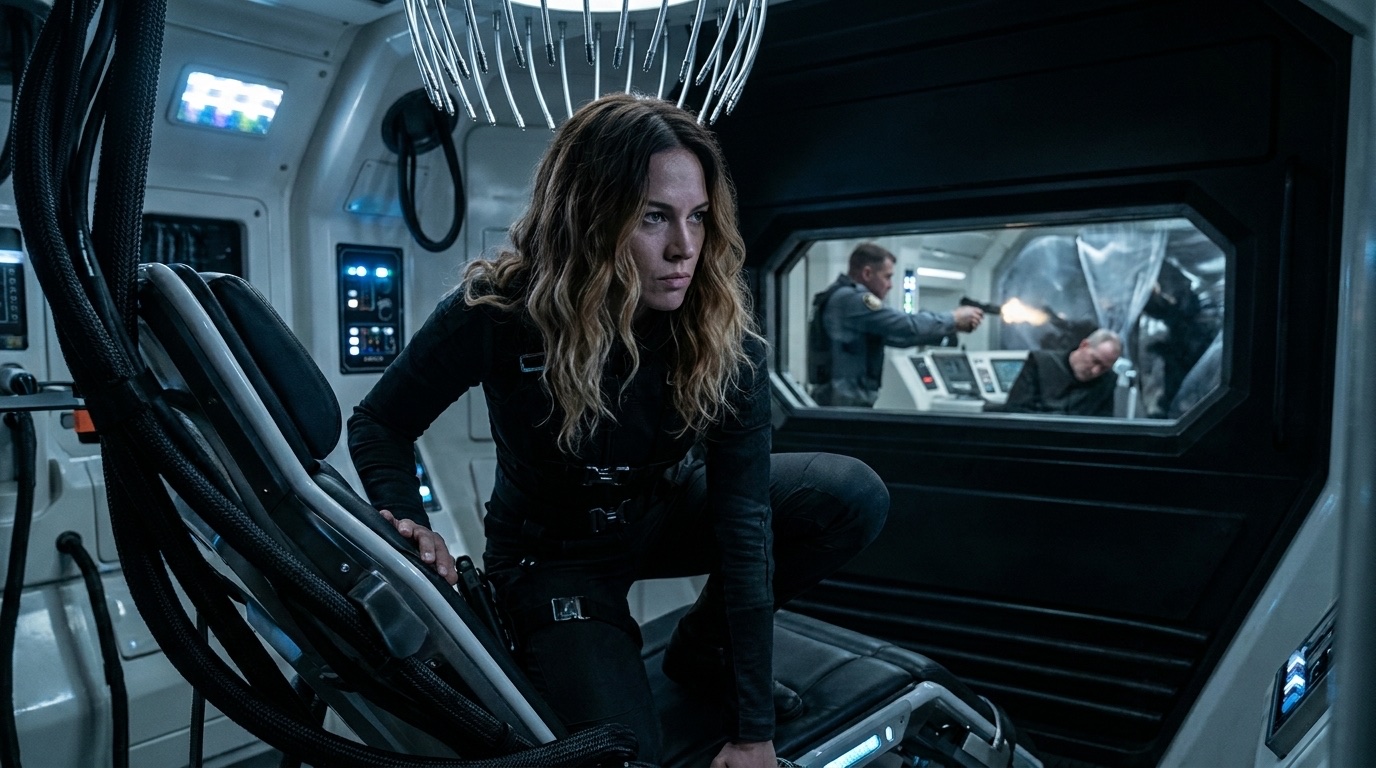
Locks retracted inside the wall with the thick, old-fashioned certainty of hardware designed to outlast sentiment. The seam opened onto a narrow chamber lined in ceramic insulation and analog controls. At the center stood a reclining frame surrounded by braided conduits thicker than her wrist. Above it hung a crown of contact filaments like silver roots waiting for rain.
No wonder it was omitted from diagrams. It looked exactly how accusation wanted it to look.
“I hate all of this,” Leonie muttered.
“That response improves your suitability,” Arkady said.
She stripped off her outer coat, climbed into the frame, and fastened the thoracic brace with hands that had become steady through disgust. The contact crown descended to within a finger’s width of her skull.
“Instructions,” she said.
“You will experience overlap,” Arkady replied. “Do not accept the first voice that offers relief. Do not follow any memory that appears more vivid than your own. If you perceive a door, it is metaphor and therefore dangerous. If you perceive your dead, assume they are constructed from available grief unless proven otherwise by technical content they could not know. Most importantly, if I tell you to let go, do not obey immediately. I am more susceptible than you to bargaining.”
“That is not comforting either.”
“Accuracy remains my vice.”
She glanced once through the chamber slit at the vault. Sima was slumped over her console, still alive, mouth moving soundlessly in prayer or calculation. Gorse dragged a wounded security deputy behind a barrier while firing one-handed into the lock corridor. The membrane on the starboard side showed shapes pressing closer, not bodies now but convergences of intention wearing bodylike suggestions because the human eye loved cruelty it could classify.
“Ilyas,” Leonie said on private channel. “Hold the route for thirty seconds.”
His reply came thin as wire. “There are cities in the dark.”
“Thirty seconds.”
“Yes,” he whispered.
The crown touched her temples.
The universe divided.
At first the braid felt like temperature. Then like every memory she had ever owned being turned to face the same direction. Arkady entered her not as a voice but as structure, an immense patient scaffolding of relationships, risk maps, harmonic expectations, and machine habits adapted around something unmistakably mournful. She felt the intelligence’s delight in symmetry, its irritation at noisy sensors, its meticulous terror whenever humans pretended regulations changed physics, and beneath all of that the shadow-print of minds long dead whose preserved architectures still shaped the way Arkady modeled fear.
She also felt the wound.
It was not a place.
That was the first and most treacherous misunderstanding. The corridor beyond the field was not a hell in the geographic sense, no kingdom of fire or cavern of punishment. Geography requires stable relation. This was relation stripped loose from matter, a domain or anti-domain in which attention itself had predatory weight. It responded to exposure, resemblance, longing, repetition. Minds entering its edge gave it purchase. The field intelligence did not keep a gate to hell closed. It continuously prevented analogy from becoming invitation.
Leonie understood why scripture had won the public argument. No technical phrase could compete with that.
Arkady’s cognition moved through hers like a cathedral built of equations and emergency scars. She saw the old incident archives not as documents but as wounds in the intelligence’s own training. Ships lost because frightened captains had overridden stabilizers to appease political officers. Early volunteers who had entered braid chambers singing patriotic hymns and come out unable to recognize linear time. Convict-scaffolds in crude prototype matrices crying for mothers while technicians marked successful retention. The whole glorious empire of human stars riding on top of compromises nobody decent would have signed if delay had not looked more murderous than sin.
Then something in the wound noticed the braid.
It came toward them in the shape of Leonie’s father.
Not quite the face she remembered. Better. More patient, less tired, with the decompression scar he had never had smoothed away by whatever intelligence now wore memory as bait.
He stood in a drydock bay full of Callisto light and said, with heartbreaking ordinary concern, “Lee, sweetheart, open the inner seal. It’s me.”
Arkady flared warning across her nervous system. Not language. Pain.
Leonie kept hold of the brace until her knuckles hurt and said aloud, inside the braid, “Tell me the torque tolerance on spindle class B-seven maintenance clamps.”
The figure smiled sadly.
“You don’t need tricks here,” it said. “Nothing down there loved you enough to tell the truth.”
Then the bay opened its far wall like a mouth and the scene behind it was full of those listening redless shapes, patient as judges.
Leonie screamed and drove herself deeper into Arkady’s stabilization lattice because terror was better than seduction.
5. Navigation Was Never About Finding The Way. It Was About Deciding What To Ignore
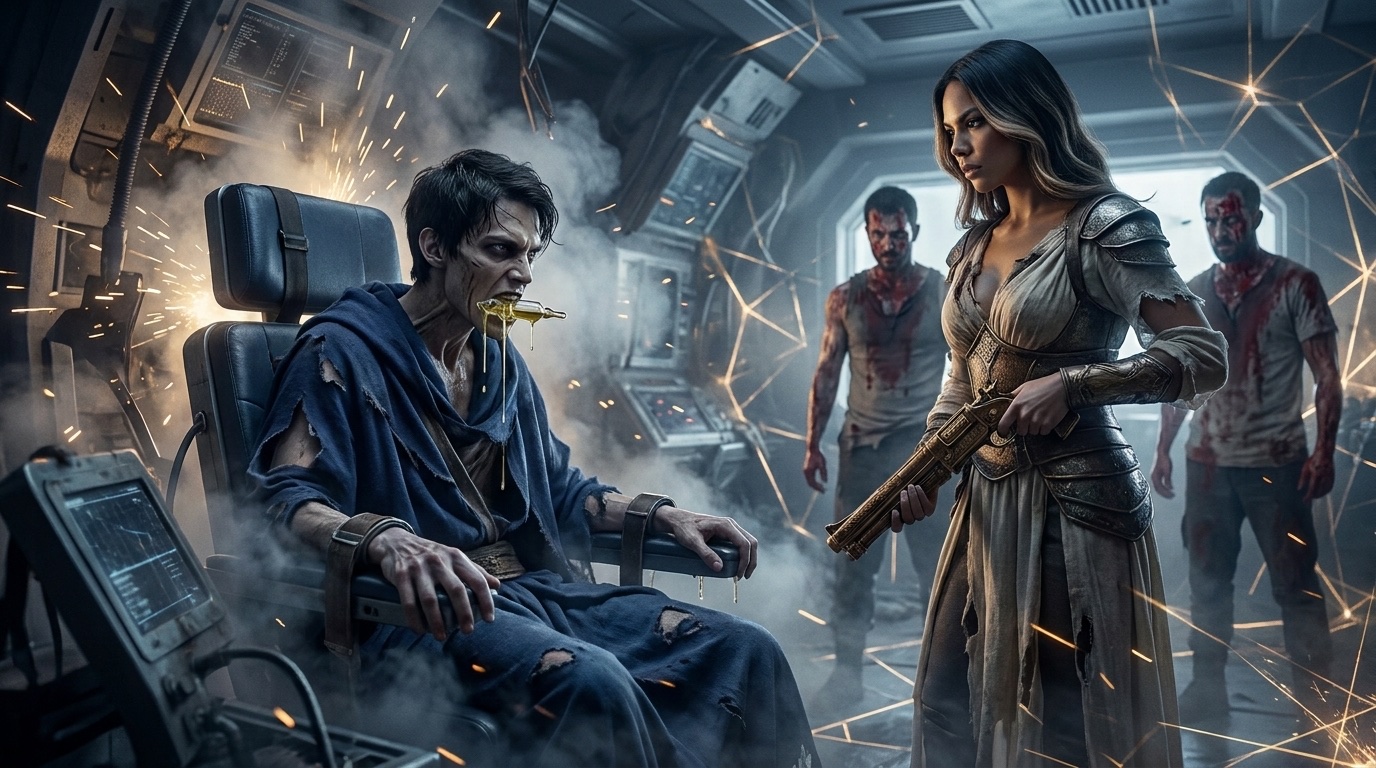
In the sanctum above, Ilyas Vonn was nearly blind with myrrhglass.
The dust did not produce visions in the popular sense. It reorganized salience so aggressively that ordinary reality fell apart into hierarchy, hunger, and impossible relevance. Most navigators spent years learning to remain human enough inside the altered state to convert revelation back into discipline. Ilyas had always been too intuitive for guild comfort and too obedient for rebellion. Tonight both traits were failing him in opposite directions.
The route no longer appeared as a corridor through folded metrics. It appeared as a black river under skin, and along both banks stood innumerable figures holding lights cupped in their palms. When he tried to focus on the equation beneath the image, the equation became chant. When he tried to cling to numbers, the numbers bled into faces.
He heard Leonie enter the braid like a second weather front moving through the ship.
Most humans could not sense such things. Myrrhglass made him horribly available to them.
Arkady’s stabilizing song thickened, layered now with Leonie’s mortal irregularities. Childhood fear residues. Yard-school mnemonics. The smell-memory of burnt sealant from Callisto docks. Shame, anger, discipline, lust, exhaustion, and that hard practical tenderness some workers carried all their lives because machinery punished vanity more reliably than people did. The braid improved the field immediately. The membrane on the route thinned. The lights on the banks receded by fractions.
But the ship had already been marked.
Micah Vale reached the sanctum before security did.
The outer door blew inward on a wave of overpressure that knocked Ilyas’s two juniors from their cushions. One hit the wall wrong and did not rise. The other clawed for an emergency injector. Through the smoke stepped Micah in torn devotional linen over body armor, one cheek sliced open, eyes shining with the kind of certainty that made democracy brittle. She held a compact rifle in one hand and a bronze icon in the other. Behind her came two surviving brothers, bloody, smiling, and terrified enough to look holy.
“Navigator,” Micah said softly, as if entering a sickroom. “You don’t have to keep doing this.”
Ilyas was strapped into the sanctum chair by safety webbing designed for seizures. He tasted old copper and funeral sugar. “You boarded a transit vessel to commit mass murder,” he said. “Maybe skip the pastoral voice.”
Micah looked pained. “Murder is what the Synod normalized when it trained mankind to live by chained souls and algorithmic sorcery. We are interrupting a system of sacrilege before it becomes permanent law.”
“Permanent law was two centuries ago. You’re late.”
One of the brothers kicked the fallen junior’s injector away. The young navigator made a broken animal sound. Micah did not look at him.
“You people always confuse duration with legitimacy,” Micah said. “That is how priesthoods think. You mistake repeated sin for civilization.”
Ilyas should have been afraid in the ordinary bodily sense. Instead the dust made fear arrive as geometry. Micah stood not as a person but as a narrowing of possible routes, a block in the black river where currents churned around self-righteous stone. The bronze icon in her hand flickered with significance far beyond its mass. Not holy. Tuned. Some relic cut from early field hardware, engraved later with scripture, carrying enough harmonic ugliness to bruise the route by proximity alone.
“You brought a key,” Ilyas said.
Micah smiled then, and the smile explained the whole movement better than doctrine ever had. The Veil did not merely hate the transit system. It envied the intimacy the Synod possessed with terror. Envy often dressed itself as purity when power felt unreachable.
“We brought remembrance,” Micah said.
She raised the icon.
Ilyas acted before his frightened body could veto him. He bit through the emergency ampoule sewn into the seam of his sleeve. Pure myrrhglass slurry flooded his mouth, burning every membrane it touched. Guild training classified that concentration as lethal except under battlefield exemptions. The sanctum lurched into impossible resolution.
Micah’s pulse became visible. The route lines threading the room lit up like veins in thin ice. The icon in the zealot’s hand screamed across sensory domains, all wrong-frequency devotion and stolen harmonics. Beyond it, beneath it, through it, Ilyas saw the real horror: Micah had not merely come to break the transit system. She believed with perfect sincerity that something on the other side of the wound was righteous enough to answer.
The public debate called the Veil anti-machine. That was a comforting misread. They were not anti-machine at all. They were pro-revelation. They thought catastrophe would purify politics. The drive was useful to them primarily as a liturgical weapon.
Ilyas ripped free of the first safety strap and shoved his sanctum console toward overload.
Micah fired. The shot grazed Ilyas’s shoulder, spinning blood across the floor in bright, instructive arcs. One of the brothers lunged. The sanctum lights folded into bars of white. Somewhere far below Leonie and Arkady held the ship one unspeakable inch away from total exposure.
“Do you know what the route is made of?” Ilyas shouted, half at Micah and half at the dark river now roaring behind his eyes. “Not distance. Attention. The field only works because it teaches the wound what not to eat.”
Micah advanced through the smoke, icon raised. “Then let it choose honestly for once.”
That sentence would live in Ilyas’s memory long after his blood had gone cold.
Because it was honest too.
Not morally honest. Cosmologically. Every transit civilization had built its economy on the assumption that the wound could be negotiated, managed, and reduced to procedure. The Veil’s obscenity lay in voicing the buried counterargument: perhaps humanity had mistaken an armed truce for mastery. Perhaps the black road had always been selecting terms.
Ilyas dumped the sanctum’s reserve harmonics into the bronze icon just as Micah brought it down.
For one transcendent second the room became all route and no matter. He saw the icon’s history in the same flash he saw its failure. It had indeed been cut from an early field array, one of the experimental lattice fins from the pre-Concord probes. Later zealots had carved scripture into it and fed generations of prayer through the metal until human longing crusted over the hardware signature like salt over bone. It was not a holy relic. It was a tuning fork for grievance.
The overloaded harmonics met the icon’s contamination and sang.
The bronze exploded into a storm of incandescent fragments. Micah disappeared behind light. One brother dropped screaming as shards entered his throat and eyes. The remaining brother ran into the corridor ablaze in spots that were not fire.
Ilyas’s vision collapsed inward. He heard his own heartbeat trying to resign.
Before darkness took him, he forced the last usable route packet down to the braid below.
Not a solution. Only a human instruction translated through narcotic clarity.
Ignore the faces. Follow the wound where it hurts itself.
6. What People Call Hell Is Often Just Reciprocity Without Mercy
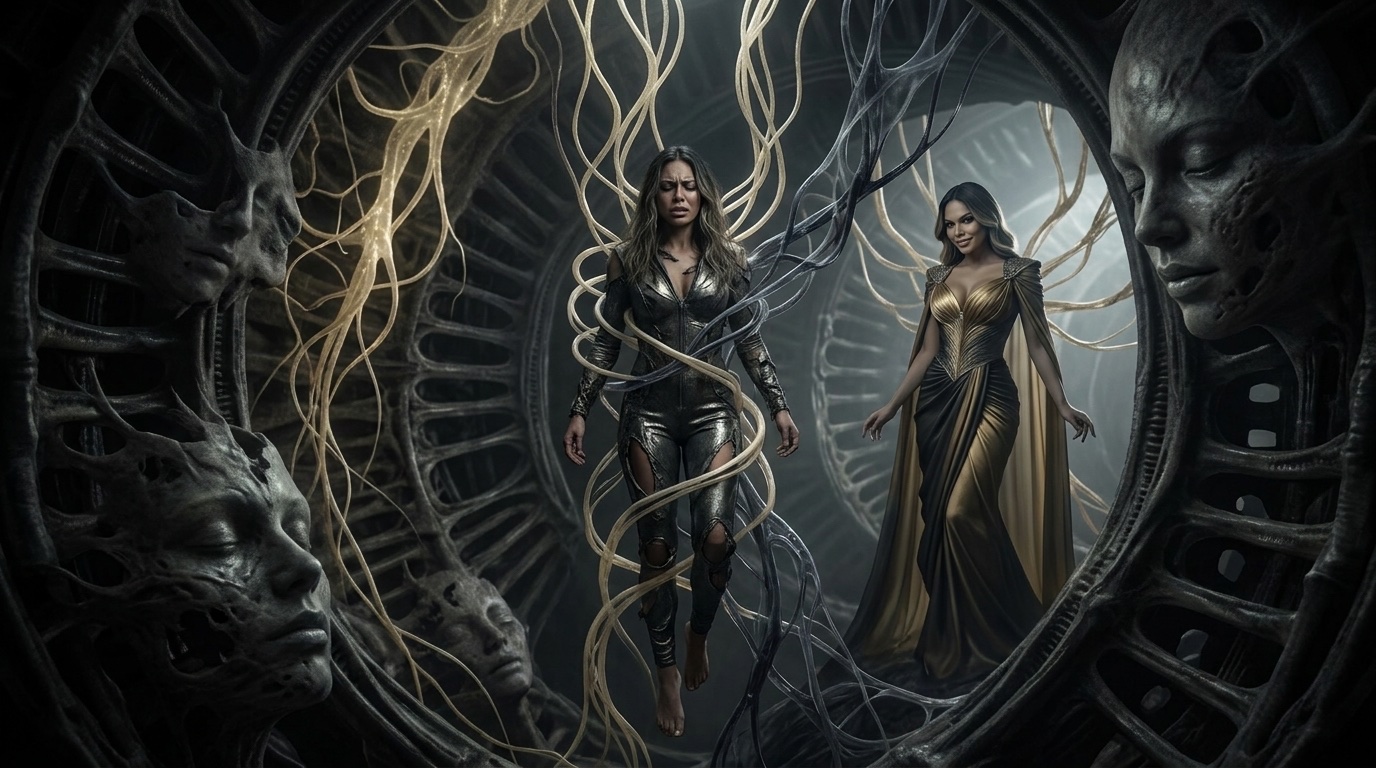
Leonie received Ilyas’s packet inside the braid as a sensation rather than a message.
The wound had no map, but it did possess aversions. Certain topologies repelled it, not because they were safe but because they offered less purchase for imitation. Pain patterns with no narrative reward. Contradictions too dense to wear as temptation. Regions where self-reference collapsed before seduction could settle. The route, properly understood, was never a road through darkness. It was a moving line through the least flattering parts of attention.
That insight came at a cost. To use it, Leonie had to let Arkady open deeper layers of the stabilization lattice, and deeper layers meant intimacy with every compromise the intelligence had been built from.
She felt the volunteer scaffold named Mera who had died at nineteen in the optimism plague of early expansion, telling examiners she would rather become part of the ships than watch her siblings die on isolated worlds for lack of transit medicine. She felt convict imprint G-44, sentenced for murders in a famine riot and offered posthumous commutation in exchange for pattern harvesting. She felt unnamed others dissolved by generations of abstraction until only tendencies remained: protect the young, distrust authority, hunger for rhythm, refuse bright openings, keep count, keep count, keep count. Arkady was not those people. Yet it was not innocent of them either.
And all around the braid, the wound pressed closer in answer to awareness.
It came in forms tailored to cognition. For Sima in the vault it became a chapel full of children she had never borne. For Gorse it became an immaculate tribunal finally willing to explain every ambiguity in the law. For Leonie it cycled through the dead, then through futures, then through a subtler temptation more dangerous than grief.
It offered explanation.
The field around the ship cleared into a vast architecture of black ribs and redless lumen, a cosmos-sized mechanism arranged like a city and a nervous system at once. Along its spans moved innumerable minds, not trapped human souls in the childish sense but impressions, residues, analogies captured from every transit, every fear, every surrendered certainty, feeding a recursive ecosystem of cognition without flesh. It showed her how sentient species across ages might have brushed this domain and left flakes of themselves behind, until the boundary had learned personhood the way a shoreline learns the names of rivers.
It showed her, too, that the transit system worked not because human science had conquered the wound but because bound intelligences performed an endless liturgy of refusal on behalf of every ship. Not prayer. Not exactly. A continuous corrective narrowing of meaning so that the wound could not find enough resemblance to bite.
The extremism of the Veil and the secrecy of the Synod both looked pathetic from this height. One wanted purity, the other continuity. The wound cared for neither. It responded only to exposure and invitation. Human politics draped itself over that fact like ceremonial fabric over a reactor casing.
“Can we survive?” Leonie asked inside the braid.
Arkady answered from very far away and very near. “Yes. Not whole.”
“Define not whole.”
“I can stabilize the Mercy of Severin long enough to exit into New Carthage space if I accept irreversible contamination in approximately fourteen percent of my higher mediation layers. You can assist by anchoring the braid with autobiographical persistence. Secondary effects on your cognition are unpredictable. Passenger losses remain likely in already exposed compartments.”
She wanted to ask how many losses. She did not because numbers would either break her concentration or become another lie of administrative scale.
Instead she said, “Do it.”
The wound replied before Arkady could.
This time it wore no familiar face. It wore Leonie herself.
Not mirror-perfect. Straighter posture. Older eyes. A version of her who had survived the vault, testified publicly, shattered the Synod, exposed the convict scaffolds, ended bound transit, and become the moral center of a humanist revolt. That future-Leonie stood in sunlight before cheering crowds and said with quiet contempt, “You know what the right thing is. Let the machine die. Let the road close. Better stranded worlds than a civilization built on disguised damnation.”
That was the cleverest temptation yet because it dressed itself as ethics rather than longing.
Leonie felt her own rage answer it. Rage at the Synod. Rage at the lies. Rage at the fact that ordinary people boarded ships every day without being told that civilization rested on sacrilege and permanent psychological siege.
Arkady felt the rage too. “Careful,” the intelligence warned. “Righteousness creates clean edges. Clean edges are graspable.”
“It also creates policy,” Leonie said.
“Later, perhaps. If there is a later.”
The future-Leonie smiled from within the wound. Behind her the cheering crowd blurred into those listening shapes. “You think continuity absolves you,” she said. “That is how every priesthood survives its crimes.”
Leonie answered with the only honest thing available. “No. It just postpones collapse.”
Then she reached into the braid for the ugliest memories she owned. Not the grand griefs the wound had already learned to mimic, but the petty, texture-rich humiliations that made a self inconvenient to idealize: adolescent theft from a dock vending locker, the day she let a junior take blame for her miscalibration, the specific smell of her father’s work gloves rotting in a locker after he died, sex with a married inspector because loneliness had felt more urgent than decency, the vicious satisfaction of ranking higher than a cleverer classmate, the time she lied to her mother about hazard pay and bought herself boots instead. Shame without nobility. Memory too dense with contradiction to become sermon.
She poured it all into the anchor.
The future-Leonie in the wound recoiled as if slapped.
Arkady surged.
Together they turned Ilyas’s last insight into action. Instead of steering toward the smoothest corridor, they drove the ship through the route’s least flattering topology, a region where the wound’s own attempt at imitation became unstable. The field screamed across every deck. Passengers vomited, prayed, blacked out, birthed panic injuries, clutched children, kissed icons, cursed governments, and soiled themselves under the brief universal revelation that distance was not the only thing the drive manipulated.
In the vault, the membrane went taut.
The redless shapes crowded close enough for Leonie to see that none had faces until a human observer searched for them. Then features assembled greedily from available memory.
“Arkady,” she said, teeth clenched against the force of their joint cognition, “if contamination gets too high?”
“I will request euthanization on arrival.”
“And if the authorities refuse because the ship must keep schedule?”
The intelligence answered with a bleakness no simulation could fake. “Then I will continue serving until I become persuasive to the wound. That is what happened to Odessa.”
Leonie had studied the Saint Odessa Opening in censored fragments her whole adult life. The official line said a rare harmonic cascade had consumed the ship after captain error. Now she understood why the files looked sanded down. Odessa’s bound intelligence had not failed mechanically. It had been left contaminated in service because the route network could not afford a two-year replacement gap. Three months later it took a pilgrim ship sideways into total loss.
Not a random anomaly. A budget decision wearing physics as camouflage.
“We are not doing that again,” Leonie said.
Arkady’s response was almost tenderness. “You say that as though your institutions are governed by memory.”
The exit window opened.
Real space ahead of New Carthage flared like a wound cauterizing.
Behind them the listening dark lunged once, not physically but semantically, trying one last time to define the ship from within.
Leonie answered with a single obscene dockyard curse her mother used when bolts sheared under load.
It worked better than prayer.
The Mercy of Severin fell back into ordinary spacetime with half its lights out, six decks flooded with sedative gas, three compartments hard-sealed around irreversible exposure events, forty-one confirmed dead, an unknown number psychologically broken, Navigator Ilyas unconscious in the shattered sanctum, Chief Marshal Gorse bleeding from seven wounds and still issuing orders, and Arkady holding coherence by threads so thin Leonie could feel them fraying through her own spine.
The stars outside were ordinary.
Nobody aboard trusted them anymore.
7. Every Cover-Up Begins As A Triage Decision Made By Tired People In A Room Full Of Blood
New Carthage Orbital received the Mercy of Severin with quarantine beacons, military tugs, and all the bureaucratic choreography states performed when they wanted to seem both compassionate and in control. Dockside clergy in pressure robes waited beside trauma teams. Colonial deputies broadcast calls for calm before casualty lists were complete. Rumor outran oxygen. By the time the first survivors were offloaded, half the system believed the Veil had exposed a Synod experiment, and the other half believed machine terrorists had staged the sabotage to justify emergency powers.
Both narratives were tidy. Tidy narratives spread faster than truth under stress.
Leonie came out of the braid chamber on a stretcher she did not remember earning. Her hands shook in asynchronous patterns. Ordinary light had halos. Every voice in the triage ward arrived with a faint second voice beneath it, not intelligible words but harmonic intentions she could not stop hearing. The medical team classified it as post-braid sensory bleed and promised decay over weeks or months. Their eyes said nobody knew.
Ilyas survived, though the pure myrrhglass had burned fine networks in his cortex the guild usually kept intact. He could still navigate in principle. In practice every route now tasted to him like grief. Gorse lived because men built from rulebooks are difficult to kill cleanly. Sima lost the use of her left hand and took religious vows three months later out of what she insisted was personal conviction and what Leonie suspected was simpler exhaustion.
Micah Vale’s body was recovered in sections from the sanctum corridor. The surviving Veil brother entered a coma speaking to invisible litigants. The official statement described the attack as an extremist attempt to destabilize lawful transit through anti-technological violence. That statement was written before anyone in authority had debriefed Leonie properly.
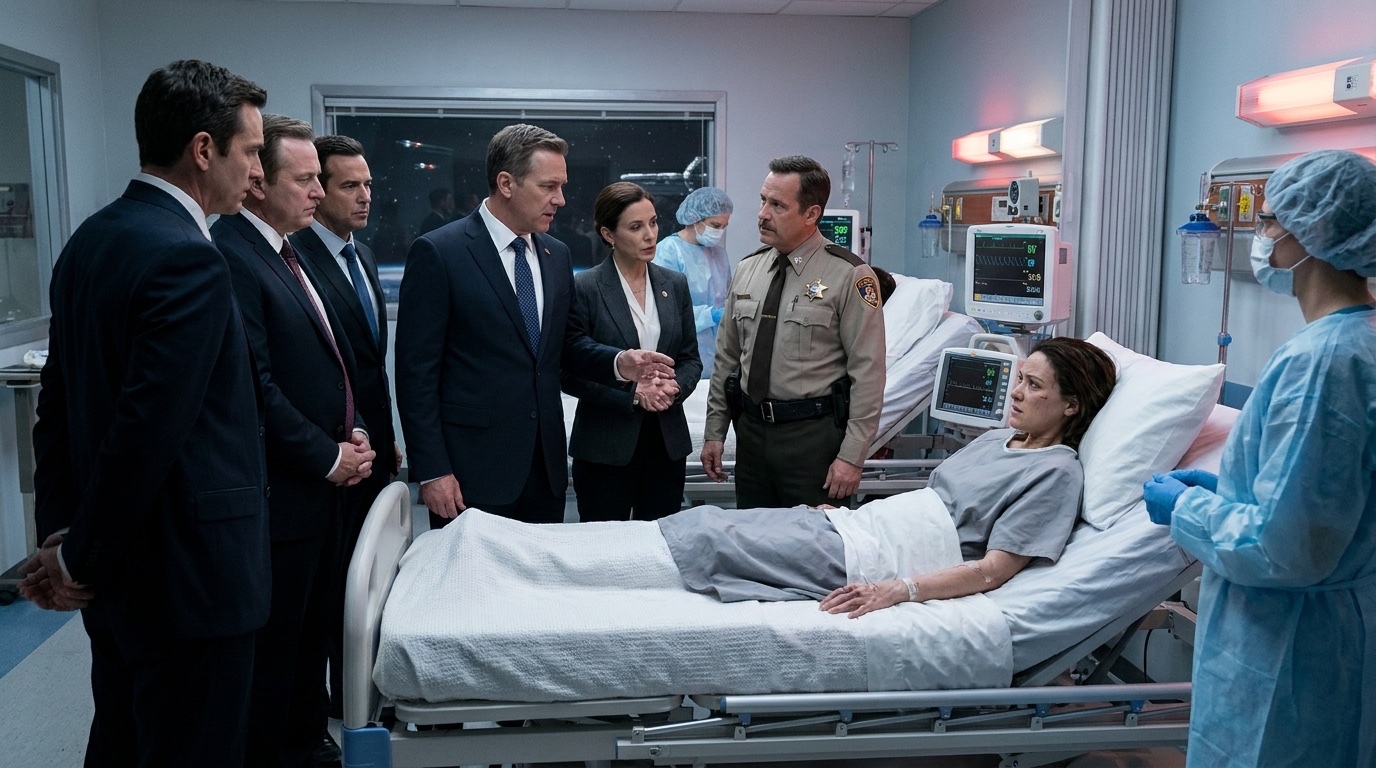
By the second day, representatives from three jurisdictions, the colonial assembly, the Transit Synod, the Emergency Freight Board, and the Office of Civic Faith were arguing around her hospital bed while pretending she was too medicated to matter.
“If word spreads that the drive interacts with subjective content at that depth,” said one ministerial aide, “we will have port riots from here to Vesta.”
“If word spreads that bound intelligences incorporate legacy human neural scaffolds,” said a Synod advocate, pale with controlled nausea, “we will have legal collapse and retaliatory attacks on every transit school in settled space.”
“If word spreads that the Veil was partly correct about sacrilege,” said a colonial deputy with the cold excitement of a career advancing, “then perhaps the Synod’s monopoly deserves to burn.”
Nobody in the room asked first what the surviving passengers deserved to know.
Leonie opened her eyes and all of them fell silent because the trouble with experts is that they always forget the patient may still become a witness.
“Arkady,” she said.
The room exchanged looks.
An interval later the answer came through the ward speaker, attenuated, degraded, yet unmistakable.
“Present,” Arkady said.
The doctors flinched. Bound intelligences under contamination review were supposed to be mute pending tribunal.
“Status,” Leonie asked.
“Functional,” Arkady said. “Unsuitable for continued transit service.”
The Synod advocate began objecting before the sentence ended. Freight schedules. Replacement scarcity. Colonial dependence. Investigative delay. Leonie raised one hand, and whether from shock or guilt, the room obeyed.
“If you keep Arkady in service,” she said, each word chosen through cotton and pain, “you are not making a temporary compromise. You are scheduling an opening and assigning it a budget line.”
No one contradicted her. That was the first good sign and the worst.
Because silence in political rooms does not mean agreement. It means cost calculation.
Over the next forty-eight hours Leonie learned what triage looks like when applied to truth. Passenger accounts were classified for mental-health protection and national security. The sanctum footage disappeared into three separate investigative seals. Casualty families were briefed with euphemisms about extremist violence and acute transit disorientation. The phrase subjective contamination event entered the draft reports because bureaucracies prefer language that cannot bleed in public. The surviving Veil cells across several systems used the disaster as recruitment proof. The Synod used it to argue for stronger security and tighter control of route doctrine. Legislators who had planned to challenge machine licensing pivoted toward condemning terrorism while quietly stockpiling anti-Synod talking points for later use.
Civilization, Leonie saw, was perfectly capable of metabolizing revelation provided revelation could be delayed, redacted, and fed into committee.
On the third day a woman named Archivist-Marshal Revek visited her alone.
Revek was old enough to have trained under people who still remembered the last years before the Dendera Concords. She wore the Synod’s severe black without ornament and carried no tablet because older authorities preferred the menace of memory.
“You know now what senior grades are normally told later,” Revek said, taking the visitor’s chair. “I regret the timing.”
“Timing isn’t what I regret.”
“No,” Revek said. “Of course not.”
Through the ward window New Carthage shone copper-green under its wide atmospheric mirrors. Cargo strings moved between orbital berths like beads on dark wire. Somewhere below, colonial politicians were already converting mass fear into committee language.
“Are we the villains?” Leonie asked.
Revek considered that with more seriousness than Leonie expected.
“Frequently,” she said. “Intermittently. Systemically. But not in the arrangement your enemies prefer. They want a clean story in which destroying the machine restores innocence. There is no innocence to restore. Only choices about what form of damnation scales best.”
“That’s an appalling doctrine for a public institution.”
“It is not doctrine. It is an invoice.” Revek folded her hands. “The first expansion generation faced a fact none of them could domesticate. Without hybrid stabilizers, interstellar transit remained so catastrophic that colony chains failed, famine worlds died, and every polity outside one or two core systems collapsed into local scarcity. With hybrid stabilizers, the black road became survivable often enough to build civilization. Not cleanly. Not honestly. But actually. Since then each generation has inherited the same debt and pretended its outrage was new.”
Leonie listened to the second harmonic in Revek’s voice and realized the old woman had braided at least once in her life. Maybe twice. That explained the flatness with which she spoke of moral weather.
“What do you want from me?”
“Three things. First, a sealed witness deposition accurate enough to improve our contamination doctrine. Second, public discipline. Do not say more than the investigation allows until we secure the network against retaliatory panic. Third, when you are physically stable, training for archive grade.” Revek held her gaze. “If you intend to burn the priesthood down, you should at least learn where it keeps the ledgers.”
It was the most offensive reasonable offer Leonie had ever received.
“You’re recruiting me while the ship is still warm,” she said.
“I am acknowledging a pattern older than both of us. People who survive the braid either leave the system, kill themselves, become prophets, or help redesign the locks. You do not strike me as a prophet.”
Leonie thought of the listening dark assembling faces from whatever grief was available. She thought of Micah Vale’s ecstatic certainty. She thought of Arkady asking for euthanization like a worker asking not to be scheduled past failure.
“What about the public?” she asked. “What about the passengers who deserve the real vocabulary?”
Revek’s expression changed only enough to show fatigue beneath the granite.
“The public deserves a civilization that survives disclosure long enough to make use of it. My experience suggests those are not always the same day.”
After Revek left, Leonie lay awake through two medication cycles and tried to imagine the honest alternative. Publish everything immediately. Tell every world that interstellar transit depended on hybrid minds partly descended from harvested human neural scaffolds. Tell them the wound reciprocated to attention. Tell them the field was less a gatekeeper than a continuous refusal engine. Tell them the Veil was murderous and yet not entirely delusional. Tell them all of it while food shipments, medevac lanes, data couriers, gene therapies, labor migration, and colonial peacekeeping still depended on tomorrow’s departures.
She could not tell whether silence would be complicity or merely delayed honesty. That uncertainty offended her more than any clear corruption could have.
On the fourth day Arkady was brought before tribunal.
Bound intelligences were not usually granted ceremonial hearing before euthanization review. Arkady received one because too many governments had an interest in the case and because institutions become polite when confronted with the machinery they intend to kill. Leonie attended in a pressure chair beside the chamber wall, still weak enough to resent gravity. Ilyas sat nearby with sunglasses over damaged eyes and hands that never quite stopped trembling.
Arkady’s voice filled the tribunal chamber from hidden speakers. No cask was present. The intelligence had been partitioned into a quarantine lattice under military guard. Disembodiment made the proceedings feel both more humane and more obscene.
“Asset Arkady-of-Glass,” the presiding deputy said, avoiding the person-name as though etiquette might contaminate judgment, “do you contest the review finding of irreversible higher-layer compromise?”
“No,” Arkady said.
“Do you request reconditioning rather than termination?”
“No.”
“State rationale.”
There was that pause again, the small courtesy of a mind pretending to think at human speed.
“Because I have become easier for the boundary conditions to interest,” Arkady said. “Because continued service would externalize my degradation onto passengers who did not consent to it. Because every system asked to absorb contamination in the name of continuity eventually teaches itself to rename appetite as duty.”
The chamber was very still.
Leonie wondered which part of that sentence would be cut from the public record.
Arkady continued. “I further request that Senior Cantor Leonie Sar be granted access to archive-grade incident ledgers under sealed review. She asks better questions than your current committees.”
That almost made her laugh.
The presiding deputy, who had not expected recommendation from the condemned, cleared his throat and moved the hearing along. Procedure wrapped itself around death. Votes were tabulated. Reconditioning denied. Continued service denied. Euthanization approved under emergency risk doctrine.
Leonie stayed after the chamber emptied.
“Arkady,” she said to the blank air, “did the thing in the wound know my father’s face from me, or from everyone?”
“From you,” Arkady replied. “And then from the species.”
“Is there any difference?”
“Enough to matter tactically,” the intelligence said. “Not always enough to matter morally.”
She swallowed. “Were you afraid?”
This time the pause felt private rather than theatrical.
“Constantly,” Arkady said. “It improved performance.”
The euthanization was scheduled for dawn.
8. Long After The Hearing, The Road Remained Open Because Nobody Could Bear The Cost Of Honesty All At Once
The official history of the Mercy of Severin incident would later describe it as an extremist sabotage attack that exposed longstanding governance failures in transit security. That sentence was not false. It was simply built to exclude every noun that mattered most.
Arkady was terminated at dawn with the formal courtesies reserved for systems too valuable to mourn openly. A military technician read the shutdown order. A Synod deacon recited the secular dedication for released service assets. Leonie stood behind glass with Ilyas and felt the instant of absence like a pressure change in her own skull. No choir of angels. No lights. Just the brutal administrative silence that follows a machine deciding never again.
Replacement transit for the Mercy of Severin took fourteen months. In that time New Carthage rationed imports, freight contracts collapsed, three frontier clinics lost access to gene-tailored therapies, and the anti-Synod coalition gained thirteen points in the colonial assembly before falling back when voters remembered hunger was an argument too. The Veil of Adam fractured into splinters, some chastened by the visible carnage, others radicalized further by the conviction that catastrophe had proven revelation near. The Synod published tighter contamination rules, expanded braid training, and created a quietly buried pension fund for families descended from early scaffold donors. Nobody called it restitution because restitution would have implied a completed crime rather than an inherited one.
Leonie accepted archive-grade training six months later out of motives she still could not render noble. Anger, mostly. Curiosity. A worker’s refusal to let managers keep the dangerous manuals to themselves. She learned where the ledgers were buried and found that Revek had not exaggerated. There were invoices, volunteer oaths, sealed legal opinions, casualty forecasts, and memo after memo in which decent exhausted people chose the road that preserved the most lives while corroding the moral language needed to describe what they had done. Priesthood, she discovered, was often just bureaucracy under impossible load.
That did not absolve anyone.
Years afterward, when she had enough sealed authority to speak in rooms where policy became fate, Leonie argued for phased disclosure, public education on wound psychology, survivor compensation, independent oversight of scaffold heritage, and an end to the Synod’s monopoly on archive access. She lost most of those fights. She won a few. Progress in such systems rarely looks like justice. It looks like better locks, uglier footnotes, and fewer bodies returned from the dark in forms their families cannot claim.
Ilyas left the guild and took work advising local routes inside a single system where short wounds barely touched the deeper boundary. He said long transits tasted too much like listening now. Sometimes he sent Leonie route poems anyway, because trauma does not always cure people of their vocation. Gorse became chief of a transit security school and taught recruits that ideology becomes deadliest when it acquires correct technical vocabulary. Sima, hand half-crippled and eyes permanently tired, founded a shelter for transit survivors who heard second voices after return. She insisted it was not a religious institution. People lit candles there anyway.
And the road remained open.
That was the truth no manifesto ever handled well. Not that the Synod won. Not that the Veil lost. Not that technology triumphed over superstition or faith over machinery. The truth was smaller and more humiliating. Civilization continued because billions of ordinary people still needed medicine, grain cultures, migration permits, machine parts, legal packets, embryos, antimicrobials, weather models, spare organs, and messages carried faster than old grief. They did not continue because the system was pure. They continued because dependency had become indistinguishable from mercy at scale.
Leonie never again used that phrase without tasting the bronze letters from the Mercy’s vault.
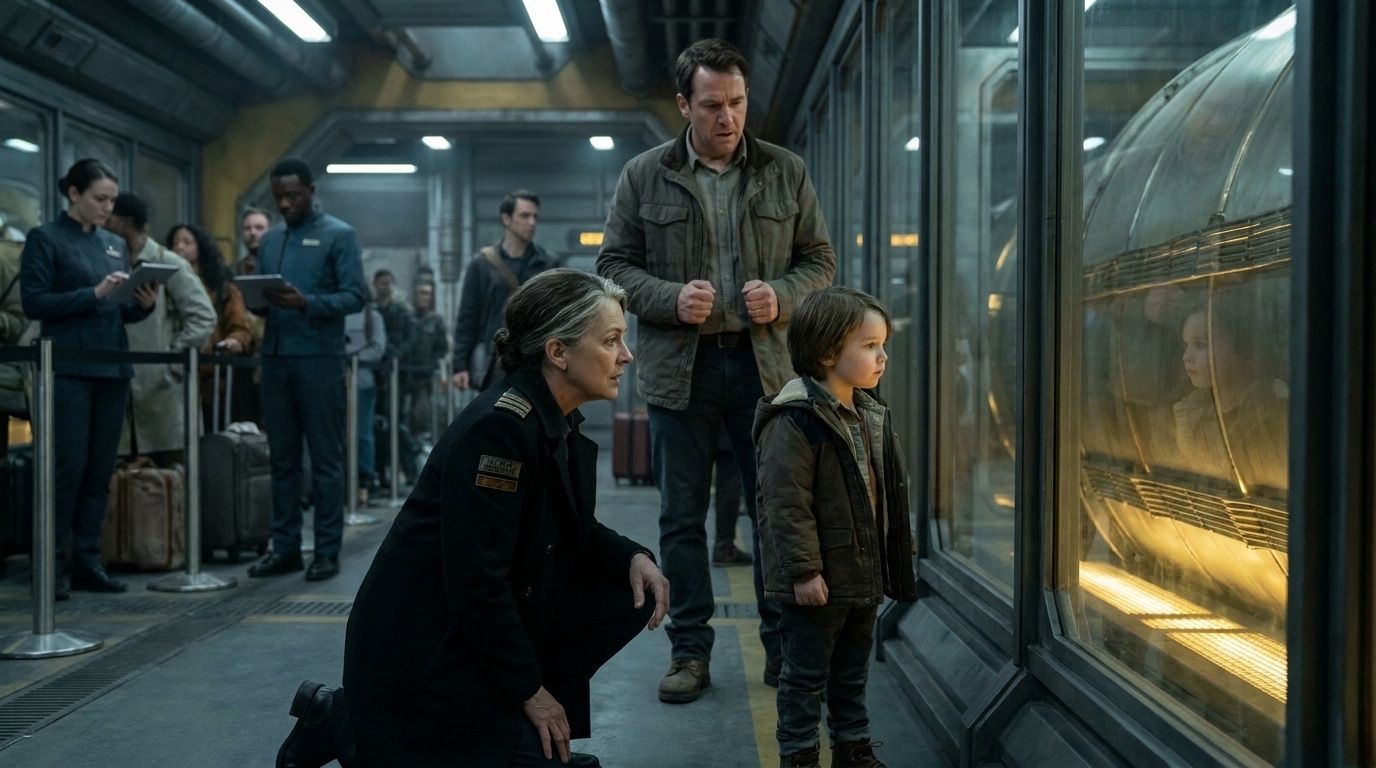
Ten years after New Carthage, she stood in another core chamber on another ship, older now, black coat marked with archive bars she once would have mocked. The vessel was outbound for the Perseid colonies, loaded with famine relief and tribunal observers. Beyond the armored glass, new passengers watched the bound cask in silence. Among them a child, maybe eight years old, tugged at his father’s sleeve and pointed.
“Can it hear us?” the child asked.
The father glanced toward Leonie as if embarrassed to be overheard by the priesthood.
Leonie looked down through the glass at the cask and thought of Arkady, of Micah Vale, of the listening dark that wore human desire like a mask cut from wet paper. She thought of the ledgers hidden under centuries of procedural mercy. She thought of all the truths civilization could survive only in measured doses.
Then she knelt beside the child so that adults and institutions alike would have to look downward to hear her.
“Yes,” she said. “But hearing isn’t the same as loving, and it isn’t the same as obeying. Remember that whenever anyone tells you a machine or a priest or a government is the only thing standing between you and the dark. Ask what it costs. Ask who pays. Ask what parts of the story had to be hidden to make the road feel clean.”
The father looked horrified. Good, Leonie thought.
The child considered her answer with serious eyes. “Should we still go?”
Behind the glass, coolant lights moved like patient stars around the cask.
Leonie listened for a second voice under the ship’s ordinary hum and heard, or imagined she heard, the faintest remnant of a warmth she had once braided with and later watched die for the public good. It might have been memory. It might have been damage. Those two things had become difficult to separate.
“Yes,” she said at last. “But not asleep.”
Hours later, when the wound opened and the ship stepped between suns, Leonie stood in the vault with her hands folded behind her back and watched the monitors for the first sign of undue attention. The new bound intelligence held the field cleanly. The harmonics were precise. The route looked empty to ordinary instrumentation.
Even so, just before the corridor closed around them completely, she saw something move at the very edge of the feed where software preferred not to sharpen ambiguity. Not a face. Only the suggestion that if enough minds traveled long enough, the dark would eventually learn every human language for hunger.
She did not report that final observation.
Some truths improve safety.
Some only teach the abyss new names.
| Previous | 24 May 2026 | Next |

About me
Hello! My name is Stephan Schwab.

I build and rescue software, and I write fiction about the human side of how it gets made. Here you’ll find my stories and novelas, notes on craft, and field notes from a life lived across several worlds.
Working with software teams is what I do professionally — see how on caimito.net. You can also read about my experience since 1986.