Mobility, As Authorized



1. The Future Reached The Village Only Where The Road Was Easy
In 2026 the shape of it was already visible to anyone willing to look without the tourist smile. Madrid had made the old diesel feel unwelcome long before it vanished, tightening low-emission access until driving certain cars into the center was less a practical choice than a declaration against the age. The AVE stitched Madrid, Barcelona, Sevilla, Valencia, Málaga into a fast, applauded Spain of platforms, lounges, and clean interchanges. European visitors called it civilized. Brussels called it a model. The trains were glorious so long as you were traveling between the places already blessed with stations. They did not stop in the middle for every comarca left outside the bright corridor, and that omission carried a politics of its own. Over the next twenty years the same logic spread from rail to streets. Each metropolitan center became a little cleaner, a little quieter, a little more expensive to enter with your own machine. Private cars were not banned in one dramatic stroke. That would have sounded crude, almost Soviet, and nobody in Brussels liked crude endings to market stories. They were edged out by low-emission rules, cost, software compliance, fleet priority, and the slow moral pressure that turns inconvenience into embarrassment.
By the mid-2040s, the last private car had disappeared from Madrid in any meaningful middle-class sense, and still no law had ever needed to confess that this had been the point. The city had done what cities do when they want to erase a habit without enduring the vulgarity of saying so plainly. It had made parking expensive enough to feel immoral, insurance costly enough to feel suspect, fuel scarce enough to feel embarrassing, and the new compliant vehicles so burdened with supervisory hardware, mandatory updates, certified autonomy layers, occupancy monitoring, route validation, and networked liability systems that owning one became a hobby for people who collected vineyards, not for people who commuted. Freedom survived, naturally. It had been moved into a premium control package with quarterly licensing. The old advertisements promised clean skies, solar corridors, fewer collisions, less noise, less dead time, transport without burden. Most of the people who applauded that future were not wicked. They wanted cleaner lungs for their children, fewer deaths on the ring roads, quieter streets, less wasted land, less waiting, less smoke. They meant well and often got what they meant in the places they knew. They did not say as clearly that transport had also become permission: where you could go, when you could stop, which road the system considered defensible, whether your reason for travel fit inside an approved pattern. In the capitals they were not even lies. You summoned a car and one came. It arrived white or silver, silent and softly lit, knowing your destination before you finished wanting it. The streets lost their parked rows and filled instead with motion. Children breathed better. Investors spoke of liberated land and frictionless access.
Far from the capitals, where the roads lifted and twisted through the folds of Las Hurdes and the slate villages clung to the mountains as if the century had failed to pry them loose, the same future arrived in a different tone. Officially the service reached everywhere. Officially there were maps, apps, subsidies, flexibility windows, rural guarantees, charging hubs, green corridors, demographic retention pilots, resilience plans. Spain had become very good at producing documents in which no one was abandoned. In practice, the cars came late if they came at all, and charged as if distance itself had become a luxury product. The vehicles could travel hundreds of kilometers, but the business model could not survive the ravines, the broken shoulders, the dirt tracks, the heat, the dead signal, the long empty return legs, or the fact that the people left outside the metropolitan archipelago still needed to stop in the middle. The contradiction was simple enough that nobody in a ministry could quite see it. The cleaner and more measurable the system became, the more stubbornly it preferred trips that resembled its own model of movement. The service could move a citizen efficiently so long as the citizen behaved like a clean data point. It had much less patience for errands, livestock, detours, arguments, tools, grandchildren, sacks, panic, weather, or the ancient rural habit of needing to do three things on one road.
So the roads that were not worth optimizing remained in the custody of older things: patched diesel engines, welded chassis, improvised filters, hidden drums of fuel, and men and women who measured intelligence not by software but by whether a machine could be made to climb home after dark with one headlamp and a cracked radiator. Around the alqueria of Cambroncino, where roofs of dark pizarra clung to the slope, old bancales had gone to scrub, chestnut shade broke over stone, and most of the children under thirty now slept in flats around Madrid, Móstoles, Leganés, or wherever the service was cheapest and the deliveries fastest, survival had become a matter of keeping simple machines alive past the point of official dignity. Backward, city people called such places when they were feeling charitable. Yet the village still possessed the oldest civic technology in Europe: people who noticed each other, remembered who needed what, and acted before a dashboard could classify the event.
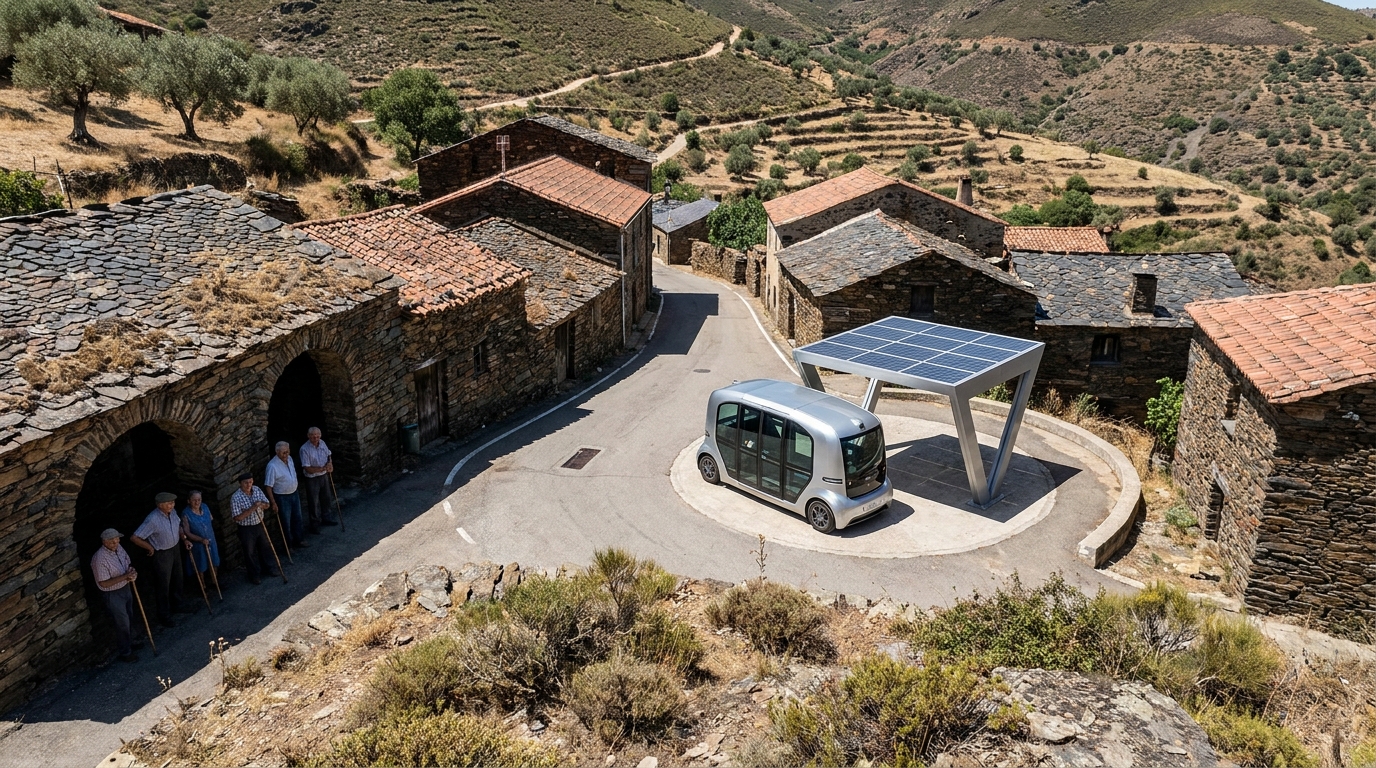
The mayor, Tomás Javier Baeza Cordero, spoke of transition.
He was fifty-two, broad through the shoulders, with a face weathered into authority by sun, funerals, permits, and years of explaining to people from Mérida and Cáceres why maps lied about mountains. When he stood on the steps of the ayuntamiento in his linen jackets and talked about sustainable access, heritage tourism, distributed mobility, and the opportunities of clean modernization, he sounded exactly like a man who could still win grants from people who had never driven the road in winter. Journalists liked him because he could speak in complete sentences without bitterness. Regional officials liked him because he knew when to praise policy before asking for exceptions. He signed the clean-transition declarations, posed under the solar canopy, and corrected older men who used the wrong vocabulary for their own disappearance. Then, when the cameras left, he made sure the contraband parts kept moving. His children, who both lived in Madrid and came home only at Christmas, the matanza, and the odd wedding, liked him in the way adult children like a father they have translated into anecdote.
The village liked him because he knew who still had injector seals wrapped in greaseproof paper from a closed Nissan dealership in Plasencia. He knew which abandoned finca beyond Arrolobos held three dead Patrols behind a caved wall. He knew which shepherd could be trusted to carry a jerrycan on the mule path and keep his mouth shut. He knew which Guardia Civil officer had a brother who still ran an old tractor on blended fuel and therefore preferred educational warnings to paperwork. Most importantly, Tomás knew when not to know things.
He owned a Land Cruiser that had never once appeared in any municipal inventory.
It slept beneath corrugated roofing on a hunting plot above the village, under cork oaks and a line of sagging netting meant once for boar. It was an old Toyota, dark green gone noble with age, kept with the kind of care that bordered on liturgy. The paint had faded evenly. The seats had been re-stitched in honey leather. The dash carried one crack as thin and deliberate as a scar. The engine bay was cleaner than the village pharmacy. Underneath, where no one photographed, a welded brace ran along the chassis on the left side, invisible unless you knew where to kneel. The transfer case whined faintly in second. The rear right door closed with a heavier sound than the others. The smell inside was leather cream, old dust, gun oil, and diesel. If the future had wanted to understand what it was replacing, it would have had to begin there.
Officially, María Vera Cifuentes Rubio had come to Cambroncino to help with communications.
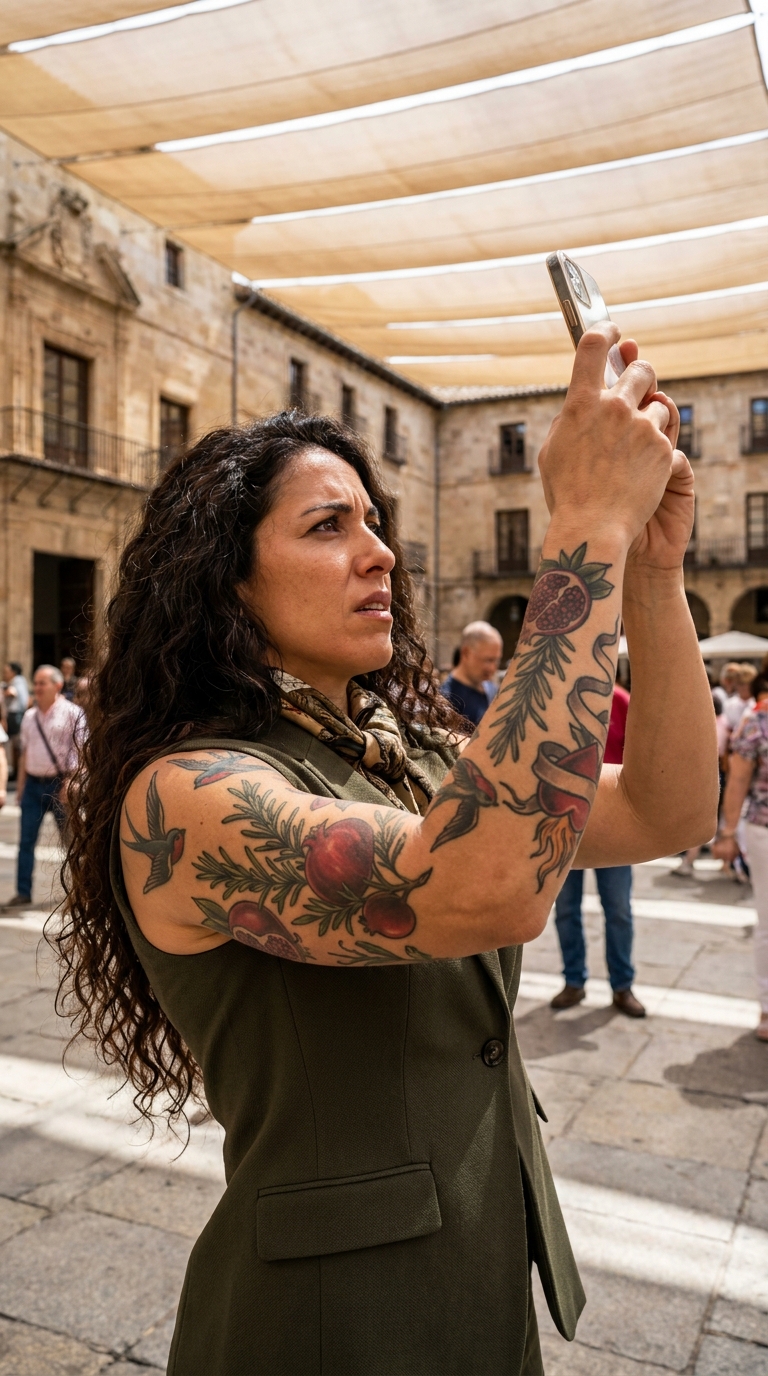
That was the phrase on the contract the province partly subsidized. Communications. Digital storytelling. Strategic visibility. She was twenty-eight, from the south of Madrid by way of a grandmother in Salamanca and two years in agencies that specialized in giving public decline the shimmer of lifestyle. She knew how to write slogans about roots without smelling of roots herself. She knew how to photograph stone walls in a way that suggested authenticity instead of neglect. She knew where to stand so the solar canopy in the square looked like innovation and not like a shade structure over a place where old men complained about signal failures. Her work was to launder abandonment until it looked intentional. She was good at it, which was part of the problem. She wore fitted jackets, expensive sunglasses, boots more costly than any in the village and better broken in than they had any right to be. Her body was gym-made and entirely aware of being looked at: strong legs, precise waist, shoulders that could carry a backpack without giving up elegance, a walk that understood the politics of a village square. On her left arm she wore a full color sleeve from shoulder to wrist, the kind of work that cost money, patience, and several cities’ worth of appointment lists. Deep reds, olive greens, indigo shadows, dusty gold. Pomegranate, rosemary, swallows, ribbon, an impossible little heart burning beneath leaves. From far away it read as glamour with money behind it. Up close, there were dates, initials, coordinates, words hidden where color darkened. Men stared first because of the arm and then because it had brought the rest of her with it.
Officially, she was the mayor’s adviser on modernization.
Unofficially, she was his Friday and sometimes Tuesday, his passenger in the Land Cruiser, his secret in the hunting blinds above the ridge where the app stopped loading and the fleet cars refused to route. The village called her the communications woman. The province called her a modernization resource. Tomás called her when he wanted the cameras to love the square or the square to stop asking questions. She knew exactly how indecent the arrangement was. She was sleeping with the mayor while helping package the village’s managed decline as strategy, and some part of her kept mistaking that moral twist for sophistication.
On the morning the story started in earnest, Vera was in the square filming the solar shade canopy with her phone held above eye level and her face arranged into practical concern.
“One more,” she told the boy from the bar, who had been recruited to ride a municipal shared pod across the frame for scale. “Slower this time. It has to feel calm, not empty.”
The boy shrugged and circled back. The pod arrived two minutes later than the app had promised and blinked politely at the curb as if punctuality were a favor. Its white shell reflected the square’s chestnut trees, the shuttered school annex, the pharmacy that now opened only three mornings a week, and the old men under the soportales who had begun describing every machine with clean lines as if it were personally offended by them.
Vera recorded. The pod slid across the image like certainty.
From behind her, Rufino Jesús Jarilla Payo said, “If you turn a little to the left, hija, you can keep the part where there’s nobody using it.”
She lowered the phone and smiled without showing irritation. Rufino was seventy-three, bent at the shoulders and straight in the eyes, with fingers blackened permanently by grease that no soap could fully defeat. He had been the alqueria’s mechanic before there was enough decline to call anyone a former anything. Now he repaired what still submitted to repair and taught younger men, badly and without patience, how not to fear old engines. His yard was half workshop, half cemetery, all useful.
“I’m filming the square,” Vera said.
“Exactly.”
He spat into the dust and looked at the pod as one might look at a relative too delicate for the weather. “That thing comes here three times a day and twice it leaves empty. But in the video it will look like the future is waiting for us.”
“People don’t fund despair.”
Rufino nodded as if he had expected the line. “No. They fund the photo of despair after you clean it and add a logo.”
Tomás came out of the ayuntamiento carrying a folder under one arm and a paper cup of coffee in the other hand. In the square he looked every centimeter what he was supposed to be: responsible, available, trimmed, not handsome in a polished way but made attractive by competence and the absence of hurry. When he crossed toward Vera he did not touch her. That was part of how they lasted.
“The call with Cáceres moved to eleven,” he said. “They want numbers on transport uptake.”
“Real numbers or grant numbers?”
“The kind that can still be said aloud.”
Rufino laughed. “Then tell them the same thing as last quarter. Everybody is very mobile on paper.”
Tomás gave him the look reserved for men who had earned the right to disrespect him. “And how is your nephew’s alternator today?”
“Still immoral, but functioning.”
Tomás sipped his coffee. “There. We all do what we can.”
Vera watched the exchange and thought again what she had been thinking more often lately: the village’s true political system was maintenance. Not ideology, not resistance, not even poverty in the abstract. Maintenance. Keeping roofs, bodies, roads, and engines one season ahead of collapse. Everything official existed above that fact like a cleaner language laid over rock. The operator sold mobility. The village required movement. They were no longer the same thing. One system optimized trips. The other carried lives.
At eleven, Tomás took the call from the meeting room upstairs, with Vera beside him and a blue slide deck open on the screen. The comarca coordinator from Cáceres appeared first, then a woman from a mobility operator in Barcelona, then a consultant in Brussels whose Spanish arrived intact but unlived. The words passed as they always did: equitable access, rural pilots, user adaptation, clean transition, low-emission intermodality, demand responsiveness. Vera advanced the slides. A graph rose elegantly. Another dipped in a way that could be described as stabilization if one had courage.
“We are seeing a cultural lag,” said the consultant.
Tomás inclined his head. “We are seeing geography.”
The woman from Barcelona smiled with corporate sorrow. “Range is not the issue.”
“I know,” Tomás said. “If the village were a straight line and everyone traveled at noon, your service would be excellent.”
The coordinator from Cáceres cut in fast, sensing tone. “What the mayor means is that local route habits remain under revision.”
Tomás folded his hands. “What I mean is this. The service works well to Pinofranqueado if someone books early and returns before dark. It works reasonably for one person going to the health center in Caminomorisco if the system likes that day’s demand profile. It does not work for an old couple who need to stop at the pharmacy, then the notary, then a cousin’s house where the husband has gone and fallen again. It does not work for the cooperativa and the almazara when people and tools still have to move before dawn in aceituna season. It does not work when there is rain and the lower track washes out and the vehicle decides the liability envelope is not worth crossing.”
The woman from Barcelona replied in the voice of someone trying sincerely to solve a problem from too far away. “Those edge cases are precisely what our next adaptive rollout addresses.”
Vera kept her eyes on the screen, but she felt Tomás look at her for half a second as if to ask whether she had noticed the phrase. Edge cases. People old enough to remember mules and young enough still to bury their own.
“We welcome the rollout,” he said smoothly. “Our village remains deeply committed to modernization.”
Vera almost admired the obscenity of it. Tomás could defend the village and betray the sentence in the same breath. He could say modernization while mentally counting fuel drums. He could thank the people designing the failure and still know exactly which illegal truck would be needed when their failure became flesh. Up there on the screen, decent people still spoke as if transport were a neutral utility. Down here it had become a soft police power with clean branding, not because they desired domination, but because every tool shapes the work done with it until the work begins to resemble the tool.
When the call ended, Vera shut the laptop and pressed both hands flat against the table.
“You enjoyed that,” she said.
“No.”
“A little.”
Tomás leaned back in the chair. “I enjoyed surviving it.”
She stood, crossed to the window, and looked down at the square. The pod had gone. Rufino was talking to two men beside a trailer stacked with sacks that might have held feed, seed, or secrets. Above the roofs the mountains closed in dry and green-black, old as contempt.
“Do you ever feel bad?” she asked.
“About what?”
“The way you speak in there.”
“Which way?”
“Like you believe all of it.”
He considered. “I believe enough of it to collect the money. I collect the money to keep the village from becoming a memory faster than necessary.”
“That isn’t the same thing.”
“No,” he said. “It’s government.”
2. The Land Cruiser Was Kept Like A Private Chapel To An Older Idea Of Power
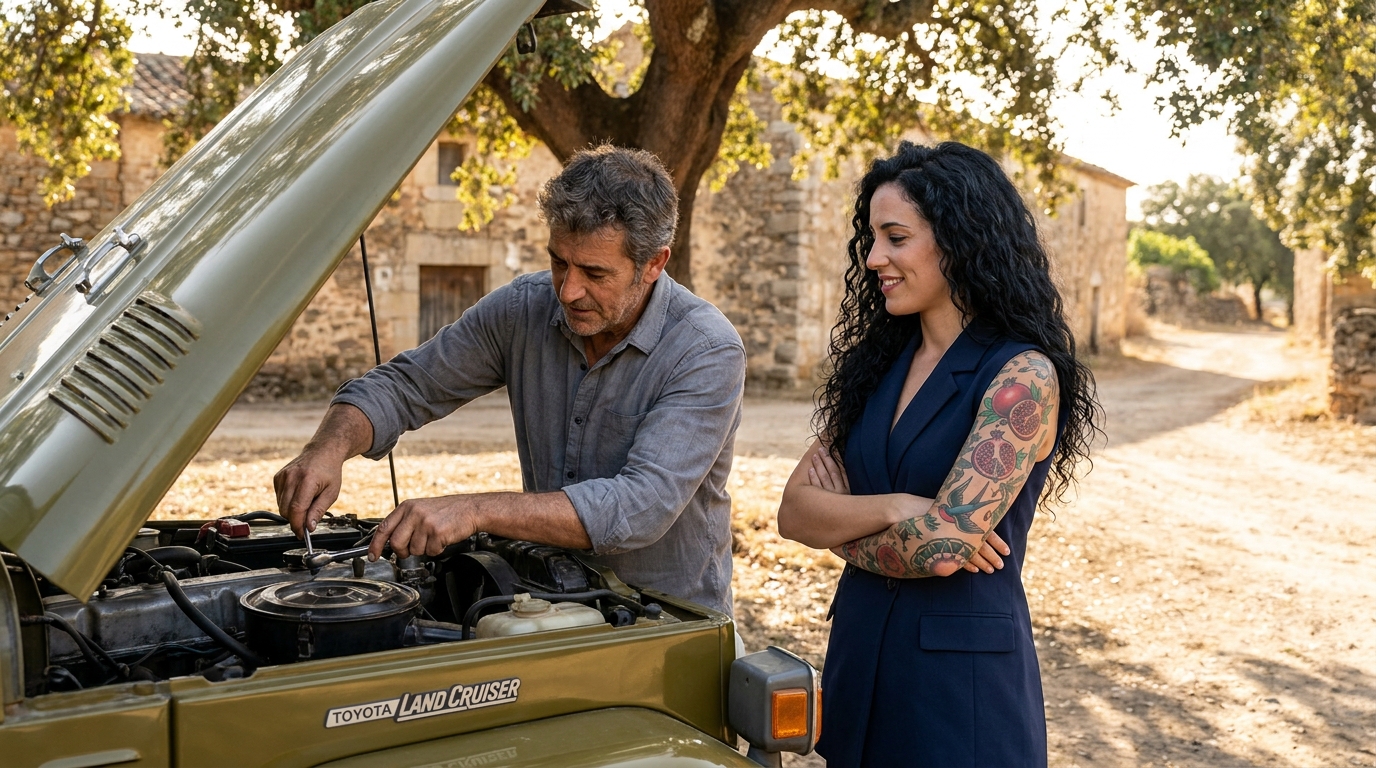
That afternoon she went with him up to the hunting plot because he said he needed to check the water tank and because both of them had become adept at using ordinary tasks as doors into other hours. They left separately. Tomás took a municipal fleet pod as far as the cooperative shed, waved at three people on the way, and vanished down a side lane. Vera waited ten minutes, then walked past the cemetery and up the lower olive path where the Land Cruiser stood in shadow behind the netting, as if the mountain had grown a vehicle by patience.
He was already there, sleeves rolled, checking a hose clamp.
“You do this every time,” she said.
“It’s a machine.”
“It ran yesterday.”
“So did I. I still bathed.”
She laughed and watched him tighten the clamp with small exact movements, neither rushed nor theatrical. This was what first undid her more than his office, his gravel voice, or the danger of him had. Not power. Competence. The body at rest inside useful work. In Madrid, men like this had thinned out into stylists of themselves, all correct angles and negotiated instincts. Tomás still looked as if the world made demands on him heavier than opinion. He was ridiculous too, of course: mayor of clean transition, priest of the forbidden diesel, public servant, private smuggler, liar in linen. The contradiction did not make him less attractive. It made him harder to dismiss.
“You know,” she said, leaning against the fender, “in the videos I make, men like you never touch tools. They gesture at plans.”
“Then your videos are very modern.”
She looked at the Land Cruiser. “If anyone in Madrid saw this, they’d want it.”
“No,” he said. “They’d want the photo of wanting it.”
“That is my entire profession,” she said.
She liked hotels with stone spas, terrazas with glass railings, old leather, expensive perfume, the click of jewelry against a wine glass. She also liked the first smell of the Land Cruiser when Tomás opened the door after the truck had sat in the sun, and the way the vehicle felt outside the regime of notifications and curated light. She liked driving up through dust, the scrape of branches on paint, the heat, the directness, the absence of managed mood. At first she told herself the attraction was novelty: an older man, a hidden truck, a secret above the village, something raw enough to interrupt Madrid. That was the story she could live with because it kept the matter decorative. The more honest version was less theatrical. Around Tomás she felt her own nerves settle. Her body stopped acting like a public relations department. Hunger, fatigue, pleasure, irritation, silence: each thing became itself again.
What she responded to in Tomás had become hard to find in Madrid and harder still to admit wanting. Over the previous twenty years the men around her had learned a new metropolitan elegance: correct language, moderated appetite, expensive self-awareness, soft hands made for screens, bodies maintained for display rather than use, a cultivated gentleness that photographed beautifully and rarely surprised her. They were careful, legible, deodorized by consensus. Even their transgressions arrived pre-explained, like restaurant allergens. Tomás belonged to an older species of confidence, not brutal, not stupid, but materially male in a way the city had been teaching itself to distrust. He lifted without asking whether he ought to. He knew the weight of gates, tires, carcasses, sacks, fuel cans. He could sit in silence without curating it. Dirt did not become him; it recognized him. When he touched her, she felt not sophistication but permission backed by strength. More unsettling than desire itself was the health of it. He did not make her feel degraded, consumed, or cleverly transgressive. He made her feel present. That, more than discretion or power, was what drew her back up the mountain.
She told herself at first that this, too, was part of the job, if not the formal one. She told herself she was learning texture. She told herself the body had its own curiosity. The trouble began when the lies stopped needing to convince her and started sounding like the only language in which she still knew how to function.
They drove higher through cork and scrub oak, the track breaking into stones that rolled under the tires and dust that entered the cabin in a slow honest way no filtration system would have tolerated. Vera sat with one knee turned toward him, sunglasses on, sleeve bright in the slant light. The truck climbed without complaint. At a clearing above the gorge they stopped. The land fell away in folds of hard green and slate, villages of dark rooflines and weathered stone scattered across the slopes, terraces half lost, the roads drawing themselves in chalk and dust where they could.
“It’s beautiful,” she said.
“Yes.”
“And dead.”
Tomás cut the engine. Silence came back piece by piece: insects, one goat bell far off, wind on dry grass.
“Not dead,” he said. “Dying is more expensive.”
She turned toward him with a sudden impatience that had nothing to do with the view.
“No quiero discutir cosas,” she said. “He venido desde Madrid para coger y para que lo hagas bien. Quiero venirme con fuerza y sentirlo todo.”
He looked at her for a second, not shocked, only measuring the force under the words.
In the square she spoke like a consultant and smiled like a brochure. Here, with the engine cooling and the mountain around them, she sounded like the truth she kept hidden from the version of herself that earned invoices. Madrid had trained everybody into explanation. Desire there came wrapped in disclaimers, politics, self-awareness, irony, negotiated tenderness, endless civilized talk. Even hunger had learned to apologize for itself. With Tomás she wanted the opposite. Not cruelty. Not stupidity. Something older and more physical than all that urban correctness: appetite without a thesis, authority without performance, a man who did not need to narrate himself while wanting her. What began as appetite kept revealing itself as relief.
She kissed him before he could answer. Outside, the truck ticked as it cooled. Inside, the light made her colors deeper, turned the reds in her tattoo sleeve almost wet, the olive leaves darker, the hidden words invisible again unless one knew where to look. He touched her thigh with the proprietary caution of a man who still found permission intoxicating. She liked that about him too. That he never behaved as if taking were the same as being wanted.
This was the metropolitan catechism she had brought with her from Madrid: sex is just sex, appetite is appetite, adults travel for pleasure and return unchanged, and meaning is what provincial people add afterward because they cannot bear freedom. She had come up from Madrid under an official pretext paid for by other people and, in the private accounting she trusted more, she had also come simply to get laid. She knew the indecency of that. She also knew how normal it had become. In the city, bodies were supposed to be modern now: available, fluent, recreational, detached. No theology. No vows. No consequences except perhaps a train home and a message the next day.
But lying there with the dust, the heat, the old truck, and Tomás’s breath close in the half-dark, she felt the doctrine fail in her own flesh. The body was not nearly as liberal as the slogans. It attached itself. It remembered. It made associations nobody had authorized. What she had come to classify as pleasure kept turning, against her plans, into allegiance. More than that, it kept turning into a form of sanity. Around him and around the village, desire no longer felt like an entertainment layered over life. It felt braided into work, weather, consequence, appetite, sleep, risk, care. It felt embarrassingly whole.
Later they lay half-dressed on a blanket in the rear with the back door open to the mountains. Her hair smelled of dust and expensive shampoo. His chest was damp. Below them the village could not be seen from that angle, only the folds of land and a hawk circling in heat.
“My daughter called last night,” he said.
“The one in Las Tablas.”
“Sanchinarro.”
“That is what I said.”
He smiled despite himself. “She wants us to sell the family house eventually. Turn it into tourist rentals before it’s worth nothing.”
“And?”
“And she explains market timing to me as if I were a decorative uncle.”
Vera lifted his hand and pressed it against the rib of her tattoo sleeve where script disappeared beneath a pomegranate rind. “Would she be wrong?”
“About the timing? Maybe not. About the house? Yes.”
“You can’t live in every wall forever.”
“No. But you can refuse to hand a place over while the people talking efficiency still think absence is neutral.”
She looked out through the open door. He was at his most dangerous when he spoke like that: not loud, not grand, but convinced by ground rather than opinion.
“You know what they’ll say about villages like this in ten years,” she said. “That the transition succeeded, but settlement patterns changed.”
“Yes.”
She smiled thinly. “That sentence could kill a region and still sound like a quarterly report.”
“That sentence is designed to survive the funeral.”
Below the ridge a shot sounded, then another, farther off. Someone else hunting. Tomás sat up and listened.
“Rufino’s grandson,” he said after a moment. “Too close to the lower path. He shoots like he’s arguing.”
Vera buttoned her shirt. “Take me to see the workshop again.”
“Why?”
“Because the videos are lying to me.”
He looked at her properly then, as if measuring whether the request was still a city mood or had hardened into something more durable. Whatever he found, he accepted it.
3. Rufino’s Workshop Preserved A Parallel State Built Out Of Plate Steel And Diesel Smell
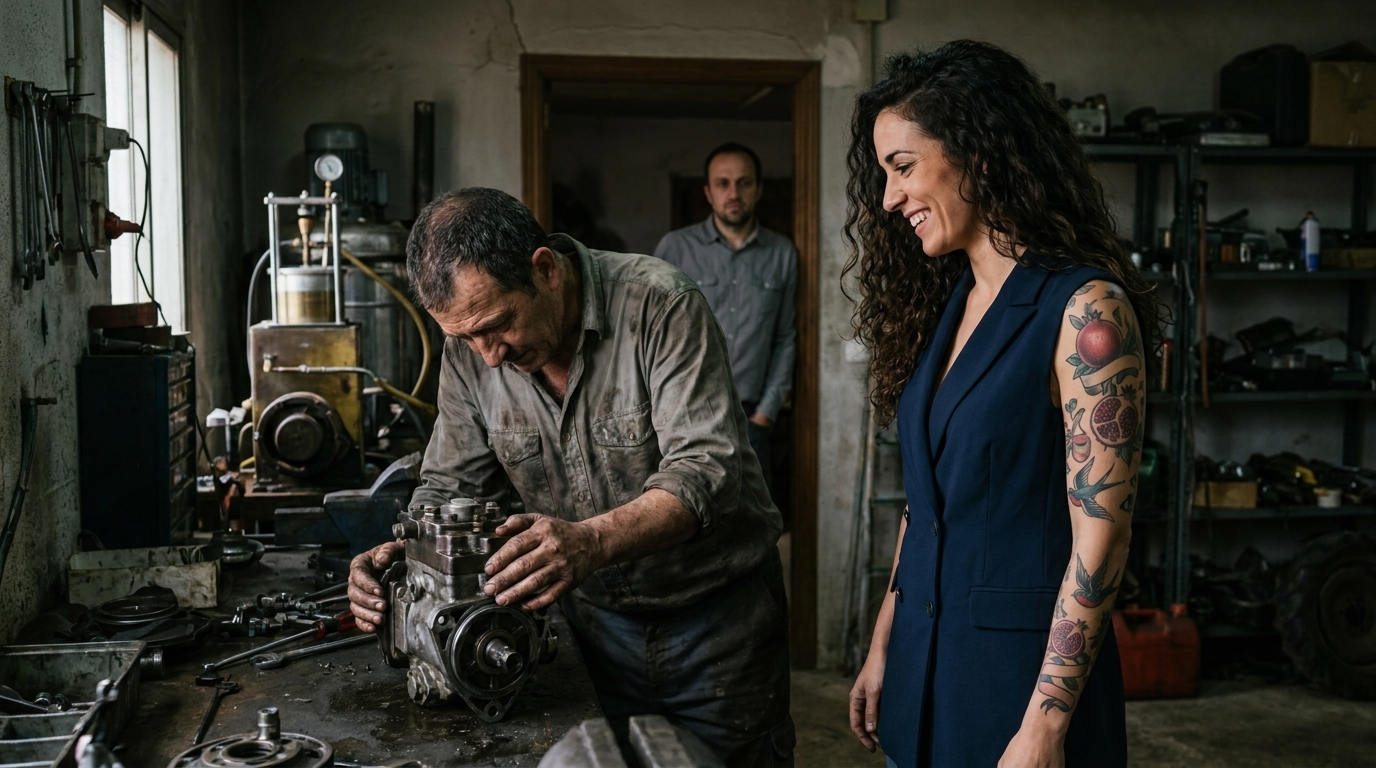
The workshop sat behind Rufino’s house under sheet metal patched in three colors. It smelled of hot iron, old oil, vinegar from biodiesel washing, singed rubber, mouse droppings, coffee, and the faint bitterness of aceituna husk tracked in on boots. The yard held engines on pallets, doors stacked against a wall, three stripped 4x4s sinking into weeds, and coffee tins full of bolts that had outlived the catalogues that once named them. A homemade press stood under the awning where they used sunflower seed and whatever else the season allowed. Behind it, in blue drums, the latest batch of fuel was settling to clarity by stubborn degrees.
Rufino looked up from a bench where he was filing a bracket cut from plate steel. “Ah,” he said. “The modernization department.”
Vera stepped carefully between parts. “Tomás says you people replace electronics on purpose.”
“When the electronics deserve it.”
“And when do they deserve it?”
“When they die and take the rest with them.” He set down the file. “You understand this machine in the square? If it says the road is too wet, nobody argues with it. It is legal, it is safe, it is certified, it is clean. Very nice. If my nephew’s old Patrol says the road is too wet, he locks the hubs, spits out the window, and goes slower. That is the whole political theory.”
Tomás leaned on the doorframe, watching Vera watch. Rufino pointed at a diesel injection pump on the bench, half disassembled.
“This,” he said, “I can strip, clean, shim, and rebuild. This understands filth and bad fuel and hatred. A compliant electric control unit? When it dies, a man in Valencia sends me a quote larger than my first wedding. What do you think the mountain chooses?”
Vera traced with her eyes the labels chalked onto shelves: filters, belts, hoses, bearings, Patrol, Montero, Land Cruiser, Hilux, none of it meant for any inspection. She thought of the square, the pod, the graphs she had just animated into reason. Then she looked at the drums.
The old reflex stirred in her anyway. Take out the phone. Film the shelves, the drums, the pump on the bench, the blackened hands, the whole illegal grammar of survival hidden behind sheet metal and bad light. But she could already see what would happen once such footage left her possession. It would not remain a complicated human truth for long. It would become evidence. Faces, equipment, fuel, unlicensed competence, all arranged into a package for people who would never climb this road and would still feel entitled to judge it. She left the phone where it was. What stopped her was no longer professional caution. It was the simpler fact that these were becoming people she did not want to hand over.
“Does this actually work?” she asked.
“Badly enough to be real,” Rufino said. “Good enough to matter.”
He lifted the top drum’s lid and let her smell it. Not petrol-station diesel. Rougher, sweeter, with oil and field still trapped inside it.
“Sunflower,” he said. “Some rapeseed when we can get it. Filter it, settle it, wash it, pray to chemistry. The injectors complain. So do the men. Both continue.”
Tomás said, “Don’t tell her too much.”
Rufino snorted. “If she were here to tell, she would have come with better shoes.”
Vera looked down at her boots, expensive and dusted white. “I can have practical shoes and still be disloyal.”
“Of course,” Rufino said. “That is why we are polite.”
The emergency began four days later with a missed booking, which was the cleanest kind of failure because everyone could blame the schedule.
María Eulalia Moreno Bravo, who was eighty-one and lived alone on the far side of a broken track above the river, booked a service vehicle to go down to Caminomorisco for a cardiology check and a pharmacy refill. The app confirmed. The app delayed. The app rerouted. The app placed her pickup point at the lower road because recent weather events had altered the road safety profile, though there had been no weather and the profile had been altered by a slide three months ago that no one had cleared because the budget had been reassigned to remote-charging infrastructure no one used. Eulalia waited in a chair outside her gate, properly served in every database that mattered. It was late July, the kind of Extremadura heat that turns tin shutters into griddles and leaves the air standing still over the stone. By noon the shade had moved off her doorway. She walked as far as the lower bend with a stick because the system had decided that the last part of her journey was now her responsibility. There she sat on a rock under a stunted olive with no real shade, missed her pills, felt the first tightness in her chest, then the dizziness, then the dry, skittering panic that comes when age, heat, and a weak heart begin combining their arguments. She called her niece in Coria with fingers that no longer closed properly around the phone. Her niece called the ayuntamiento, where Vera answered because Tomás was in Nuñomoral arguing about watershed maintenance.
At first it was only a familiar scramble: who has signal, who has keys, who is closest, who can go.
The village still knew how to move. It had been doing so since long before movement required a subscription. One woman called a niece, the niece called the ayuntamiento, Vera called across the square, Rufino was fetched, keys were found, a route was remembered, and help began to assemble in human sequence rather than digital order.
Rufino’s grandson had taken the Patrol to Plasencia. The school van was dead. The municipal pod in the square refused the route because the road classification had degraded below liability threshold, which meant the machine had moral permission to abandon a woman and still remain correct. Tomás could not return for an hour. Vera stood in the office with the phone hot against her ear while Eulalia’s niece cried and tried not to sound afraid.
“Stay with her if she calls again,” Vera said. “We’re going.”
She said we before she knew who we meant. Then she went still for one hard second. In the square outside sat the legal future: silent, certified, unavailable. In the cabinet behind her slept the opposite: undeclared, combustible, effective, politically fatal. She knew what taking those keys would mean. It would expose Tomás, expose Rufino, expose the entire polite fraud by which the village survived. It might also keep an old woman alive. For once the choice arrived without aesthetic fog, without irony, without the usual metropolitan cushion of language. Then she took the keys to the Land Cruiser from the envelope hidden in the false back of the filing cabinet behind old cultural festival programs, because Tomás had once shown her where they were and afterwards both pretended he had not.
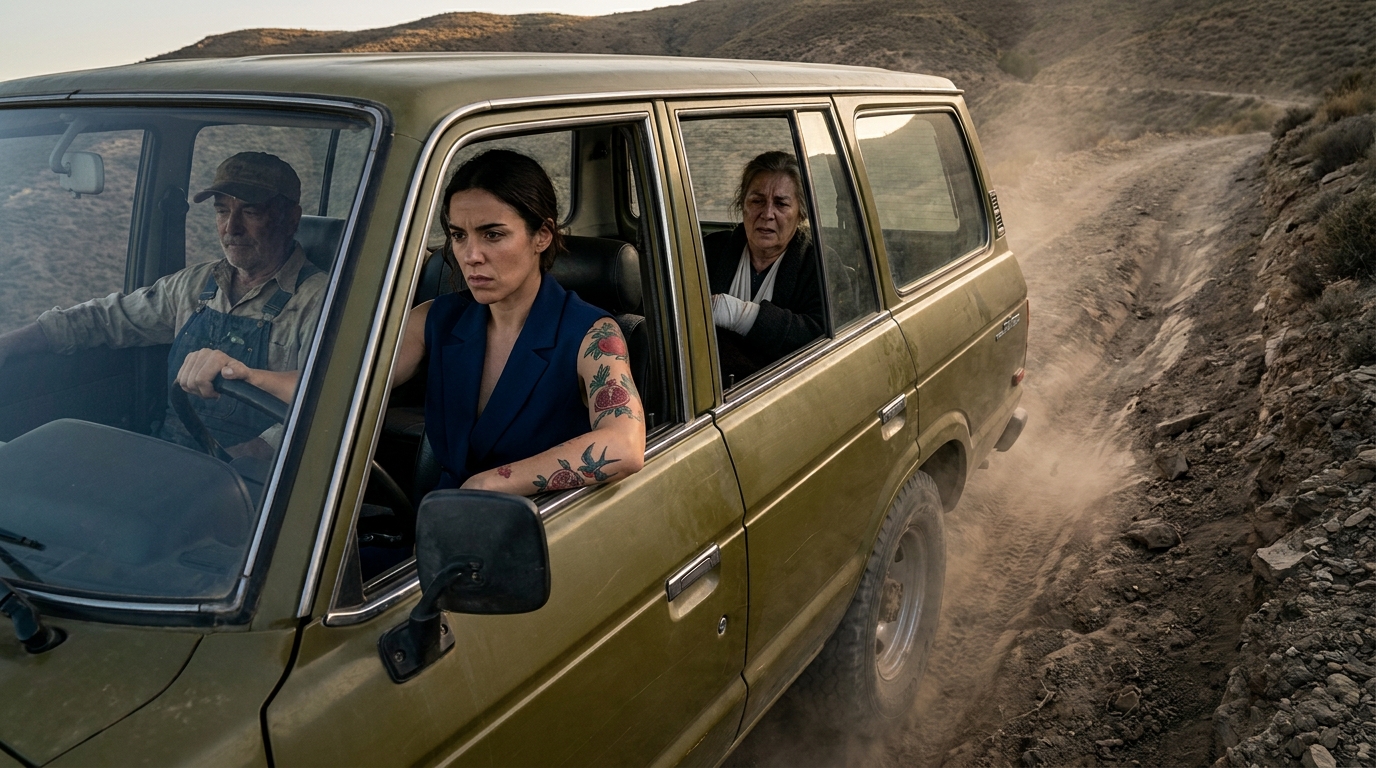
The alqueria saw her leave. Later it would remember every detail and disagree on none of them. The PR girl from Madrid in fitted jeans and the green field jacket, sleeve blazing in the sun, taking the old illegal truck out of the square as if she had been born to its steering wheel. She had not. She did not drive beautifully. She drove hard and concentrated, learned the clutch by force, missed second once, swore, found it, and kept going. Whatever else in her had become compromised, performative, expensive, or false, the deeper instrument was still there and still pointed correctly when a life was on the line. At the cooperative shed she picked up Rufino without asking if he wanted to come. Someone else had already run to tell Eulalia’s neighbor to bring a sheet for shade. Someone opened the pharmacy though it was not the hour. Someone called ahead to the health center. The village did not panic. It distributed necessity.
He climbed in carrying a metal case and said only, “Good. Faster than waiting for virtue.”
The track above the river had worsened since spring. Ruts deep as memory. Slate loose under dust. Two washouts half filled with stone. Heat shimmered above the hood and made the terraces swim at the edges. The Land Cruiser crawled where the certified service had refused to consider possibility. Every meter was an emissions violation with a pulse. Vera’s hands hurt from gripping the wheel. Rufino smoked against the open window and gave instructions with the lack of panic only old mechanics and butchers manage around failing bodies.
They found Eulalia sitting where the path widened before the bend, gray with pain and fury, lips gone dry, blouse dark at the spine, breath too quick and too shallow. When Vera touched her wrist, the skin felt frighteningly hot.
“I paid for the booking,” she said before anything else.
“Of course you did,” Rufino replied.
They got her into the back with more difficulty than dignity. Rufino wet a cloth from his flask and laid it against her neck. Vera turned the truck and drove downhill with the old woman’s breaths counting the corners, each one either too fast or absent long enough to terrify. Halfway to the health center Tomás called, finally aware, voice rough with speed and poor signal.
“Where are you?”
“On the river road.”
“In what?”
“You know in what.”
He was quiet one beat too long. “How is she?”
Rufino leaned over and took the phone from Vera. “Less dead than if we had stayed modern.”
Vera kept her eyes on the road and felt, beneath the fear and jolting concentration, a brutal kind of relief. She had spent months helping people describe the difference between image and reality without ever having to choose between them. Now she had chosen, and the choice had not been elegant at all. It had been loud, illegal, filthy, and morally clean. Behind her, Eulalia made a sound like someone trying not to die inconveniently.
They made the health center with minutes that later sounded more dramatic in retelling than they had inside the truck, where there had only been heat, dust, and the ordinary terror of running out of time. Eulalia lived. The nurse on intake said another half hour in that sun might have finished the afternoon for her, especially after the cardiac strain. This was the obscene part. Not the illegal truck. Not the hidden fuel. Not the mayor’s little museum of undeclared combustion. The obscene part was that the dirty, outdated, socially embarrassing machine had done the clean system’s job. There was paperwork, of course there was paperwork, because a life saved by the wrong technology still required administrative correction. Before sunset there were photos, because someone at the center recognized the mayor’s truck, and by night the first image had traveled: Vera beside the Land Cruiser under the yellow clinic lights, hair loose from its clip, sleeve bright, one hand on the rear door, the old woman’s blanket visible inside like evidence pulled halfway into the world. The caption was malicious first, then admiring, then political. Rural transition manager forced to use diesel 4x4 after public service vehicle fails elderly patient in Las Hurdes. By midnight someone had matched the truck to Tomás through old hunting permits and a grudge. By morning the provincial paper was calling.
4. The Scandal Began The Moment A Real Road Demanded More Than Compliance
In the square, men who had hidden filters in flour sacks for three years tried and failed not to enjoy themselves. It is difficult to maintain proper shame when the contraband has just saved a neighbor. What pleased them was not vindication alone. It was recognition. For one afternoon the old knowledge of the place had proved itself in public.
Tomás returned before dawn and found Vera on the bench outside the ayuntamiento with a bottle of water and no patience left.
“You should have called me before taking it,” he said.
“Would you have told me no?”
He stopped. “No.”
“Then save us both the morality.”
His face held exhaustion, anger, admiration, and the beginning of fear. “They’re asking why the mayor of a transition village maintains an undeclared combustion vehicle.”
“Because your village isn’t a line item.”
“That answer won’t help.”
“Neither will the truth.”
“The truth is worse,” he said. “The truth is that the diesel worked.”
Rufino emerged from the soportales carrying coffee in two chipped cups. “You are both wrong,” he said. “The truth will help for six minutes, which is longer than their vehicles.”
The reporter from Cáceres came at ten. A woman younger than Tomás and older than Vera, sharp enough to know where embarrassment turns into story. She stood under the solar canopy with the square behind her and asked questions in the clean order of people who expect institutions to betray themselves tidily. She was not cruel. She simply belonged to the world in which a system failure becomes legible only once it can be quoted. The canopy made a fine backdrop. Solar panels always did. They suggested virtue without having to transport anyone.
Why was the vehicle undeclared? Why had the public service not been able to complete the route? How widespread was informal use of legacy combustion vehicles in the municipality? Did the mayor consider himself in breach of the transition framework?
Tomás answered with the discipline of a man shelling almonds. The vehicle was a privately maintained rural support asset used exceptionally in a medical contingency. The village remained committed to clean mobility. Yesterday’s event demonstrated the need for better adaptation of service criteria to mountain realities. No one disputed the environmental benefits of transition. What was required was territorial intelligence. He did not say that territorial intelligence had arrived yesterday smelling of diesel and old leather.
“And the fuel?” the reporter asked.
Tomás smiled with only the left side of his mouth. “For that truck?”
“For the truck and others.”
“I imagine people who feel abandoned become inventive.”
It was a beautiful sentence because it accused nobody powerful.
She looked at Vera. “And you? Does this change the story you’re here to tell?”
Vera felt the square gather around the question. Not physically. More old than that. Listening through shutters, behind coffee, under hats.
“Yes,” she said.
Tomás turned his head slightly toward her.
She continued before caution could return. “The story is not that rural people resist modernization. The story is that modernization likes to count itself where the road is easiest. If a service cannot fetch an old woman from two kilometers of broken track in forty-degree heat, then the village is not refusing the future. The future is refusing certain roads. Yesterday the illegal diesel did the legal service’s work. That is not nostalgia. That is an audit.”
The reporter’s eyes sharpened. “Can I quote that?”
“You already have.”
By afternoon the sentence was everywhere locally and nowhere that could actually change procurement. Brussels consultants called it colorful. Cáceres officials called it unhelpfully binary. None of them were monsters. Most would probably have helped Eulalia personally if they had stood where Vera had stood. Their failure was colder than that. They encountered the village mainly through categories, and categories are merciless in ways kind people often are not. In the village bar the sentence was repeated with approval because it sounded like something city people might mistake for theory, which was useful because theory frightened them less than shame.
The operator responded with a statement about route safety envelopes and continuous service improvement. The province promised review. The review would take months, which was a polite administrative unit meaning nothing with consequences would happen before the heat broke. In the meantime, the village’s hidden economy came under new attention. Two inspectors arrived a week later with tablets, pale shirts, and the kind of politeness that expects cooperation from places it never fully believed in. They wanted to examine storage structures, maintenance yards, and undeclared mobility assets. One of them wore shoes that had never met dust honestly.
Tomás received them with coffee and all his public grammar.
“We are happy to assist.”
Rufino locked his workshop and misplaced the key. Half the village became remarkably bad at understanding questions. The Land Cruiser vanished into a chestnut grove behind a cousin’s abandoned barn. Blue drums moved by night to terraces above the river where no van would ever climb. Vera spent the first day of inspections accompanying the visitors with such impeccable strategic warmth that even Tomás began to suspect she was enjoying herself. She was. Moral conflict, she discovered, did not prevent professional excellence. Sometimes it improved it. The inspectors themselves were courteous, sunburned by noon, thirsty by one, and almost touching the truth without ever being able to hold it. They kept looking for an infraction. The village kept presenting a civilization.
At lunch she sat with them in the bar and explained demographics, lifestyle adaptation, communication barriers, and the emotional complexity of late-transition communities until both inspectors were nodding as if hardship were fundamentally a matter of narrative framing. Meanwhile, three boys removed an injection pump from a half-buried Montero behind the old school and carried it through the ravine in feed sacks.
That night Tomás found Vera on the plot beside the hidden Land Cruiser, smoking one of Rufino’s terrible cigarettes and looking down at the truck as if it were a sleeping animal.
“You were very good today,” he said.
“I am professionally false,” she replied.
“No. You’re precise. It’s different.”
She dropped the cigarette and ground it under her boot. “Do you want to know what I was thinking while I was smiling at them?”
“Probably not.”
“I was thinking I used to like this kind of work.” She touched the hood with her fingertips. “Making places legible for people who would never really come. Turning damage into texture. Decline into atmosphere. You can live very well doing that if you don’t mind hating yourself in aesthetic installments.”
He leaned against the door beside her. The evening smelled of dry grass and cooling metal.
“And now?”
“Now I know too much about filters.”
He laughed quietly. “That is how all corruption starts here.”
“Then I am becoming locally qualified.”
She turned to him. “Do you ever think about leaving?”
“Every winter.”
“I mean truly.”
He watched the dark gather over the ravine. “If I leave, the village loses one more person who knows where things are.”
“Things?”
“Pipes. Feuds. Keys. Graves. Why one wall still stands and the next fell. Which road can take weight after rain. Who still talks to whom after 1998. Where the old chestnut grafts are. Who can weld. Who can lie convincingly to an inspector. Which woman says she needs transport when what she needs is for someone to notice she’s not well.” He looked at her. “Places are made of things, Vera. Mostly small ones.”
She rested her head briefly against his shoulder, not from tenderness alone but from fatigue and the relief of not performing. It struck her then that what she had first named rawness was often just coherence: a man whose words, hands, obligations, and wants still belonged to the same body.
“Your children won’t come back,” she said.
“No.”
“Mine don’t exist.”
“Yet.”
“Don’t do that.”
“What?”
“Make the future sound reasonable.”
He took her face in one hand then, rough palm and careful thumb, and kissed her with a weariness that felt truer than heat. Later, in the back of the Land Cruiser, she watched the colors of her sleeve move in the half light against his skin and thought absurdly that the tattoo had always been waiting for this landscape, these leaves and dust and scratches, as if the arm had been an unfinished map until the mountain provided the missing legend.
The inspectors left with nothing they could seize and enough to report uneasily. The article from Cáceres spread further. A television segment came and went. The operator quietly adjusted two route classifications in the valley and called it adaptive listening. The village celebrated the concession with suspicion. Nobody thought the system had learned anything except the cost of embarrassment, which is the only metric bureaucracies truly respect.
Summer hardened. The hills browned. More bookings failed. More old cars moved at dawn and after dark. The hidden drums behind the terraces grew lighter, then filled again when the sunflower pressing finished. Vera stayed longer than her initial contract required. She began editing less from the square and more from Rufino’s bench, asking which words old parts used for each other. She filmed less of the pod and more of hands repairing things. None of that material was easy to publish officially, because officially the village was adapting, not evading. So much of it remained on her drives, a secret archive of a place refusing disappearance by routine acts of mechanical blasphemy.
5. From The Ridge The Difference Between Abandonment And Efficiency Was Visible
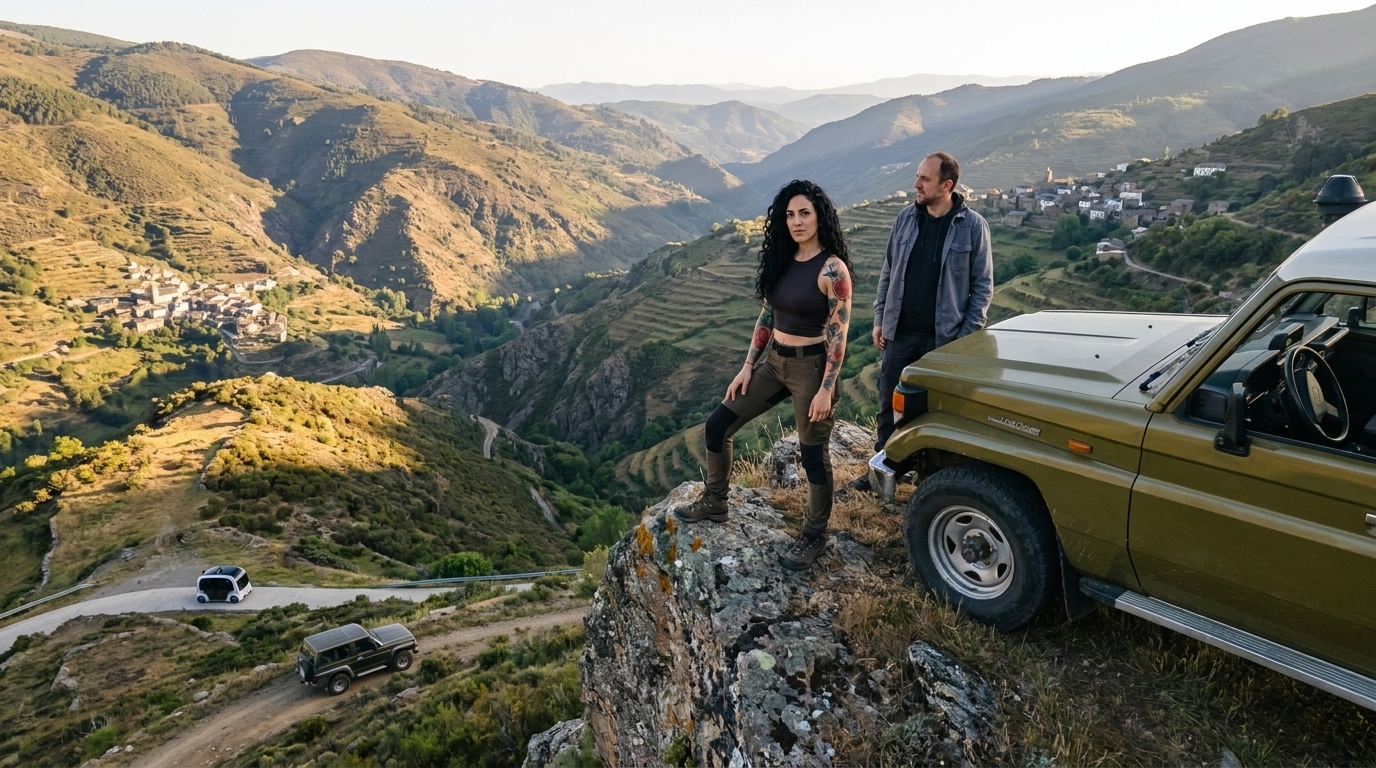
One Sunday in late August, when the heat had pushed everyone toward either church or shade and the cicadas sounded electrical enough to count as local satire, Tomás took her up above the highest terraces before dawn.
They were not hunting. They told themselves this each time they carried the rifle anyway.
From the ridge they could see almost everything that mattered to the alqueria. Roofs of dark pizarra, ravines, olive terraces gone thin, the service road where the fleet cars turned back, the dirt tracks continuing after. The new charging canopy in the square was a pale geometry even from there. So was the church roof. So was the primary school that no longer filled.
“Look,” Tomás said, and pointed toward the lower road.
A white service pod had reached the bend above the river and stopped. It sat there gleaming in the first sun, its system unwilling to proceed. Then, after a pause long enough to become ridiculous from a distance, it turned with insect delicacy and left. Even retreat looked elegant when the paint was clean.
Far below, not five minutes later, a plume of dust rose from another track. Rufino’s nephew in the patched Patrol, heading where the pod had declined to imagine itself.
Vera laughed first and then, unexpectedly, felt tears rise with it.
Tomás glanced at her. “What?”
“Nothing.”
“That is crying.”
“I know what it is.”
He waited.
She wiped her face and looked out at the two roads, the white machine gone, the old diesel continuing. “I just thought,” she said, “that this will all be described one day as inefficiency.”
“Probably.”
“And it isn’t.”
“No.”
“It’s love,” she said, angry now because the word had chosen itself. “Or duty. Or stubbornness. Or fear. Or just people refusing to let each other die according to a schedule written in Barcelona. But it isn’t inefficiency. They call it that because love is not a budget category and duty cannot be sold as a subscription.”
Tomás said nothing. He was wise enough to leave revelations alone while they were still hot.
The sun came up over the folds of Las Hurdes, laying new gold on old stone, on terraces built by hands long gone, on a solar canopy bought by a grant, on drums hidden from inspectors, on a truck that had no place in any clean chart and every place in the life below. Vera stood beside the Land Cruiser with her expensive boots in red dust and her bright sleeve catching the first light, and for the first time since arriving she understood that she had mistaken certain forms of damage for sophistication. She had come wanting a masculine exception, a little private barbarism to season metropolitan life. Instead she had found something far less fashionable and far healthier: people whose desires, duties, tools, and loyalties had not yet been fully separated from one another. She understood then that she could not keep translating this place for other people without choosing whether translation itself was a kind of betrayal. She had come to make the village easier to explain. The village had made her harder to excuse.
Down in the village, bells began for mass. A dog barked. Someone started an engine that should, according to every efficient logic, have been dead years ago.
Tomás opened the passenger door for her.
She looked once more at the road where the pod had turned back and at the dust where the Patrol had gone on.
Then she got in, and the Land Cruiser carried them down toward the village by the older route, the one that still expected something of the people using it.
| Previous | 05 Jul 2026 | Next |


About me
Hello! My name is Stephan Schwab.

I build and rescue software, and I write fiction about the human side of how it gets made. Here you’ll find my stories and novelas, notes on craft, and field notes from a life lived across several worlds.
Working with software teams is what I do professionally — see how on caimito.net. You can also read about my experience since 1986.