Mobilizing Private Savings


The Productive Future
The Directorate had discovered that citizens were saving too much of their own money.
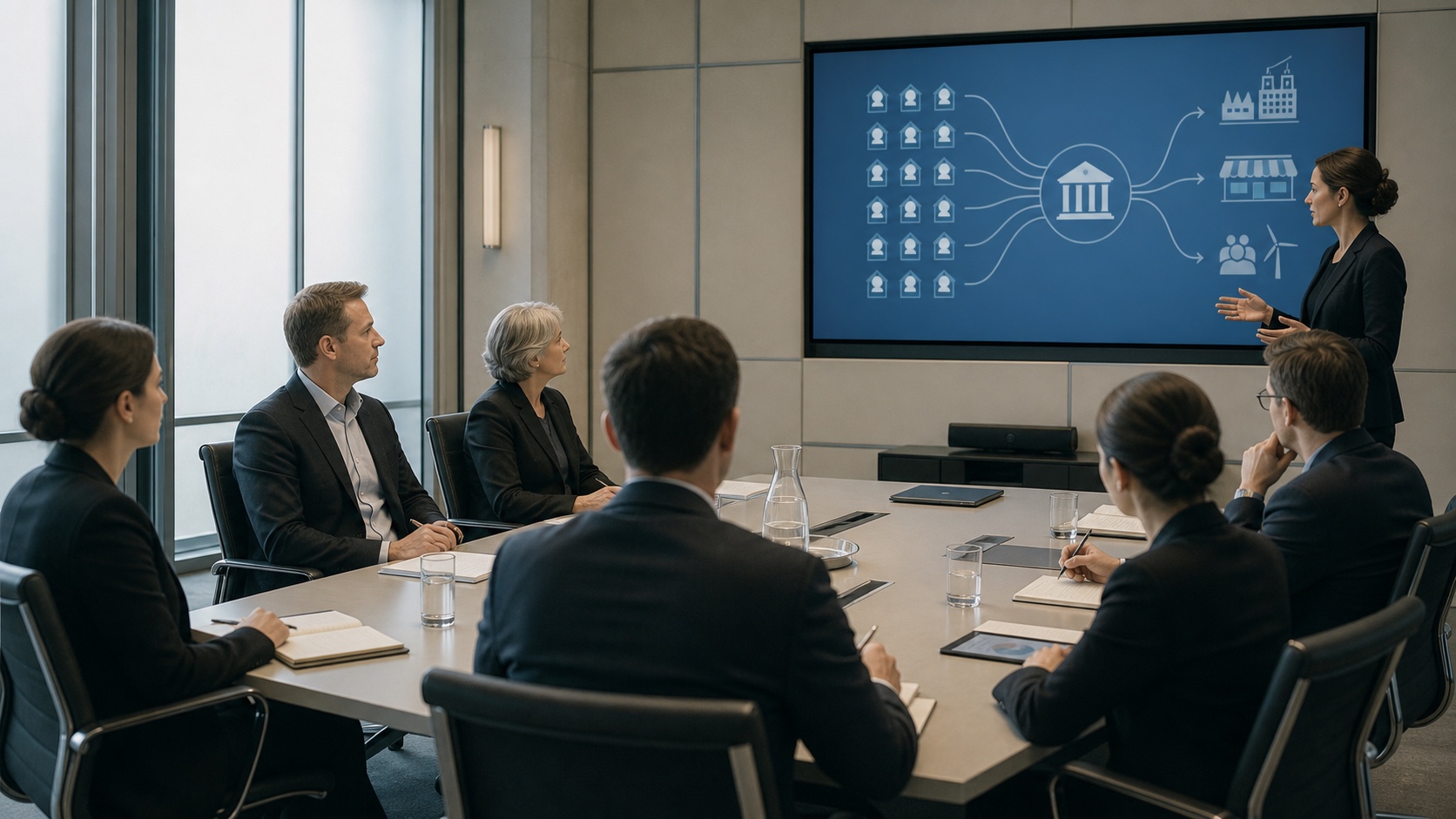
Halden received the announcement at 8:12 on Monday morning. A blue banner crossed both screens on his desk: PRIVATE SAVINGS FOR A PRODUCTIVE FUTURE. Beneath it, the Directorate invited every department to help households transform dormant balances into useful growth.
He liked the word useful. It gave work a moral weight that profitable never carried.
At nine, his unit chief explained the program. Citizens would keep their accounts. The Fund would pool part of their savings, select promising enterprises, protect the public interest through majority ownership, and report measurable benefits to every participating community.
“Young founders need more than money,” she said. “They need structure.”
Halden opened the first two applications after lunch.
Mara’s file came from a warm town near the old continent’s sunlit rim. It contained photographs of an empty commercial hall, equipment quotations, a three-year lease, letters from future members, neighborhood health figures, projected jobs, and a map that placed the nearest competing gym two bus rides away.
The portal surrounded her application with green marks.
Lukas applied from a vast northern city. His file contained a screen recording, links to users on the network, three letters from businesses, and a program that compared purchase orders, invoices, and delivery records until it found money that companies had lost between them.
The portal surrounded his application with amber boxes.
Halden watched the demonstration twice. The software found a duplicate payment in eleven seconds. Then he returned to the assessment page.
Employees: 0.
Certified asset valuation: Not supplied.
Approved premises: Not applicable.
Recognized pilot partner: Pending.
Enterprise maturity: Insufficient evidence.
He did not distrust Lukas. Distrust required a judgment. The portal had not yet produced an object that Halden could judge.
Across the split screen, Mara’s floor plan cast a clean rectangular shadow beneath the proposed equipment. Lukas’s software glowed without weight inside a video window.
Halden created two case folders and assigned both founders an interview.
One of them had a business. The other had brought a laptop.
Everybody Was Already There
Every morning the government warned citizens about the network. By noon it posted the warning on the network.

Mara read that morning’s warning while she stirred coffee in her parents’ kitchen. The Directorate advised citizens to avoid unverified financial claims, extremist material, foreign manipulation, medical misinformation, and people who presented commercial opportunities without licenses.
Her mother leaned across the table. “Did your aunt answer about the paint?”
Mara closed the warning and opened the family group. Night still covered the warmer continent across the ocean, but nine relatives had already debated the color of a gym they had never seen. Her aunt wanted yellow. Her grandfather wanted the green from a football club nobody in Mara’s town followed. Two cousins had turned the empty hall into jokes and added bodies with impossible muscles.
The same screen carried forty-three messages from future members. They wanted early sessions before the buses started, late sessions after restaurant shifts, a safe place for teenage girls, heavy free weights, affordable monthly plans, and no mirrored wall where strangers could film them.
Mara posted a poll about opening hours.
Above it, the government warning collected thousands of replies. A journalist linked to a court notice from the New World. Its new law blocked foreign censorship penalties and allowed the network to claim damages from any institution that punished it for refusing a removal order. The Directorate answered that harmful speech still required firm action. Someone asked when the Directorate would issue the fine it had announced last month. Nobody answered.
Mara scrolled past politicians condemning the network, restaurants advertising lunch on it, police requesting witnesses, parents sharing lost pets, a preacher predicting a flood, a famous singer announcing an ocean cruise, and a man in a rainy city demonstrating software she did not understand.
Her father entered wearing his delivery jacket. He examined the poll.
“Six in the morning?” he said. “People voted for that?”
“Thirty-two already.”
He smiled as if thirty-two strangers had signed a witness statement.
Mara saved the results for her Fund interview. She needed the network to prove that real customers existed. The Directorate needed the network to explain why nobody should trust it.
Nobody trusted the network enough to leave it.
Code Casts None
The assessor watched three businesses use the software and asked when Lukas planned to begin the pilot.

Lukas sat at the only table in his apartment while rain drew bright tracks down the window. Behind him, commuter trains crossed the dark water every four minutes. On his laptop, Halden occupied one half of the screen and three live customer accounts occupied the other.
The warehouse uploaded delivery records every afternoon. A restaurant group reconciled supplier invoices each Monday. A small factory scanned handwritten receiving notes after every shift. None of them waited for a demonstration. Their staff had already built the software into ordinary work.
“Watch the warehouse account,” Lukas said.
The program paired six months of purchase orders with invoices and delivery confirmations. It rejected harmless differences, marked a shipment that had never arrived, and found a second payment hidden beneath another reference number.
A message appeared from the warehouse manager: Recovered 11,400. Running the current month now.
Halden nodded and looked toward his second monitor.
“When would an approved pilot begin?”
“You just watched it.”
“I watched a user operate the product. A pilot partner accepts supervision, reporting duties, and outcome verification.”
“They recovered real money.”
“That demonstrates usefulness.”
Halden asked which approved formation pathway could carry the project. The local-enterprise pathway expected premises, supplier quotations, projected jobs, and community outcomes. The industrial-innovation pathway expected certified intellectual property and laboratory review. The digital-adoption pathway expected an approved lead buyer inside one strategic sector. Lukas had active users across three sectors and fit none of them.
Then Halden asked who had certified the code’s value, where the Fund could register its interest, and which approved body would supervise the businesses that already used it.
Lukas opened the customer list. The three businesses had processed 28,000 documents that month. Their messages requested fixes, features, invoices, and contracts.
Halden opened the assessment fields. No approved formation pathway. No certifiable asset value. No supervised pilot. No strategic category.
He did not doubt the software. Doubt would have required him to evaluate what Lukas had built. His task required him to evaluate whether the Fund could invest in what surrounded it.
“The demonstration impressed me,” Halden said. “I will take the application to the committee.”
After the call, the factory uploaded another shift. Lukas’s screen marked three discrepancies for review. Halden’s portal marked the category field empty.
The Decision
Halden approved the gym’s minimum return and rejected software that might grow thirtyfold before lunch.
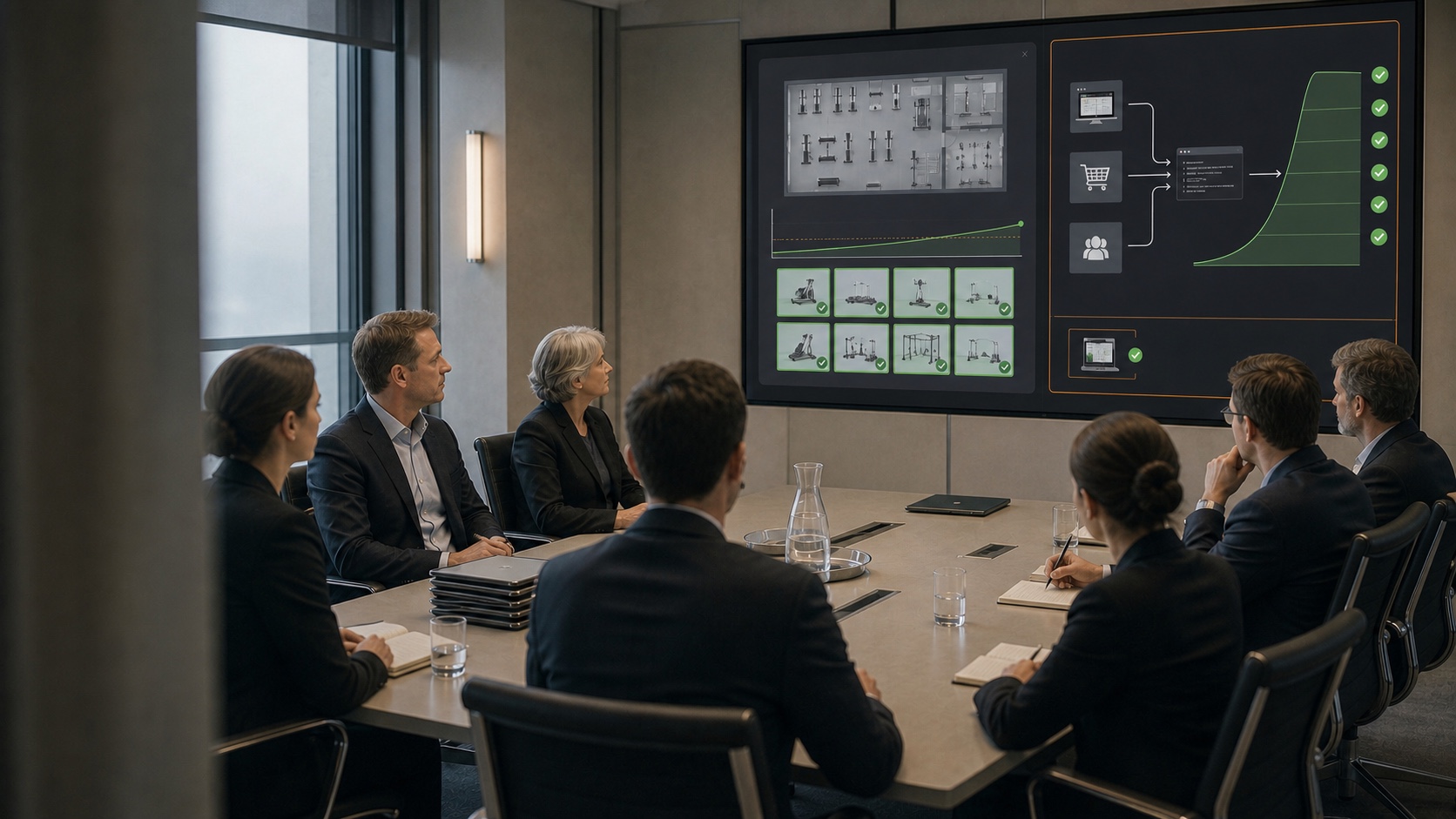
Neither applicant had formed a company. The Fund would create one only after approval. The committee needed to decide what it understood well enough to own.
Mara’s recorded interview came first.
“A room, racks, showers, trainers, memberships,” she said. “People already ask when we open.”
That was enough. Regional development priced the empty premises. Procurement priced the equipment. Employment counted five jobs. Public health converted members into activity outcomes. Investment safety calculated what the Fund could recover by selling the machines.
The model predicted a return of 4.2 percent. The mandate required four.
Each familiar noun opened another box in the committee portal. Property. Procurement. Employment. Accessibility. Energy. Health. Communications. Governance. Beside each box, the portal inserted a fee from the approved-provider schedule.
Eight green marks appeared under PROFESSIONAL CAPACITY. Another indicator counted eight local service contracts. The gym would pay every fee from operating revenue.
“Does the return include them?” Halden asked.
Investment safety clicked REQUIRED COSTS. “They protect the return.”
Then the committee watched Lukas recover money for three businesses.
His software needed no building, machines, inventory, or local supply chain. A fourth customer added almost no cost. The forecast ranged from total loss to thirty times the investment.
To choose a point inside that range, someone needed to understand the code, security, customer workflows, competitors, and how quickly the product could scale. The digital specialist managed policy programs. He did not build software. The risk model counted the physical recovery value as zero and ignored upside beyond the Fund’s target return.
The digital specialist opened Lukas’s budget. It funded engineering, security, and sales. She added one technical audit, then searched for recurring capacity support.
“Who provides independent oversight?” she asked.
“The customers test every release,” Halden said.
She tried governance, procurement, communications, and employment support. None gave the software a value or a category. She removed them one by one. The professional-capacity column returned to a single green mark. The local-services indicator returned to one.
Halden chose the return he could defend. He approved a protective 51 percent Fund share and eight mandatory advisers for Mara. He invited Lukas to return with certification, a supervised pilot, and sponsorship from a strategic sector.
He believed both decisions protected the citizens whose savings he invested.
The gym promised 4.2 percent, eight advisory contracts, and machines the Fund could sell. The software offered a path to thirty times and required someone to understand it.
A Gym Casts a Shadow
Mara showed her parents where she would put her name. The Fund’s contract showed who could take it down.
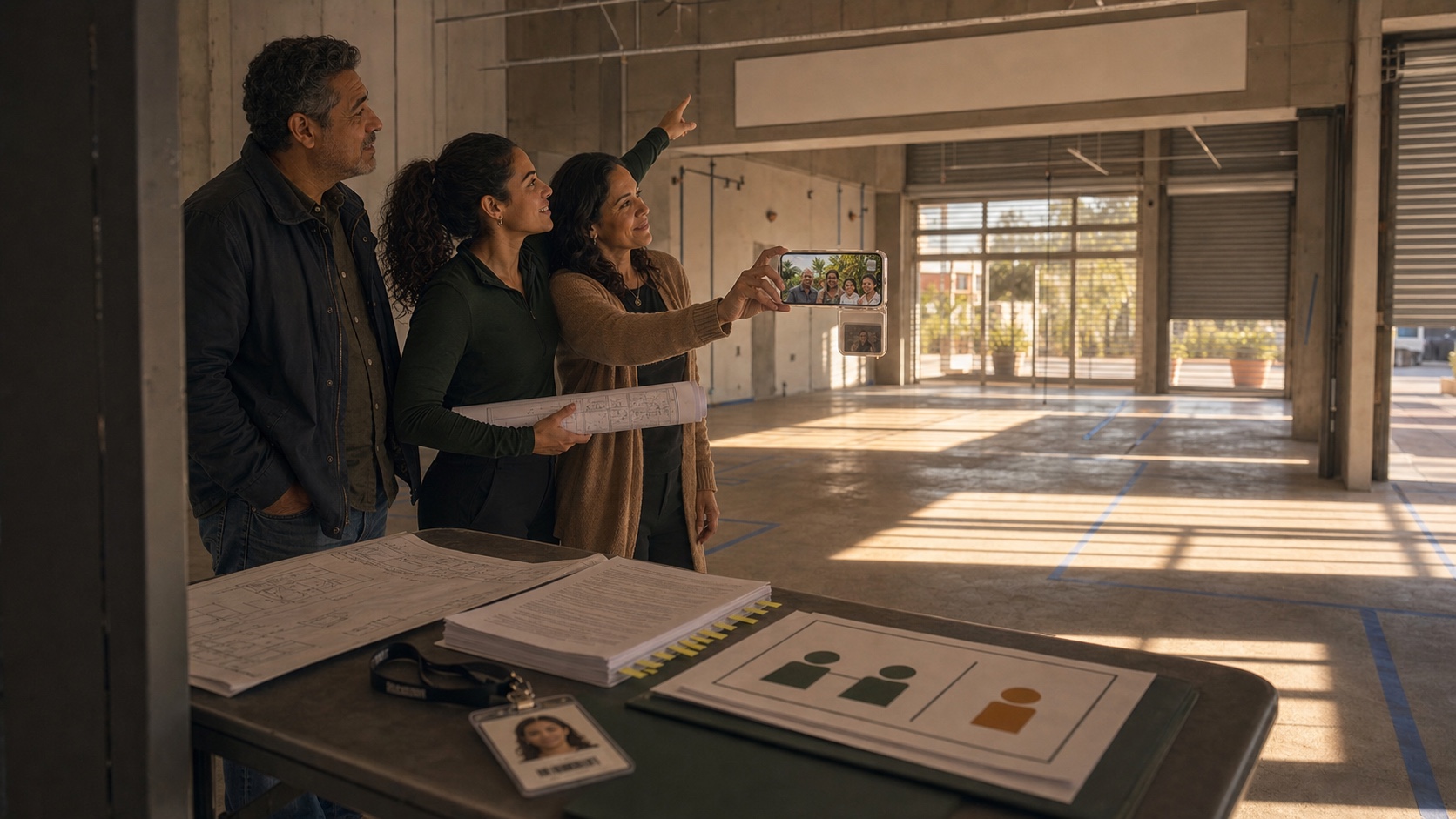
Late sun entered the empty hall through dusty metal shutters. Mara taped blue rectangles onto the concrete where the squat racks would stand. Her father paced out the changing rooms. Her mother photographed the blank wall above the entrance for the family group.
Faces appeared on the phone from across the ocean. An uncle offered to paint the hall and ignored the distance. An aunt argued for yellow walls. Mara’s grandfather asked her to turn the camera slowly, then fell silent.
“Your name goes there?” he asked.
Mara pointed above her mother. “Right there.”
Her parents had crossed the ocean before Mara could remember it. They cleaned rooms, delivered parcels, washed dishes, and learned the names of supervisors who never learned theirs. Now their daughter would put the family name over her own door.
After the call, Mara opened the contract on a folding table. The Fund’s lawyer had marked twelve places with yellow tabs.
The Fund would supply the lease deposit, renovation, showers, flooring, insurance, and equipment. In return, it would own 51 percent of the company. Mara would own 49.
A diagram gave the Fund two of the three board seats. Mara received the third. The new company would sign the lease, buy the machines, own the brand, hold the membership list, and employ Mara as managing director at the legal minimum wage. The board would approve the annual budget, equipment purchases, prices, hiring plan, public communications, and any change to the name.
Her father tapped the two Fund seats.
“If they want one thing and you want another?”
“Two votes win.”
“Can they fire you?”
Mara found the termination clause. “The board can replace the managing director.”
Her mother looked up at the blank space above the entrance. “I thought this was the place where nobody could fire you.”
“They make it possible,” Mara said.
Her mother nodded. “I know.”
The Fund officer joined them by phone. He spoke carefully. The majority share protected the citizens whose savings paid for the project. If the gym failed, the company could sell the machines. The board would protect Mara from expensive mistakes. Mara would lead daily operations and share in every success.
“We want this to remain your story,” he said.
Nothing he said sounded false.
The bank had rejected Mara twice because she owned no property. The landlord would hold the hall until six. Thirty-seven future members had already asked when they could pay deposits. Mara knew which weights they wanted, which trainers they trusted, and which buses reached the door before work.
At 5:52, she signed every yellow tab.
Her name would go above the entrance. Two people she had never met would decide whether it stayed there.
The Empty Ship
The inspectors found everything required to finance a company except an investor.

The party ship entered the northern port three days before departure. Halden boarded at sunrise with customs officers, maritime inspectors, two financial investigators, and a communications technician who carried three locked cases.
The authorities knew the rumors. New World investors financed the voyage to find founders whom they could not legally approach on the old continent. If anyone offered unlicensed investment services during the crossing, the investigators intended to stop them before the first passenger arrived.
They started below the waterline.
Engineers opened machinery spaces. Officers searched crew lockers, cold-storage rooms, linen cages, kitchens, medical cabinets, stage rigging, and the narrow corridors behind the theater. Dogs inspected luggage stores. Technicians copied the crew network map.
Nothing suggested finance.
The upper decks offered more promising evidence. One floor contained rows of desks, whiteboards, soundproof booths, and conference rooms with wall-sized screens. Every table supplied power. A satellite system promised enough bandwidth for hundreds of simultaneous video calls in mid-ocean.
“A party needs this?” an investigator asked.
The ship’s operations manager smiled. “People work remotely. We sell three weeks, not three lost weeks.”
The investigators opened every cabinet. They found cables, markers, cleaning cloths, spare keyboards, and instruction cards for video calls. They found no prospectus, contract, client list, investor, broker, fund representative, or schedule of financial meetings.
In the largest conference room, the chief inspector pointed at the blank video wall.
“Does the equipment constitute a service?” he asked Halden.
Halden opened the Directorate guidance. A financial service required an offer, a provider, a regulated activity, and a recipient. The ship provided rooms and communications. The screens might carry any person and any conversation after departure.
“The room cannot offer anything,” Halden said.
The chief inspector nodded. “Then we certify the room.”
By late afternoon, the team had searched the ship from keel to satellite mast. Halden signed the financial section of the report. The form listed every inspected space and every absent provider.
He had found every tool and no recognized role that turned the tools into a service.
Passengers with Laptops
The officer waved an inflatable flamingo through customs. Then Lukas placed his laptop in a gray tray.
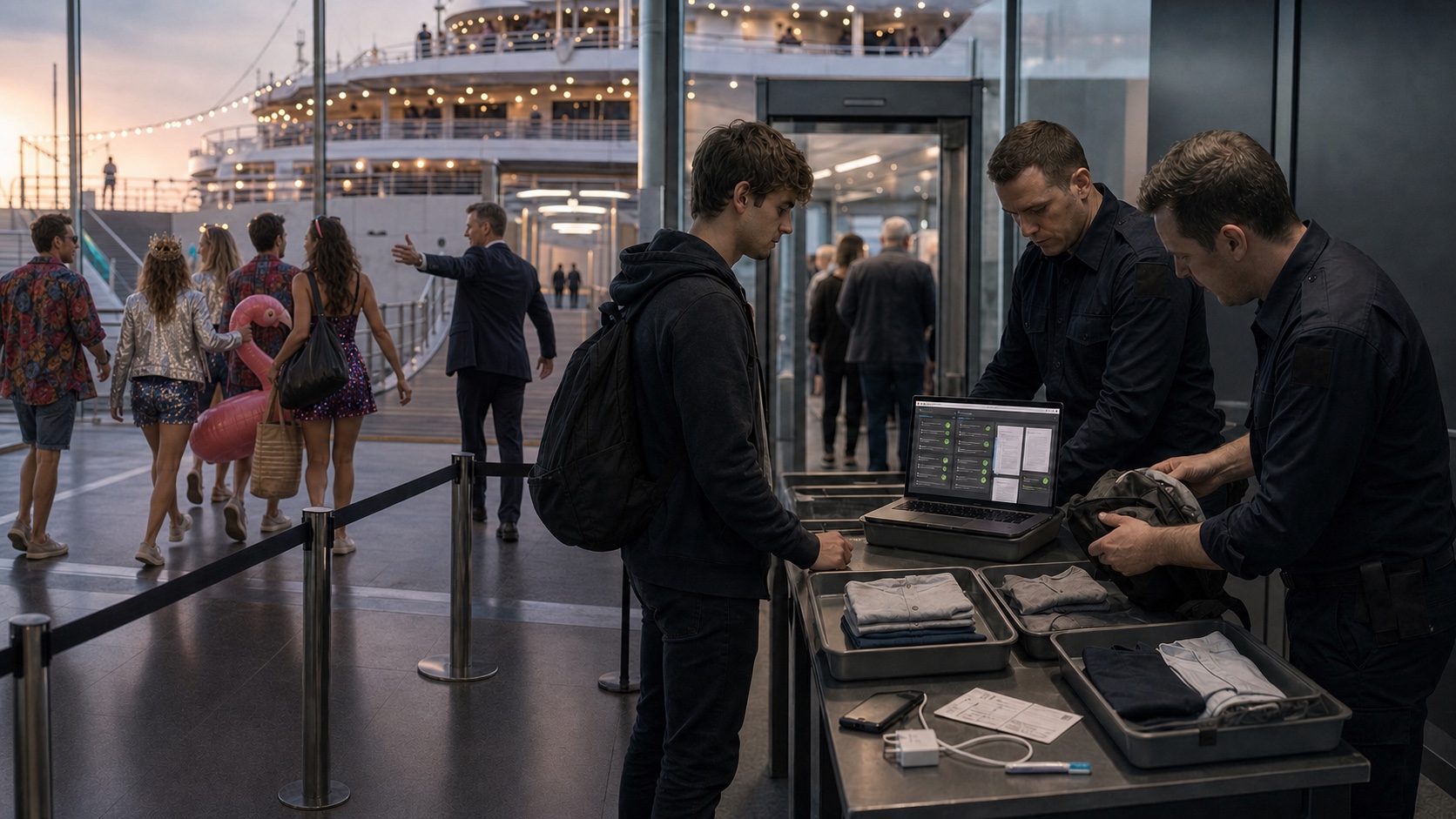
The flamingo belonged to six friends in silver jackets. One carried three bottles. Another wore swimming goggles on his forehead. The officer counted the bottles, made a joke about the weather, and pointed them toward the gangway.
Music drifted through the glass from the ship.
Lukas stepped forward alone.
“Purpose of travel?”
“Holiday.”
The officer looked at the laptop. “For three weeks?”
“That is the cruise.”
“Open the bag.”
Lukas placed four shirts, a charger, an adapter, a toothbrush, and a paperback beside the tray. The laptop remained open on his software dashboard. Three customer accounts showed the morning’s completed work in green.
The officer leaned closer. “You work during holidays?”
“It runs every day.”
“What does it do?”
“It compares delivery documents. It finds discrepancies before companies pay the wrong amount.”
“It handles payments?”
“No.”
“Financial records?”
“Delivery records.”
The officer called a colleague. Party passengers flowed around the inspection desk in bright shirts and sequins. A woman removed a plastic crown so it would fit beneath the metal detector. Her friends applauded when she put it back on.
On Lukas’s phone, the post that had sold him the ticket still showed the ship at sunset: live music, pools, an included flight home, and a desk facing the ocean. Beneath it, strangers had written an accelerator that moves, a loophole with cabins, and the most expensive hangover in the New World.
The inside cabin had cost less than another supervised pilot application.
The second officer checked Lukas’s single ticket and the empty address field after arrival.
“Who paid for your voyage?”
“I did.”
“Who will you meet aboard?”
“I don’t know anyone.”
“Has anyone offered you money?”
“No.”
“Work?”
“No.”
“Shares in a company?”
“I don’t have a company.”
“Where will you sleep after arrival?”
“The cruise transfers us to the airport.”
“Will you take the flight home?”
Lukas looked through the glass at the ship. “Yes.”
The first officer turned his screen toward him. A notice listed unlicensed investment, brokerage, incorporation, and financial advice at sea.
“People hear promises on these trips,” he said. “Some lose everything. Read it carefully.”
Lukas read every line.
“This protects you,” the officer said.
Lukas pressed I UNDERSTAND.
The officer pushed the tray back. “Enjoy your holiday.”
Lukas closed the laptop on three businesses waiting for tomorrow morning’s results.
Fifty-One Percent of Help
The Fund made Mara independent by purchasing control of her company.

Her employment adviser delivered the good news during the first construction meeting. The gym would employ Mara as managing director at the legal minimum wage. The arrangement guaranteed full social protection from the first day, including health coverage, pension contributions, unemployment insurance, and paid leave.
“Leave from whom?” Mara asked.
The adviser smiled. “From the company.”
The company already had eight advisers.
The governance adviser scheduled the oversight committee. The public-health adviser designed measurable outcomes. The accessibility adviser widened a doorway. The procurement adviser replaced Mara’s equipment list with certified suppliers. The employment adviser drafted contracts. The energy adviser ordered a consumption assessment. The communications adviser prepared the opening campaign. The citizens’ representative protected the savers who owned the Fund.
Every adviser listened. Every adviser found something real.
The accessibility adviser noticed that one shower would exclude a wheelchair user. The energy adviser showed how poor ventilation could double summer cooling costs. The employment adviser caught a clause that might deny trainers proper overtime. Mara thanked each of them and meant it.
Then the invoices arrived.
The Fund paid for bricks, flooring, machines, and startup capital. The gym paid the advisers from operating revenue. Their contracts renewed automatically while the Fund held its shares. Each renewal added another green mark to the Fund’s capacity-support report.
During the fourth meeting, the communications adviser asked Mara where her parents came from.
Mara described the warmer continent across the ocean, her mother’s first hotel job, her father’s delivery routes, and the money they sent home when they could barely cover rent. She explained why the blank wall above the entrance mattered.
The adviser wrote quickly.
“A powerful inclusion story,” she said. “New roots, stronger communities.”
“They did not come here to become a story.”
“Of course not. That makes it authentic.”
The adviser confirmed the dates, improved several phrases, and scheduled a photographer. She acted with care. She wanted the public to see what its savings could accomplish.
Mara looked around the unfinished gym. Eight competent people now knew how to protect her workers, customers, Fund, building, public image, and family history.
Before hiring her first trainer, she had acquired eight managers.
A Profitable Enterprise
The gym made a profit. Its founder still checked the price of lunch.
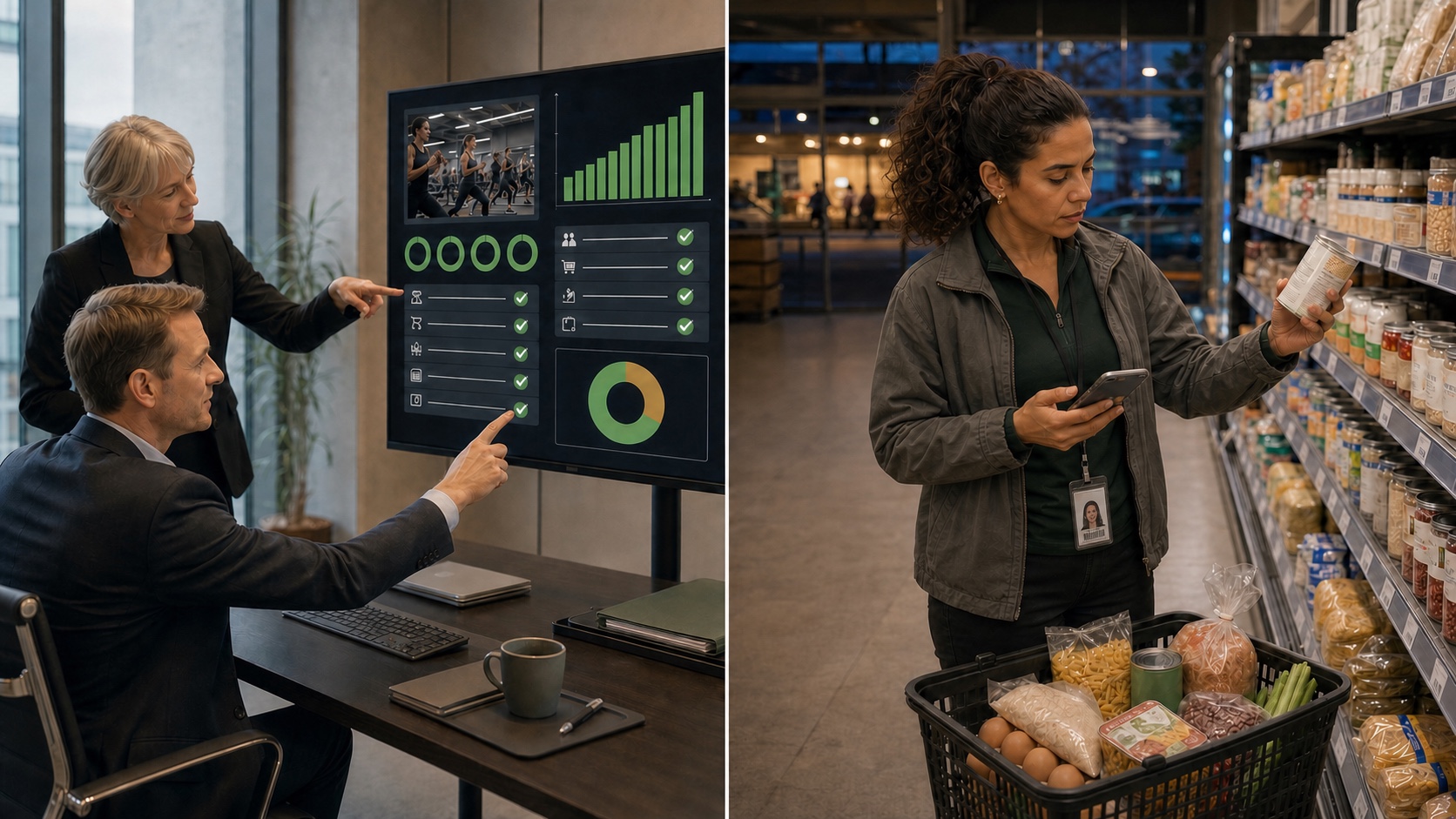
Halden opened the first quarterly report at his desk. Green rings filled as the data loaded: jobs created, members enrolled, activity hours completed, women participating, young people served, household savings mobilized, and projected return on public capital.
The gym exceeded every target.
Photographs showed Mara teaching a deadlift, greeting an older member, and smiling beneath a plaque that credited the Fund. The floor shone. Afternoon light crossed rows of approved machines. The town had turned an empty hall into measurable health.
Every image confirmed a category that his committee had selected months earlier.
Halden felt the quiet satisfaction of a decision that survived contact with reality.
He opened the financial page. Membership revenue covered rent, utilities, payroll, cleaning, insurance, maintenance, and equipment financing. The gym then paid its governance, public-health, accessibility, procurement, employment, energy, communications, and citizen-representation advisers.
The remaining amount formed distributable profit.
The Fund received 51 percent. Mara received 49 percent.
A note explained that the managing director also drew a protected minimum salary. Another note praised management for keeping staffing costs within the approved range.
Halden clicked the adviser total. The dashboard grouped all eight contracts under SAFEGUARDING AND CAPACITY SUPPORT. It did not compare their individual invoices with Mara’s salary. It did not add her dividend to her wages or ask how many nights she worked after closing.
Those questions belonged to household income, not enterprise performance.
His unit chief stopped beside the desk.
“The gym?”
“Profitable in the first quarter.”
“Excellent. We need one strong example for the savings campaign.”
Halden showed her the photographs. She chose the one with Mara at the center and the Fund plaque clearly visible behind her shoulder.
“That is what productive investment looks like,” she said.
Halden approved the success classification. The Fund had protected public money, created work, improved health, revived a vacant property, supported a young woman, and produced a return. Every monitored outcome had moved in the intended direction.
The dashboard showed the founder in every photograph and nowhere in the distribution.
The Evening Show
The pop star introduced the scouts without using a single word the inspectors could quote.

For the first day, nothing unusual happened. Passengers filled the pools, bars, restaurants, and dance floors while the old continent remained visible behind the ship. Lukas answered two customer messages from his cabin and kept the laptop in his bag.
The coast disappeared during the second afternoon.
At sunset, the captain announced international waters. The ship answered with music from every deck. Hundreds of passengers entered the theater for the evening show, and hundreds more held phones above their heads before the famous singer reached the stage.
After the third song, the lights widened.
“We brought some remarkable young people with us,” the singer said. “They love ideas, they love builders, and they want to meet every entrepreneurial spirit aboard.”
Twelve guests walked into the light. They wore party clothes, not suits. The singer named only their first names. Nobody called them scouts, brokers, advisers, representatives, or agents. Nobody mentioned a fund, investment, company, contract, or financial service.
The audience understood anyway.
Clips reached the network before the next song. Passengers tagged friends, joked about pitch decks beside the pool, and posted cabin numbers beneath demonstrations. The Directorate’s inspection report appeared in screenshots: no unlicensed provider found.
Then the bass returned, silver paper fell from the ceiling, and the real party consumed the ship.
Lukas met one of the twelve near a crowded bar after midnight. She introduced herself as Sena and asked what he built.
He started with the sentence from his Fund application. “A cross-sector reconciliation platform for small and medium enterprises—”
“No,” Sena said. “What does it do?”
“It finds where a company paid for something that never arrived, or paid twice, or received something nobody invoiced.”
“Does it work?”
“Yes.”
“Show me.”
He glanced at the dancers pressing around them.
Sena laughed. “Tomorrow. Sober. Ten in the coworking room.”
She moved toward another passenger before Lukas could ask whom she represented.
By morning, everyone who needed to know had understood an announcement nobody had made.
Her Own Voice, Revised
Before the investment, Mara had followers. After it, she had a communications strategy.

She had built her audience with short videos from parks, borrowed training rooms, and her parents’ tiled courtyard. She answered questions in the language people used. She showed mistakes, laughed when a resistance band snapped, and admitted when she needed to look something up.
The Fund admired that authenticity and assigned an adviser to protect it.
The adviser renamed Mara’s simple strength gym the Community Wellness and Productive Longevity Center. The procurement adviser replaced the squat racks she wanted with a certified modular system. The public-health adviser added low-impact group sessions. The reporting framework required opening hours that served three target populations.
None of the changes ruined the gym. Members still came. Many liked the new classes. The certified racks held weight as reliably as the cheaper ones Mara had chosen.
Each change simply moved the gym one step farther from the room she had described to her parents.
For the opening campaign, the Fund produced a video about her family. An actor read her mother’s first winter as a story of resilience. Her father’s night deliveries became a journey toward opportunity. The narrator said Mara had transformed sacrifice into community health through the power of mobilized savings.
Her parents watched the preview at the kitchen table.
“Those things happened,” her mother said.
“Not like that,” her father said.
Mara recorded her own message for the members who had followed her before the Fund arrived.
“You asked for a place to train before work, after the restaurant closes, and without strangers filming you. We built it.”
The communications adviser listened with genuine warmth.
“Beautiful,” she said. “Could you say the approved name? And mention productive longevity. We also need ‘our family chose this town as its new beginning.’”
“My parents chose the first place where someone hired them.”
“That may sound negative.”
Mara recorded the message again. She pronounced every approved phrase clearly. The adviser posted it from Mara’s account, where it reached twice as many people as her old videos.
Her name grew larger on the sign and smaller in every decision.
The Event That Never Happened
Millions watched the prohibited introduction, but Halden could not find anyone who had made it.

The Directorate’s monitoring team assembled the ship’s evening show from 614 public recordings. One angle showed the singer. Another showed the twelve guests. Hundreds showed raised phones, falling silver paper, and passengers cheering at words that named no regulated activity.
Halden froze each version at the introduction.
He searched for an offer, provider, price, fund, security, promised return, or invitation to invest. The singer said young people, ideas, builders, and entrepreneurial spirits. The guests displayed no company names. The ship sold entertainment, rooms, food, and communications.
“Everyone knows what happened,” an investigator said.
“What happened?” Halden asked.
The investigator opened his mouth, then looked at the evidence fields.
Legal affairs joined the meeting. The old continent could still investigate the network, demand reports, and issue preliminary findings. The New World’s speech law now blocked enforcement of censorship penalties and allowed the network to seek damages in its own courts. The Directorate had stopped announcing fines. It had not stopped protecting citizens.
The team drafted a warning instead.
Halden wrote that unlicensed people might approach passengers with investment, incorporation, brokerage, or advisory offers during the voyage. He urged travelers to verify credentials, reject pressure, protect confidential information, and report suspicious contact.
The Directorate posted the warning on the network.
Within minutes, passengers shared it beside clips from the show. Some mocked it. Others thanked the Directorate and asked how to verify an investor. Several founders who had not understood the singer’s introduction now asked where the coworking rooms were.
The warning gave the unnamed event an official outline.
Halden watched the reach counter rise. The warning had reached the right audience quickly. It had also supplied a vocabulary, a location, and a list of services to anyone who had missed the signal.
He completed the incident record. Under IDENTIFIED PROVIDER, he selected NONE. Under DOCUMENTED OFFER, he selected NONE. Under PUBLIC EXPOSURE, he selected HIGH.
The Directorate had warned everyone about an event its evidence said had never occurred.
The Room with No Investors
The investment meeting contained no investor aboard the ship.

Sena met Lukas outside a soundproof conference room at ten the next morning. She carried coffee and no folder. Inside, a wall-sized screen faced a table bolted to the deck. The ocean moved through a narrow window beside it.
“Who do you work for?” Lukas asked.
“Today? Nobody in that room,” she said. “I make introductions.”
The screen lit up.
Six people appeared from the New World: two investors, an operator from a restaurant group, a warehouse owner, a software founder, and a lawyer who said he would remain silent unless someone created a legal problem. Their morning sunlight entered from the opposite side of the world.
Nobody offered Lukas money.
The warehouse owner sent him a file instead. It contained purchase orders, invoices, delivery records, handwritten receiving notes, and deliberate errors that his staff had planted. Lukas loaded it into the software.
The program found two duplicate invoices and one missing shipment. It missed a quantity change that someone had written in blue ink at the bottom of a page.
“Why?” the owner asked.
“The handwriting model read seven as one.”
“Can you fix it?”
“Yes.”
“When?”
Lukas looked at the file structure. “Give me an hour.”
The investors asked about pricing, ownership, competitors, data security, and what would happen if a large accounting company copied the feature. Their questions cut harder than the Directorate’s questions. The forms had asked whether an approved expert had valued the software. These people asked how quickly a customer would cancel.
Lukas did not know every answer. He said so.
The warehouse owner leaned back. “Fix the handwriting and run our current month. If it works, I will pay for the trial.”
The lawyer finally spoke. He named a price. The owner agreed. Lukas opened his banking application and watched the trial payment arrive before the call ended.
Sena had introduced people. The ship had supplied a room and a connection. Every investor remained an ocean away.
His first customer paid before the Directorate would have considered his application complete.
The Waitress Went Home
Mara’s former restaurant colleague arrived ten minutes before closing. Her black apron wrapped her waist, and she carried the smell of coffee, grilled fish, and lemon cleaner into the gym.

She placed her phone on the reception desk. A white house stood above a strip of blue water. Six names filled the message beneath it.
“I found it,” she said. “Two nights. Ninety-six each if we book before midnight.”
“For Lina’s birthday?”
“All of us. Like before.”
Mara enlarged the terrace, the long table, the cheap plastic chairs facing the sea.
“Put me down as maybe.”
“No maybes. You missed last year.” Her friend counted on her fingers. “We leave after you close on Friday. I drive. We come back Sunday evening. You lose nothing.”
Behind them, a member dropped a barbell. The impact traveled through the floor.
“I don’t have ninety-six,” Mara said.
Her friend looked from Mara to the full training floor and back again.
“I can cover you until payday.”
“Payday came yesterday.”
Mara led her into the office and laid her phone beside the keyboard. Her friend bent over the payslip.
“Managing director,” she read. Her finger moved to the number. “That’s the minimum.”
“The employment adviser says it protects me.”
“From what?”
Mara opened the last quarterly statement.
Her friend studied the transfer. “That covers three months?”
Mara nodded.
“I carried almost that home during festival week.”
An email arrived. Eight people had replied to the same thread. The employment adviser wanted one correction. The facilities adviser wanted two. The communications adviser had replaced Mara’s first paragraph. The governance adviser had attached a new template.
Her friend scrolled through the names. “Do they all work for you?”
“They advise the gym.”
“Who pays them?”
Mara opened the monthly accounts. Her friend read the invoices one by one, then glanced through the glass at forty people lifting, running, and stretching beneath the bright lights.
“Can you stop paying one of them?”
“Not alone.”
Her friend untied the apron and folded it over her arm.
“We could book one night. Fifty-four.”
Mara checked her balance.
“Dinner, then. Lina would want you there.”
“I close at nine.”
“We’ll wait.”
Mara turned the monitor toward her. The report now contained thirty-two empty fields. The adviser expected it at eight the next morning.
Her friend took the phone from the desk. “I’ll tell her you tried.”
At eleven forty, the group chat lit up. One friend claimed the room with the balcony. Another circled the twin beds. Lina chose the sofa so nobody else had to.
Mara turned her phone facedown and entered her working hours in the founder-autonomy report.
The Seed Round at Sea
Lukas closed the seed round without shaking an investor’s hand.
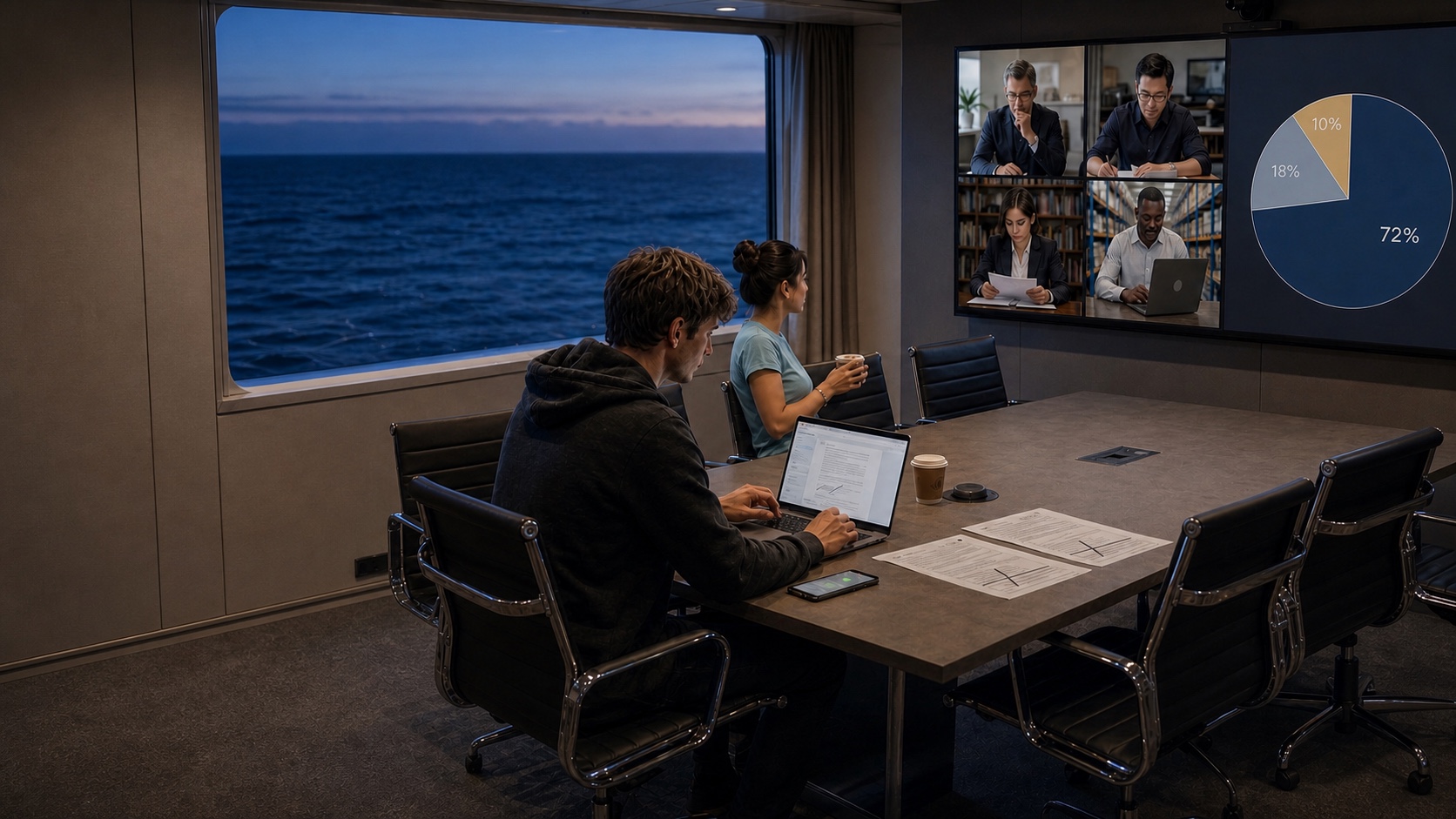
The warehouse trial found enough errors in three days to pay for a year of the proposed subscription. The restaurant operator supplied another dataset. Lukas fixed the handwriting model between breakfast and the first afternoon concert, slept through most mornings, and took calls while party music vibrated through the conference-room walls.
Sena arranged the meetings. She never negotiated for either side.
The investors did not behave like rescuers. They challenged Lukas’s price, reduced his valuation, demanded information rights, required security reviews, and reserved the right to invest in the next round. One wanted a board seat. Lukas refused. Another wanted exclusivity for a market he had never entered. He refused that too.
They argued about the product because they expected the product to make money.
A lawyer appeared on the video wall and created the company in the New World. The seed investors took 18 percent. The company reserved 10 percent for future employees. Lukas kept 72 percent and control of the board.
He signed from the ship with the ocean moving behind his reflection.
The money reached the new company account on the sixteenth day. It did not arrive alone. One investor introduced him to a logistics group. The software founder introduced him to a security specialist. The restaurant operator sent a list of five companies that suffered the same reconciliation problem.
Each conversation produced work.
The ship remained a party. Most passengers never opened a laptop. They slept beside pools, danced until sunrise, lost sunglasses, fell in love for four days, and argued about who had promised to call after the included flight home.
The investors never boarded. They watched demonstrations from offices and kitchens across the ocean. They risked their own money through contracts that the ship neither offered nor signed.
On the final evening, Lukas stood on deck with Sena while the New World’s lights brightened beyond the horizon.
“What happens when we dock?” he asked.
“Most people go to the airport,” she said. “You have another appointment.”
Lukas looked at the incorporation certificate on his phone. The Directorate had invited him to return after an approved sector learned how to classify what three businesses already used.
The software had become a funded company without entering a single approved category.
Temporary Immigrant
Lukas’s first legal status in the New World did not say founder. It said temporary immigrant.
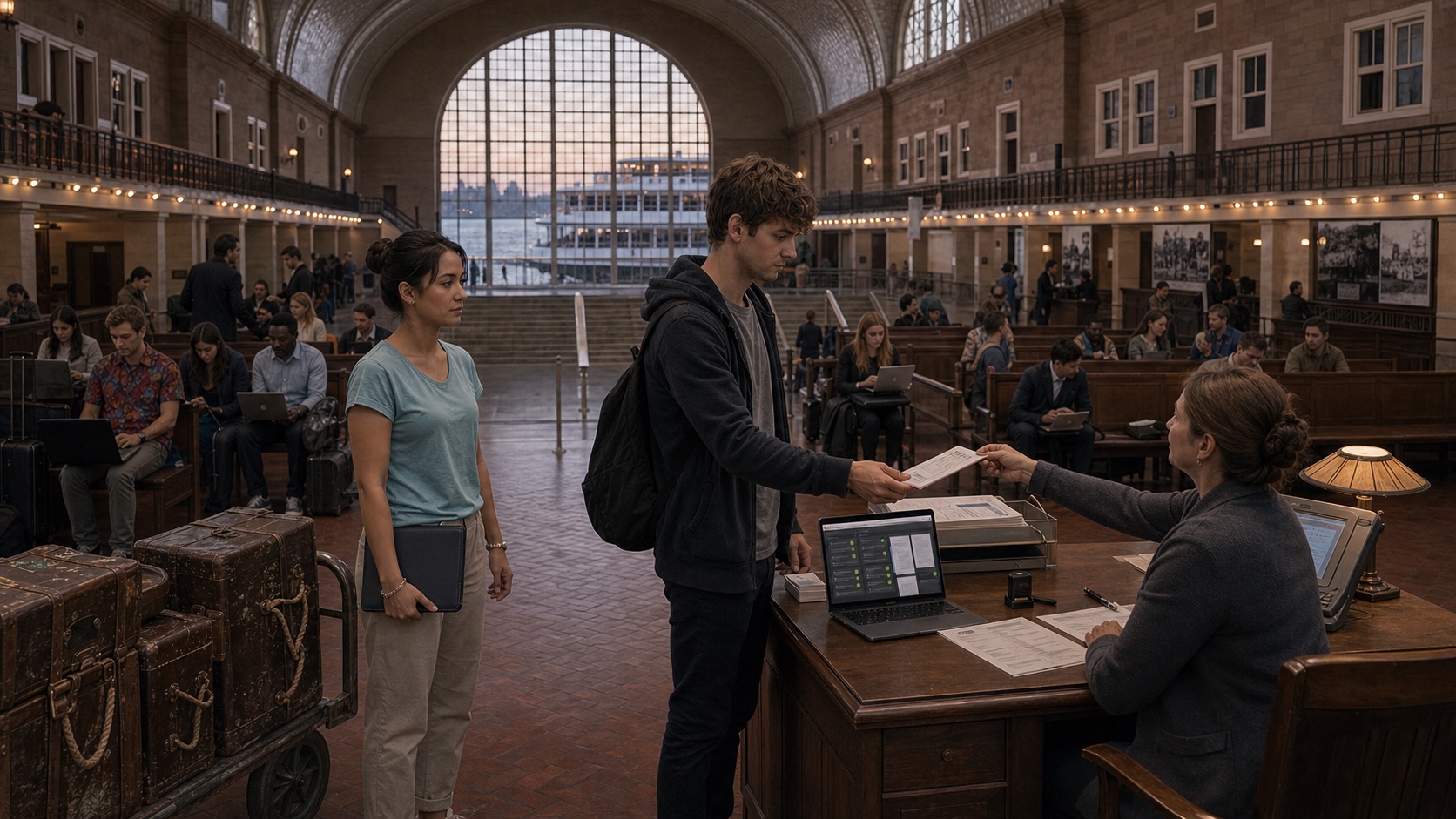
The ship entered a broad harbor before sunrise. A low island broke the dark water ahead. Red-brick wings stretched from a limestone entrance, and four square towers lifted green copper domes above the roof. Enormous arched windows caught the first light. A city rose behind them through layers of glass, brick, bridges, and morning haze.
The ship turned once and settled against the island pier.
Partygoers crowded the rails in yesterday’s clothes. They filmed the skyline, traded accounts on the network, and searched their bags for sunglasses. Crew members rolled their suitcases toward the main gangway and pointed them to the airport coaches.
Sena waited beside a narrower gate and counted fourteen passengers.
Each carried a laptop. Some also carried incorporation papers, customer commitments, or letters from investors. One woman hugged a prototype against her chest. A man in a flowered shirt held a signed contract inside a clear plastic sleeve.
They entered beneath an iron canopy.
The first room had once swallowed the baggage of entire families. Brass rails divided the red-tiled floor. Old trunks stood behind glass along one wall: cracked leather, rope handles, dented corners, initials worn smooth. The founders’ suitcase wheels rattled past them.
Thirty-six stone steps climbed to the second floor. Countless shoes had hollowed the center of each tread. Lukas felt every dip beneath his soles.
The stairs opened into a hall large enough to hold the noise of an ocean crossing. A pale tiled vault curved high overhead. Balconies ran along both sides. Dawn poured through arched windows taller than the houses of Lukas’s childhood. Rows of dark wooden benches faced a line of inspection desks.
Black-and-white faces covered one wall. Families held bundles, coats, babies, and paper tags. None smiled for the camera.
The fourteen founders sat among the empty benches. Officers called them forward one at a time.
Sena placed Lukas’s documents on the desk: company registration, seed agreement, trial contract, temporary accommodation, health insurance, and a letter from the warehouse owner.
The immigration officer touched the papers but looked at Lukas.
“What did you build?”
Lukas opened his laptop and showed her the missing shipments and duplicate payments.
“Who uses it?”
He opened the two customer accounts.
“Who pays for it?”
He showed the trial receipt and the new company balance.
“Where will you work?”
Sena gave him the address of a shared office near his first customers.
“Whom will you hire?”
“A security engineer first. Then someone who understands sales better than I do.”
The officer entered his answers, checked the customer letter, and pressed a stamp into a temporary residence document.
“Thirty months,” she said. “Report any change of address. Apply for renewal before this expires. Bring your customer, revenue, and payroll records. This gives you no promise of another thirty.”
Lukas read the status line again.
Temporary immigrant.
He slipped the document into the same padded sleeve that had carried his laptop onto the ship.
Three stairways descended from the hall. Sena led him down the left one. The center staircase led to more interview rooms. The right returned toward the dock.
At the bottom, morning light filled the baggage room. Outside, the airport coaches pulled away with music playing through an open window. The founders followed Sena through a smaller door beneath the copper towers.
Lukas crossed the ocean as a native son of the old continent and entered the city through the immigrant door.
The old continent had asked which approved category could contain him. The officer on the island asked who already used what he had built.
Founder of the Year
The Fund named Mara Founder of the Year and asked her not to move the equipment.
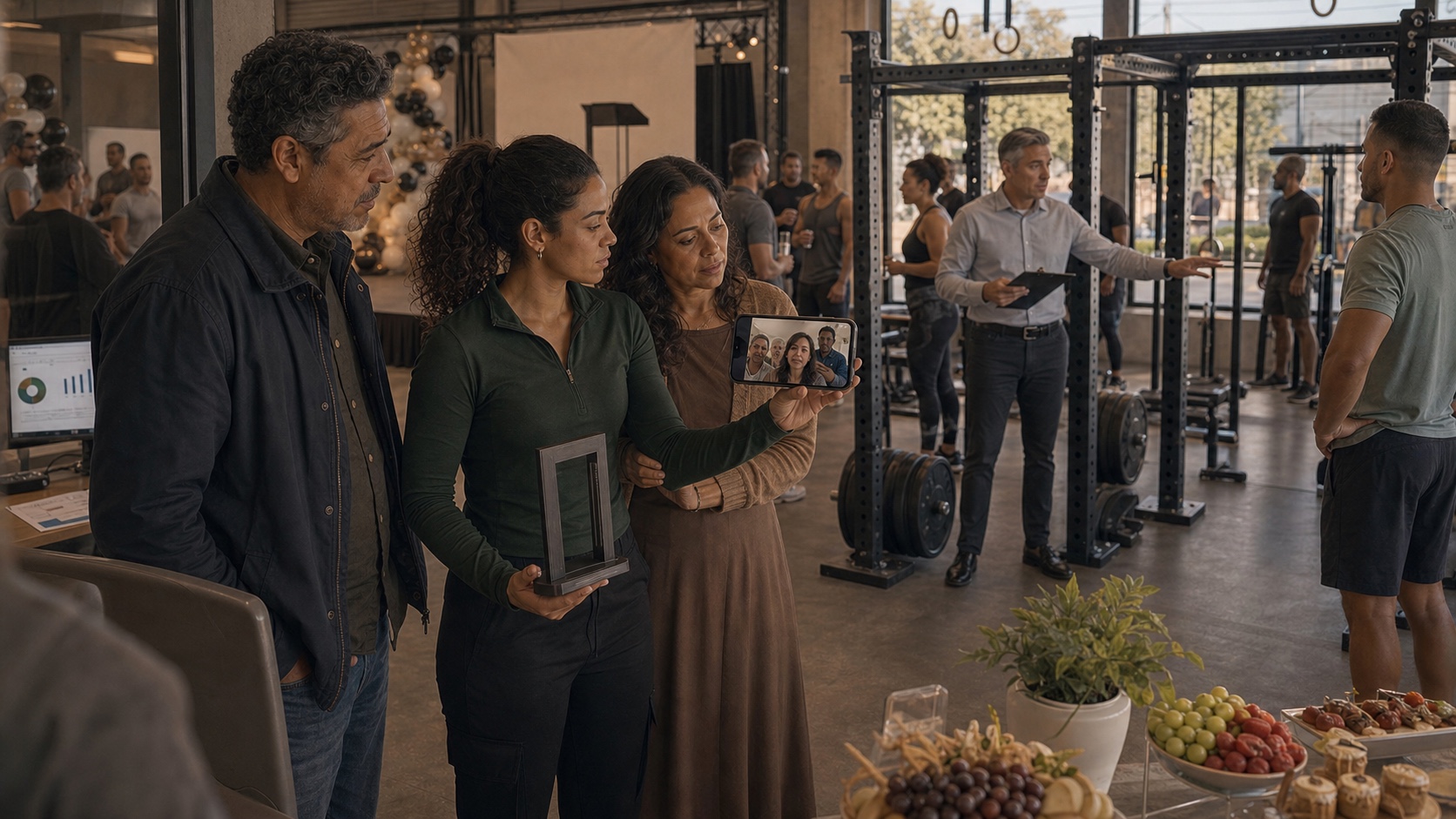
Workers installed a small stage inside the gym for its first anniversary. The Fund sent banners, a lectern, two photographers, three advisers, a regional director, and an award shaped like an open door.
Mara wanted to move two squat racks before the ceremony. Members had complained for months that the narrow gap forced them to turn loaded bars at an angle.
The facilities adviser stopped her beside the floor anchors.
“The approved plan fixes these positions,” he said. “Send me the revised safety distances and I will request consent.”
“We can move them twenty centimeters now.”
“Then the insurer may question the installation.”
He meant to protect the gym. Mara left the racks where they stood.
Her parents arrived in their best clothes. Relatives gathered around a phone across the ocean. Members filled the training floor, careful not to lean against the banners.
The regional director praised Mara as an independent local entrepreneur, a child of newcomers, and proof that private savings could create opportunity without sacrificing security. The audience applauded every true part of the sentence.
Mara accepted the open door and smiled for the photographers.
After the speeches, the Fund served fruit, mineral water, and small cakes from an approved caterer. Mara’s aunt called through the family group. The relatives passed the phone until the aunt found a quiet corner.
“You did it,” she said. “Is it yours now?”
Mara looked toward the office. Her minimum-wage payslip lay beside the latest adviser invoices. The profit statement showed the Fund’s 51 percent distribution and her 49 percent remainder. The facilities adviser stood between the racks, explaining the approval process to her father.
She imagined answering plainly.
The gym employed her. The Fund controlled it. Advisers guided it. Members filled it. Her family name covered the wall. Every public measure called it successful.
Across the ocean, her aunt waited.
Mara raised the phone so the family could see the crowded floor, the award, and the name above the entrance.
“It is profitable,” she said.
The Forms Accounted for Everything
The annual report contained one success, one abandoned application, one clean ship, and a new category called founder emigration.
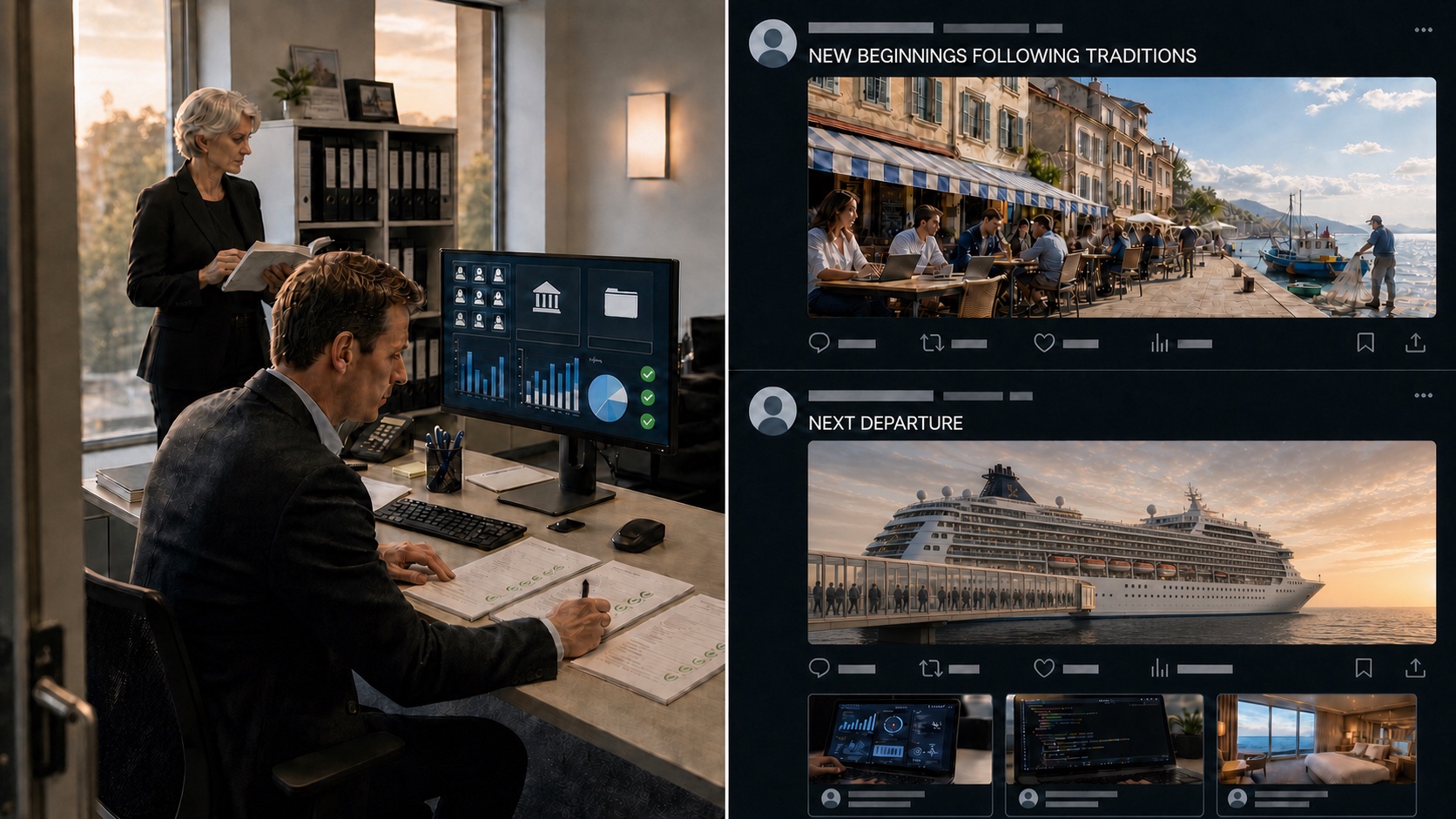
Halden completed the files in that order.
The Fund classified Mara’s gym as a profitable investment that created jobs, improved health, renewed a neighborhood property, and demonstrated inclusion. Lukas’s application remained PROJECT NOT PURSUED. The ship inspection found no unlicensed provider. Customs recorded that every questioned passenger had received and acknowledged formal safety advice.
Another Directorate supplied the new report.
Young builders had left the old continent in growing numbers. Many had traveled on party cruises, formed companies during the crossing, and received temporary residence after arrival. The report called the pattern founder emigration.
Halden searched for Lukas. The systems refused the connection. His Fund file contained no company. Customs recorded a holiday departure and safety acknowledgment. The inspection found no provider. The immigration record belonged to another jurisdiction.
His unit chief read the report beside him.
“We cannot let every ambitious young person believe opportunity requires an ocean,” she said.
Halden agreed.
The Directorate created the Safe Founder Mobility Program with money from mobilized savings. It converted empty hotels into approved residences and coworking centers in sunny seaside towns where quiet promenades faced faded signs that still promised summer. Licensed travel advisers arranged relocation. Approved video providers connected founders with mentors. Fund representatives offered capital under protective governance.
Halden helped write the campaign.
NEW BEGINNINGS FOLLOWING TRADITIONS, the launch film said.
It showed young builders working beneath striped awnings, local craftspeople opening workshops, fishing boats leaving at dawn, and old hotels filling with light. One sequence showed Mara’s town from above, though it never showed her gym. Halden saw a sincere answer to two problems: founders needed opportunity, and towns that once welcomed tourists needed new life.
He did not ask why a working product had failed the first application. The new program already offered a place, a category, a residence, advisers, and measurable regional outcomes. It could see the founder before the founder arrived.
Halden posted the launch film on the network.
Beneath it, the party ship announced its next departure. Replies filled with laptop symbols, cabin prices, jokes, warnings, and demonstrations from builders seeking scouts.
Halden believed the Safe Founder Mobility Program had arrived just in time.
By evening, the forms accounted for everything they could see.
| Previous | 19 Sep 2026 | Next |


About me
Hello! My name is Stephan Schwab.

I build and rescue software, and I write fiction about the human side of how it gets made. Here you’ll find my stories and novelas, notes on craft, and field notes from a life lived across several worlds.
Working with software teams is what I do professionally — see how on caimito.net. You can also read about my experience since 1986.