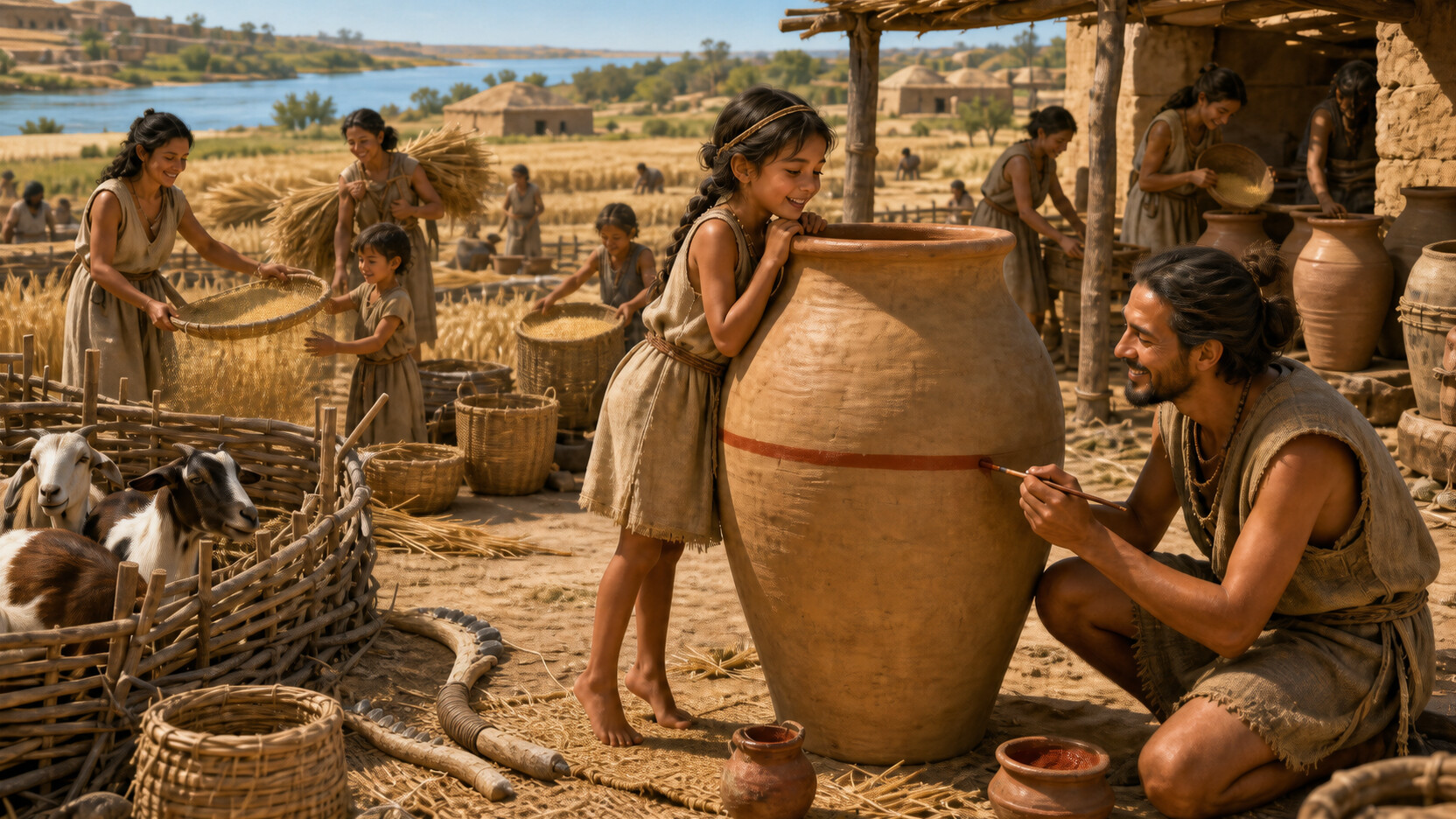
Nami and the potter give the harvest a place to wait.
The new jar was taller than Nami.
She stood on her toes beside it while the potter painted a line around its belly with red clay.
“Up to here,” he said. “That will feed a household through the rains.”
Nami put both hands on the jar and tried to imagine eating so much porridge. “Even Uncle Kesh?”
The potter considered this. “A smaller household.”
Outside, the harvest moved toward them in golden armfuls.
The fields began beyond the last mud-brick wall and ran down to the river in narrow strips. Men and women cut the grain with flint-toothed sickles, gathering the stalks against their knees. Children carried bundles to the threshing ground. Goats watched from their enclosure with the injured patience of animals excluded from a feast.
Nami's bundle was not the largest, but she had tied it herself. She dropped it beside the growing stack and returned to the field at a run.
“Walking saves breath,” her brother called.
“I have more breath!”
By midday, the village hummed from one end to the other. Stalks cracked beneath wooden sledges. Grain rattled through woven sieves. Chaff rose in pale clouds whenever the wind came down from the hills. Everyone became the same dusty color, except for their teeth.
Under the granary awning, Tarek kept the count.
For every basket poured into a storage jar, he rolled a small piece of clay between his fingers and set it on a board. A round piece marked barley. A long piece marked emmer. A tiny clay goat waited at the edge for the herders' share.
Nami delivered a basket with both arms wrapped around it.
Tarek shaped a round counter and handed it to her.
“You count this one.”
She placed it carefully beside the others. There were so many that the board looked like a little village of seeds.
Some grain went into jars for the rains. Some filled smaller sacks for planting when the river withdrew. A basket went to the potter, whose new jars stood drying against the wall. Two went to the family repairing the eastern channel. One was set aside for travelers who would return with salt, black stone, and stories from beyond the hills.
The final basket went to the bakers.
They had been waiting for it.
Before sunset, the smell of warm flatbread reached every courtyard. Nami carried the first stack to the threshing ground, where reed mats covered the dust and someone had already begun tapping a drum. The potter arrived with a jar of date drink. The channel diggers washed their hands at the well. Even the goats received a heap of fresh stalks and stopped looking offended.
Tarek brought out the counting board. He and Nami checked each clay piece while the last light touched the filled jars inside the granary.
“Did we make enough?” she asked.
He pointed to the bread, the seed sacks, the jars, and the people settling onto the mats.
“We made tomorrow,” he said.
Nami took a hot piece of bread, burned her fingers, changed hands twice, and laughed all the way back to her family.