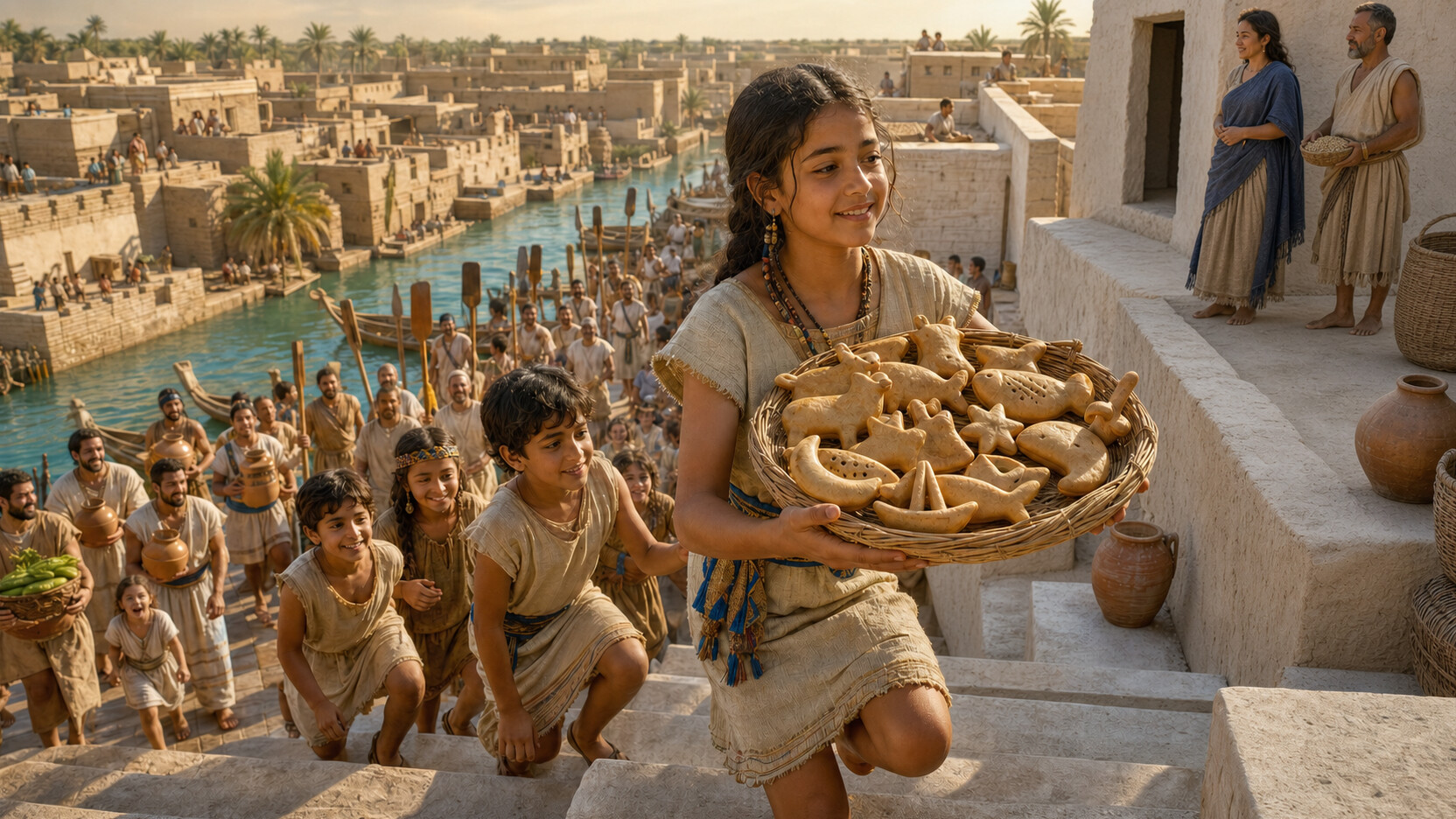
Amat keeps the bread offerings ahead of their volunteer guards.
Amat knew the city by its smells.
Near the river gate, it smelled of wet rope, fish scales, and the black mud scraped from the bottoms of reed boats. The potters' lane smelled of smoke. The copper yard smelled sharp enough to taste. At the bakers' courtyard, where her father worked before sunrise, the air smelled of sesame, hot brick, and the flat loaves she had been told not to touch.
She touched one.
“That loaf belongs to the goddess,” her father said without turning.
Amat put it back. “She can have the next one.”
“The goddess ordered first.”
Today everyone had orders.
The river had begun to fall, leaving fresh silt along the fields, and the city was preparing the procession that opened the canal gates. Sweepers cleared the broad road to the temple platform. Brewers rolled jars into the shade. Gardeners arrived carrying onions, dates, and the first cucumbers of the season. Two scribes sat beneath an awning with clay tablets on their knees, recording each delivery while arguing about whose reed stylus had disappeared.
Amat's mother came from the weaving house with a folded length of blue wool balanced on her head.
“Straight from the dye bath,” she said. “Do not touch it.”
Amat showed her blue fingers.
Her mother sighed. “At least now they match.”
Amat's own task was to carry a basket of small bread figures from the bakers' courtyard to the temple kitchen. There were cattle, fish, moons, stars, and tiny boats with sesame seeds for passengers. She counted them at every corner because children followed her through the lanes offering to guard the basket.
“From what?” she asked.
“Us,” they said.
The temple rose above the flat roofs in bright tiers of whitewashed brick. From its stairs, Amat could see the whole city moving toward the processional road. Brickmakers came with red dust in the lines of their hands. Boat crews carried polished oars. The reed cutters wore new belts. Soldiers stood at the gate with clean spearheads and flowers tucked behind their ears.
In the upper courtyard, the ruler waited beside the high priestess. He wore a wool skirt heavy with fringe and looked hot. The priestess wore Amat's mother's blue cloth across one shoulder. It shone like river water.
A kitchen steward took the bread figures from Amat and arranged them around a large round loaf. One little sesame passenger had lost its head.
The steward looked at Amat.
“Dangerous river,” she said.
He placed the headless passenger at the back of the boat.
When the drums began, the city answered.
The ruler lifted a basket of seed. The priestess poured river water into a stone basin. Below them, workers pulled the wooden gate lever, and water rushed into the first canal with a brown flash. People cheered from the banks. Children ran alongside the new current until the guards shouted and then ran faster.
At sunset, the temple servants returned the offered bread to the courtyards in great baskets. Amat found her family on the roof, where neighbors had spread mats between cooling jars. Her mother tore the goddess's loaf into pieces and passed the first one to Amat's father.
“Did she like it?” Amat asked.
He tasted the bread with great concentration.
“She left us the best part.”
Below them, lamps appeared one by one along the canal. Above them, the first stars took their places.