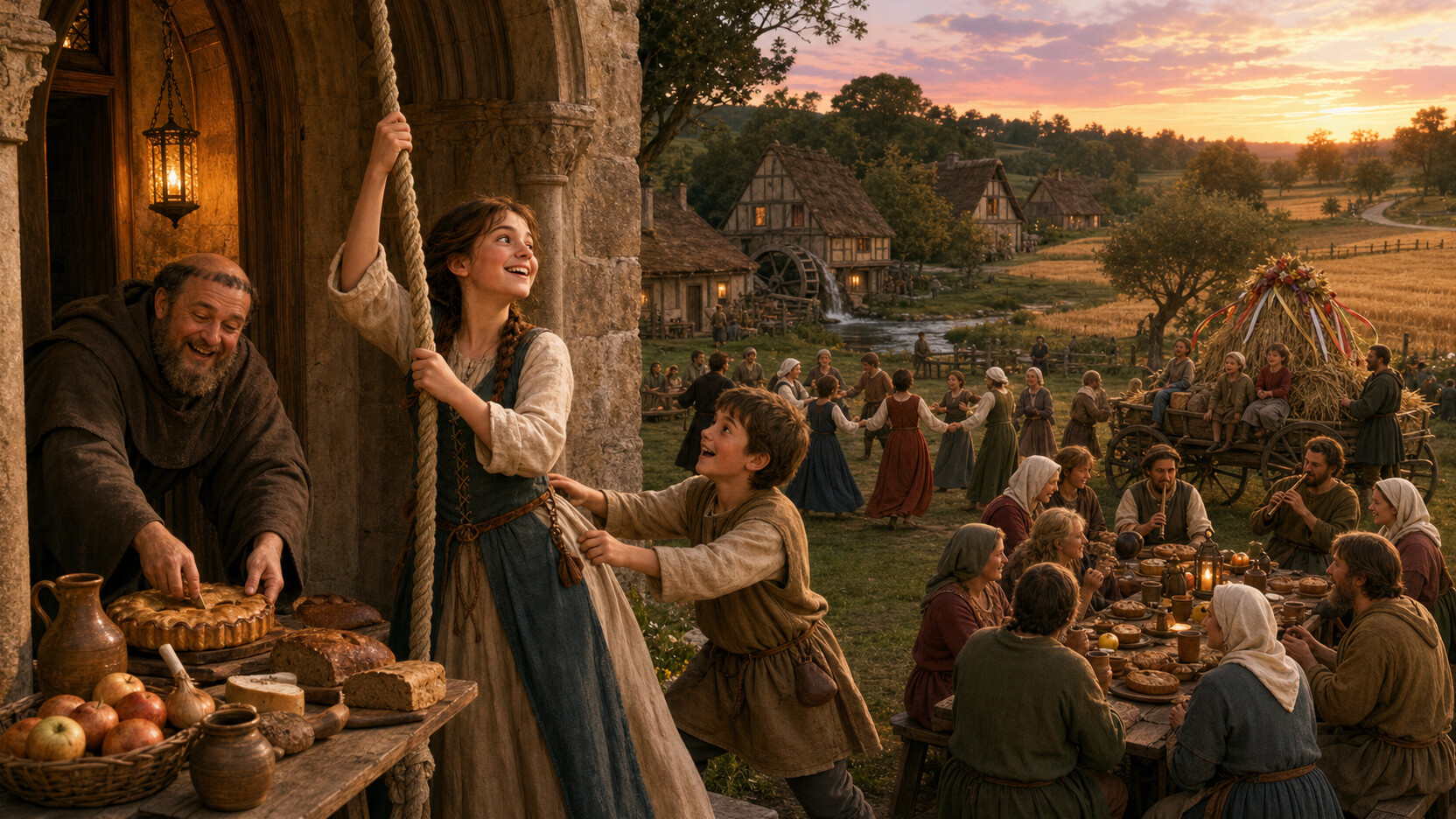
Aveline rings for the dance before Brother Tomas reaches the pie.
The bell was late, and everyone noticed.
Aveline stood in the rye field with her sickle resting against her shoulder. The sun had cleared the alder trees. The mill wheel was already turning. Even the baker's chimney had begun to smoke, but the church tower remained silent.
“Perhaps morning has been canceled,” her little brother said.
Then the bell gave one enormous, surprised clang.
A flock of rooks rose from the roof. The oxen looked up. Across the field, every head turned toward the tower.
Two smaller notes followed, then a pause, then another wild blow.
“That is not morning,” Aveline said. “That is either a wedding or Brother Tomas falling down the stairs.”
It was the rope.
By the time Aveline reached the churchyard, half the village had gathered beneath the tower offering advice. The bell rope had looped itself over a roof beam. Brother Tomas stood on the ladder while the priest held the bottom and objected to every movement.
“Left,” called the blacksmith.
“His left or ours?” asked the miller.
“The Lord's left,” said Aveline's grandmother.
Nobody knew which side that was.
The rope came free at last. Brother Tomas rang the proper morning pattern, and the village returned to work as if the sun had received permission to continue.
It was the final day of the rye harvest.
Families moved down the field in a broad uneven line, cutting and binding. Aveline's father sharpened sickles on a stone. Her mother tied sheaves faster than anyone else and placed the crooked ones in a separate row for her husband. Children carried water, chased mice from the stubble, and gathered every fallen stalk into small bundles of their own.
At noon, the bell crossed the fields again.
The sickles stopped. People stood among the sheaves while the priest's voice drifted from the lane, saying the familiar prayer. Aveline heard only every third word, but everyone knew where to answer. Then they sat in the shade of the hedge and opened cloths filled with brown bread, hard cheese, onions, and apples.
Her grandmother broke an apple with both hands and gave Aveline the larger half.
“I saw that,” her brother said.
“Grow older,” said Grandmother.
By evening, the field stood golden and bare. The last sheaf was dressed with ribbons and carried to the church porch. One cart went to the mill. One portion filled the parish store. Seed grain was lifted into the driest loft. The rest traveled home in wagons with children riding on top and singing verses that became less respectable with every repetition.
The harvest supper filled the green after sunset.
The baker brought pies from the common oven. The shepherds played pipes. The carpenter turned two benches into a table and complained when dancers used it as a bench. Lamps shone in the church doorway, where painted saints watched the feast with bright round eyes.
Brother Tomas found Aveline beside the bell rope.
“You counted every ring today,” he said.
“You rang one extra at dawn.”
“The bell was clearing its throat.”
He placed the rope in her hands.
Aveline rang for the dance.
The first note rolled over the roofs, the harvested field, the millstream, the orchard, and the road disappearing into the dark. Everyone on the green cheered. The musicians began before the echo had faded.
Her brother pulled her toward the circle.
“Who rings the bell in heaven?” he asked.
Aveline looked back at Brother Tomas, who was already reaching for a pie.
“Someone with better timing.”