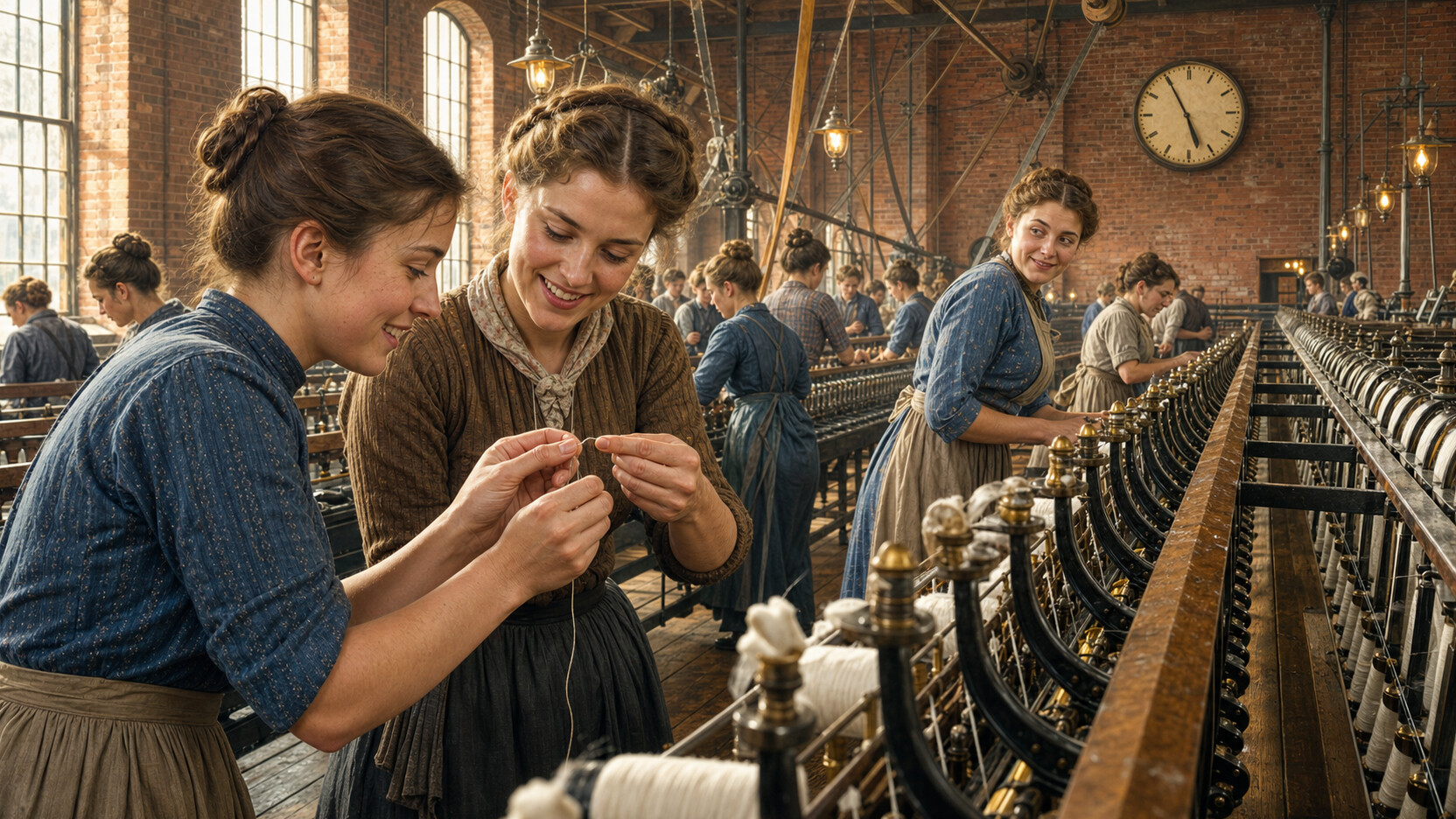
Nell and Rose repair one thread while Ada keeps the neighboring frame moving.
The factory clock ran four minutes fast.
Mr. Bell called this efficiency. Everyone else called it four minutes.
Nell Foster reached the gate while the minute hand still trembled below six. She held up her worker token for the porter, hurried across the brick yard, and joined the stream of women climbing the spinning-room stairs.
“Three minutes to spare,” said Ada beside her.
“Seven by the church clock.”
“The church does not pay us.”
At six, the steam whistle sounded.
The mill woke floor by floor. Shafts began to turn beneath the ceiling. Leather belts caught, slapped once, and settled into motion. Rows of frames shivered into life. Hundreds of bobbins spun beneath the gas lamps, pulling clean white thread from soft clouds of cotton.
Nell tied back her sleeves and walked her section.
She tended two spinning frames, each longer than her family's kitchen. She knew their voices: the smooth humming run, the dry chatter of a hungry bearing, the quick tick of a thread about to break. Her new assistant, Rose, heard only noise.
“Number twelve is unhappy,” Nell said.
Rose leaned closer. “Which one is twelve?”
“The unhappy one.”
A thread snapped.
Rose caught the loose end on her second attempt. Nell showed her how to twist the fibers between damp fingers, join them without a knot, and return the spindle before its neighbors gained too much distance. By the fourth break, Rose no longer needed help. By the sixth, she was correcting Nell's reach.
The room moved by bells.
One bell opened the windows. Two called the mechanic. At eight, a short ring sent the first group for tea. At noon, the frames coasted to silence, leaving everyone's ears full of a ghostly hum.
The workers carried lunch into the yard. Nell had bread, cheese, and an egg. Ada had pickled onions and enough opinions for the entire spinning room. Rose had forgotten her spoon, so they passed one around while a brass band practiced beyond the warehouse.
The band belonged to the mill. Its cornet player worked in packing, its drummer fired the boilers, and its conductor kept the accounts. They were preparing for Saturday's contest against the railway works.
“We need another alto horn,” Ada told Nell.
“I do not play.”
“Neither does Walter, and that has never stopped him.”
The afternoon brought a rush order: blue sewing thread for a uniform maker in Leeds. The foreman brought new counts. The mechanic adjusted the gearing. Nell divided the frames with Rose and Ada, and they kept the bobbins moving while carts crossed the floor collecting each finished row.
At five forty-eight, the final cart left their section.
At six, the whistle released them.
Outside the pay office, Nell exchanged her token for a paper envelope. She counted the coins beneath the yard lamp: rent, coal, food, a little for her mother, and sixpence for the evening arithmetic class at the Mechanics' Institute. Two pennies remained for Saturday.
“Alto horn,” Ada said.
“Seed cake.”
“You cannot march with seed cake.”
“Then I will eat while standing still.”
They walked home with the crowd, past foundries, warehouses, chapels, shops, and rows of lit windows. Behind them, the night shift entered through the same gate. Ahead, the church clock struck six—four minutes after the factory had already done so.
Nell smiled.
“Slow,” she said.