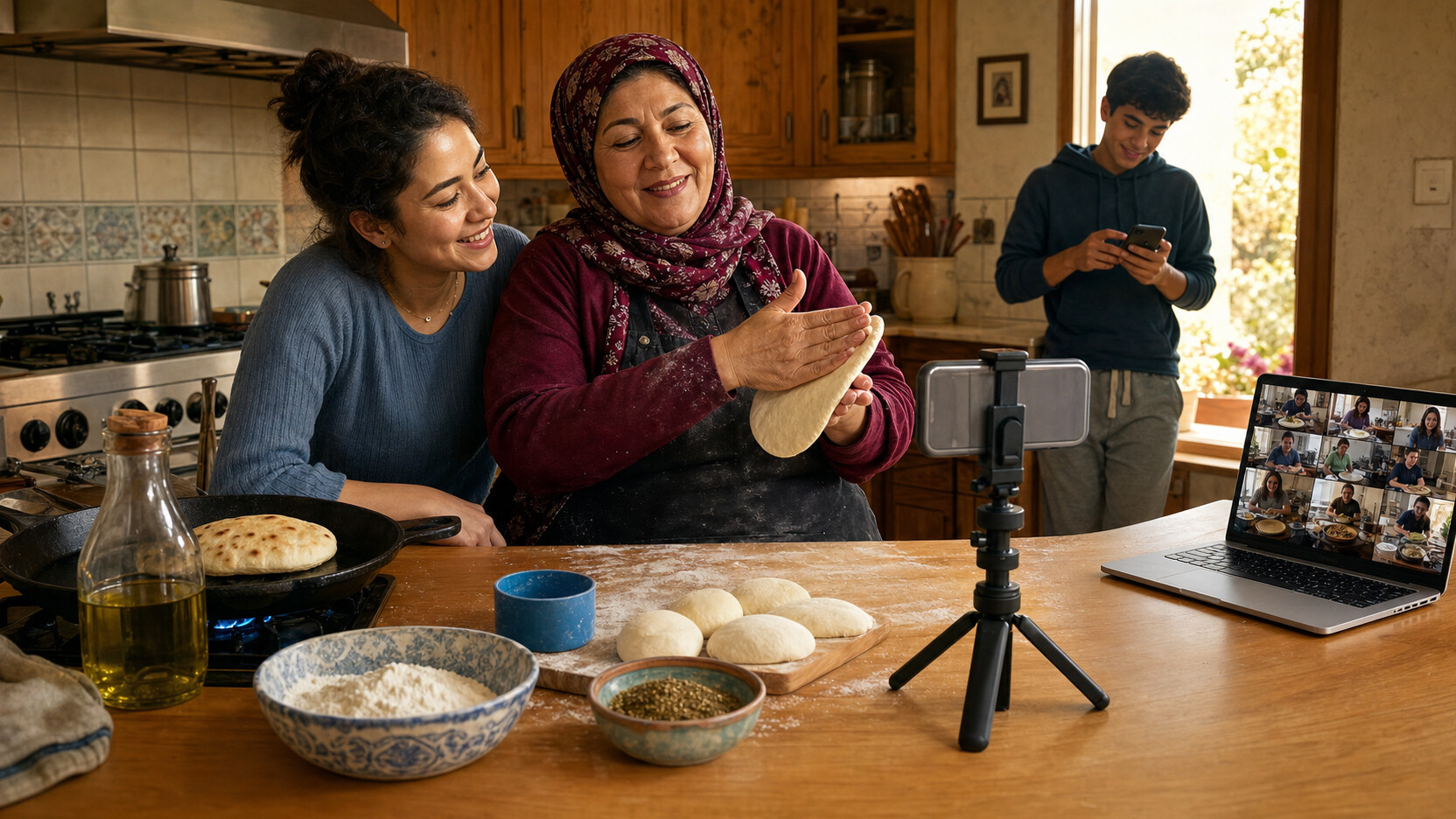
Salma discovers that Rami has invited thirty thousand people into the kitchen.
The first viewer arrived before the dough had risen.
Nadia propped her phone against the sugar jar and waved at the screen.
“Hello, Cousin Rami.”
A small heart floated past her face.
Her grandmother Salma looked over from the kitchen table. “Is he inside the telephone?”
“He is watching from Montreal.”
“Then tell him he still owes me a visit.”
Rami had asked for Salma's flatbread recipe. Nadia could have written it down, but Salma measured flour with a blue cup that had lost its handle, water with her palm, and yeast by saying enough. A live video seemed easier.
At first there were twelve viewers. Nine were relatives.
Nadia introduced the ingredients while Salma corrected her.
“Two cups of flour.”
“Three.”
“You put in two.”
“The cup is larger when I hold it.”
The viewers sent laughing faces. Rami shared the video with friends. Someone asked whether the recipe worked without a stone oven. Salma leaned toward the phone until one eye filled the screen.
“Bread works where people are hungry.”
The viewer count climbed to eighty-seven.
A baker in Marseille asked about the flour. A student in Manila wanted to know whether she could use a frying pan. A man waiting for a bus in Toronto sent a picture of the blue cup his own grandmother used. Salma forgot that she had objected to the broadcast and began addressing the phone as if it were a crowded table.
“Not so much water,” she told Manila. “Marseille, your dough is too cold. Toronto, that cup is for coffee.”
Nadia's younger brother joined from the living room, although he was six meters away. He added a row of fire symbols and denied it when Salma called his name.
By the time the dough was ready, four hundred people were watching.
Nadia divided it into balls. Salma flattened each one with quick turns of her hands and laid it on the hot pan. The bread swelled at the center. Comments moved too quickly to read.
Then the first reply video appeared.
A woman in São Paulo held up a round of dough and copied Salma's wrist movement. Two children in Dublin tried it and dropped theirs on the floor. A restaurant cook in Seoul flipped a perfect bread into the air. The student in Manila showed a small pan on a dormitory stove and shouted when her bread puffed.
Nadia placed the replies beside the live video. Soon the screen became a wall of kitchens.
People compared flour, pans, fillings, grandmothers, and the correct way to rescue dough that had attached itself to a ceiling. Someone added music to Salma's kneading rhythm. Someone else turned her larger cup explanation into a twelve-second song.
Salma watched herself sing from Nadia's phone.
“I do not sound like that.”
“That is your voice.”
“The telephone has made it taller.”
When the final bread came from the pan, Nadia brushed it with oil and za'atar. She broke it open close to the camera. Steam clouded the lens.
The viewer count passed thirty thousand.
“How many?” Salma asked.
Nadia turned the screen toward her.
Salma looked at the number, then at the empty flour bowl.
“Rami invited too many people.”
She reached for the large cup.
“We make another batch.”