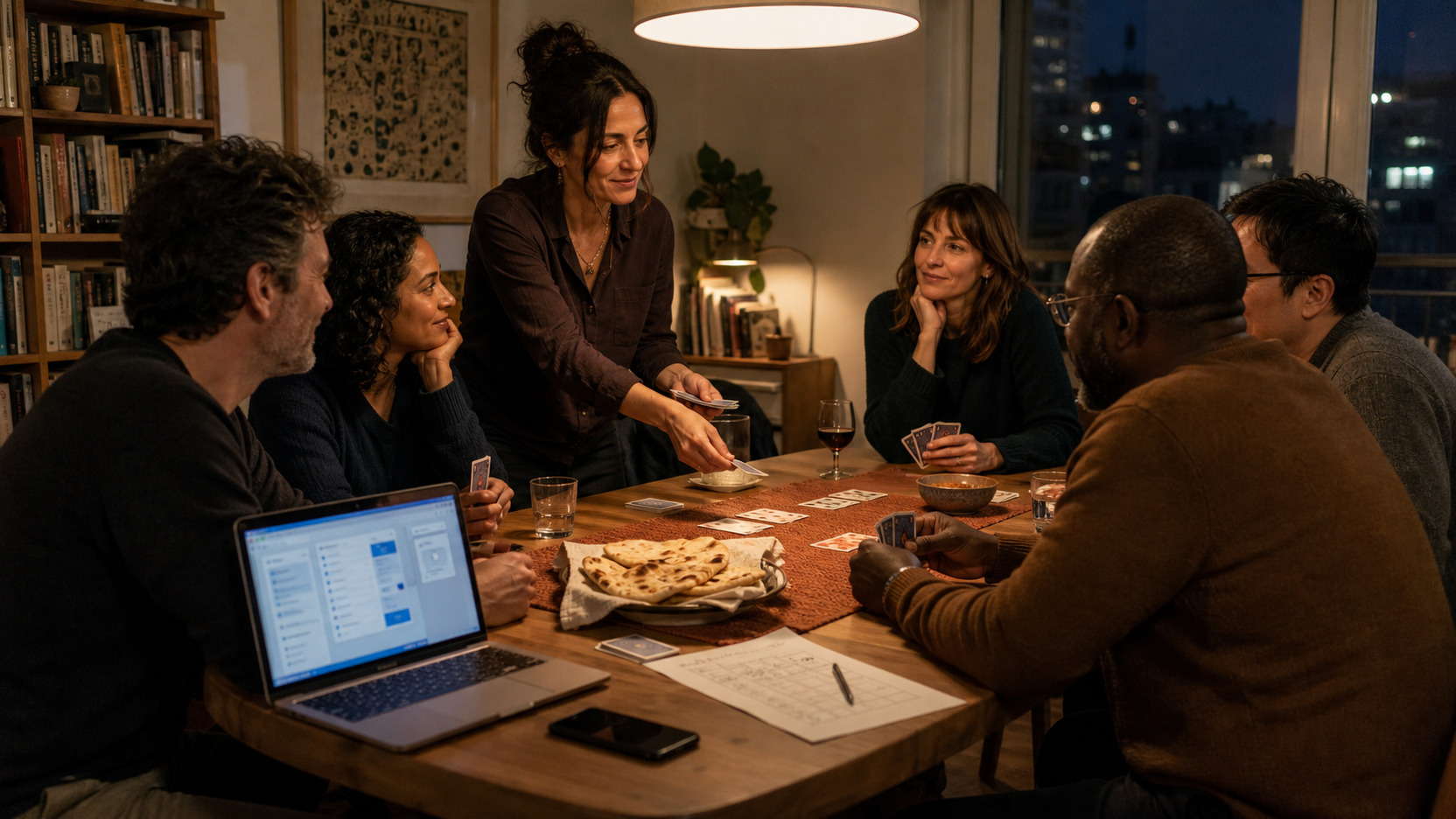
Lina deals the next round while the job search continues at the edge of the table.
On Monday, Mara's new AI assistant completed the week's work before anyone had finished breakfast: interviews summarized, prototypes compared, estimates checked, presentation drafted, and the launch announcement translated into twelve languages.
Dev refreshed the board.
“Do it again,” he said.
“That is not how finished works.”
They checked everything. The figures added up. The translations read naturally.
At ten, Mara closed the presentation.
“We are going outside.”
The assistant prepared directions, appointment notes, and questions. Mara added tape, markers, cardboard models, and a blank page.
At the community center, Mr. Benítez showed them that the device screen disappeared in sunlight. Two teenagers redrew the menu buttons. A baker tested the controls with flour on both hands. Dev dropped a cardboard model, and the teenagers improved it by stepping on the remaining pieces.
By four, they had a brighter screen, larger buttons, and twelve new problems that had not appeared in any summary.
Their manager called while Dev was losing at table tennis.
“The board says the project is finished.”
“The board has not met Mr. Benítez,” Mara said.
That evening, she took warm flatbread to the Thursday table at Lina's apartment.
The six friends had met every Thursday since university. They ate, played games, and complained about people who scheduled Friday morning meetings.
This Thursday, three of them no longer had Friday morning meetings.
Lina had translated medical and legal documents for sixteen years. Last spring, her company had sent her to a conference as an expert. In February, it kept two reviewers and released the other forty-one.
Owen had trained junior programmers. There were no junior programmers in his department now. Cass had illustrated schoolbooks until a publisher generated an entire reading series during a Tuesday demonstration.
“The dragon had six fingers,” Cass said, opening the flatbread. “But it was delivered early.”
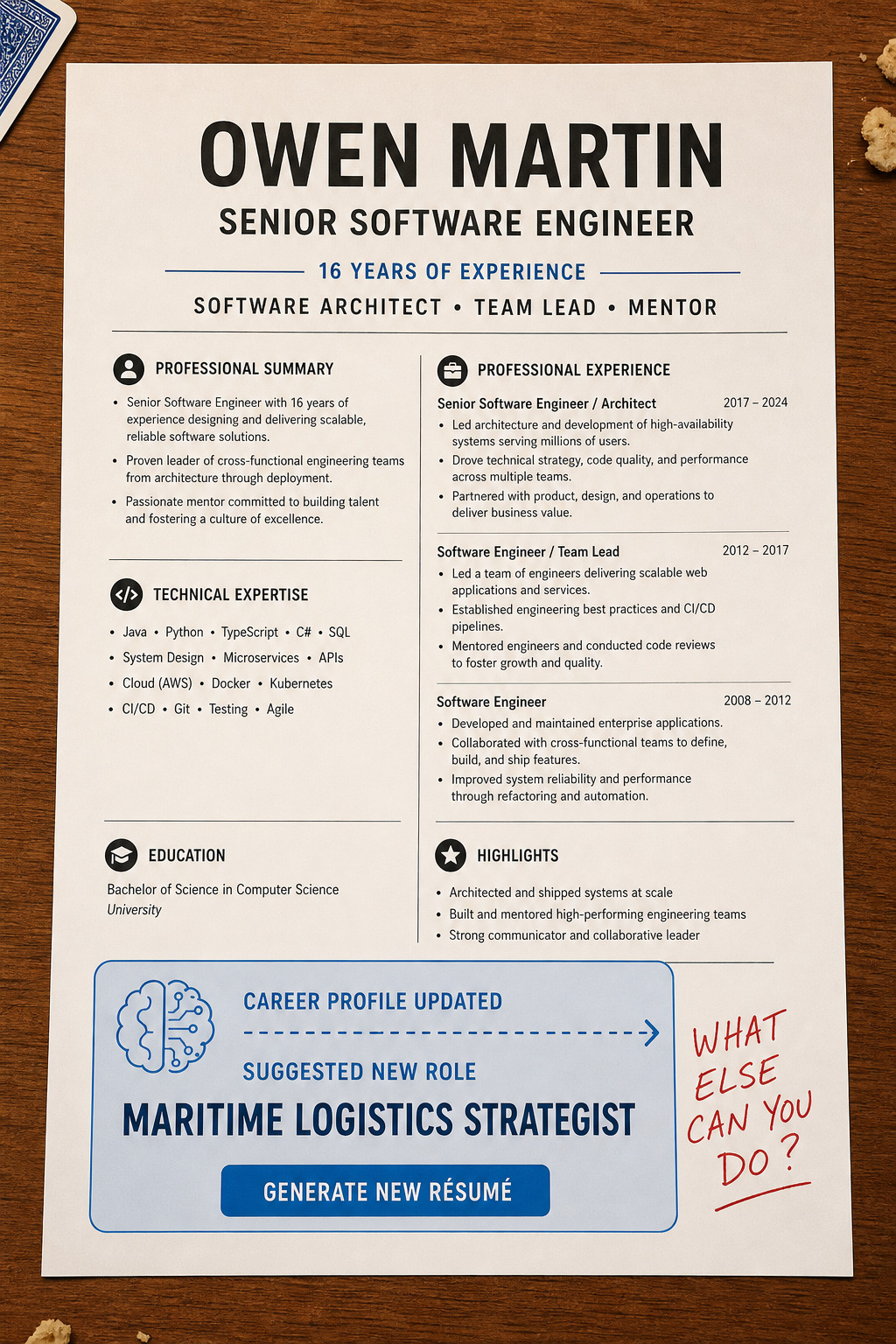
Sixteen years of experience, redirected in one click.
Owen dealt the cards while an AI service rewrote his résumé for careers he had not known existed.
“It believes I could become a maritime logistics strategist,” he said.
“Can you sail?” Mara asked.
“It did not mention sailing.”
Lina's phone chimed with a rejection. She turned it face down and explained the rules of the game in half the time Owen had taken the previous week.
They played. Cass drew a better score sheet. Owen repaired the loose table leg. Lina caught Mara cheating accidentally and Dev cheating with concentration.
Between rounds, they opened the job spreadsheet.
Last year it had tracked promotions and salaries. Now it held application dates, automated rejections, insurance deadlines, and a column titled WHAT ELSE CAN YOU DO?
Lina tapped her row.
“I know three languages, two legal systems, medical terminology, and the difference between a sentence that is accurate and one that will frighten a patient.”
“Put that in the column,” Mara said.
“It does not fit.”
They ate the last bread while Mara described the sunlight problem. Her friends listened, asked questions, and rearranged the whole project between them. Cass sketched a folding shade. Owen suggested using the light sensor already inside the device. Lina pointed out that brightness meant little if older users could not understand the warning messages.
Mara added everything to the project board. The gold circle sorted their ideas and produced a plan before the next hand was dealt.
“Your manager will like that,” Dev said.
“He told me I see the whole system.”
“You always did.” Lina gathered the cards. “They just have a name for it now.”
For a moment, nobody spoke.
Then Owen looked around the table.
“What do we call the rest of us?”
Cass placed the repaired score sheet between them. Lina held the deck. Owen's résumé continued improving itself on the counter.
Mara had known them as a translator, a programmer, and an illustrator for almost twenty years. None of those answers seemed to work anymore.
Lina began dealing the next round.
“Tonight,” she said, “you are all on my team.”
What waits for us when work is gone?