Bread and Games—But What Are We For?


“What do you do?”
The question asks about work, but its answer often becomes a person. Hunter, farmer, potter, weaver, factory hand, manager, translator, programmer: each name describes a useful activity and offers a place among other people. Work fills the stores, pays the rent, marks the hours, and returns an identity to the person performing it.
Across thousands of years, the arrangement changes. Food becomes grain, grain becomes wages, wages become careers, and careers become promises of progress. New tools enlarge what one person can accomplish. New institutions decide which accomplishments matter. Around every fire, field, temple, factory, office, and glowing screen, people learn how to be needed.
Then comes 2026. Machines begin performing activities that required a human career only the year before. Bread may still reach the table. The games may never end. But the old introduction—I am the person who does this—no longer settles the question.
1. The Fire Belonged to Everyone
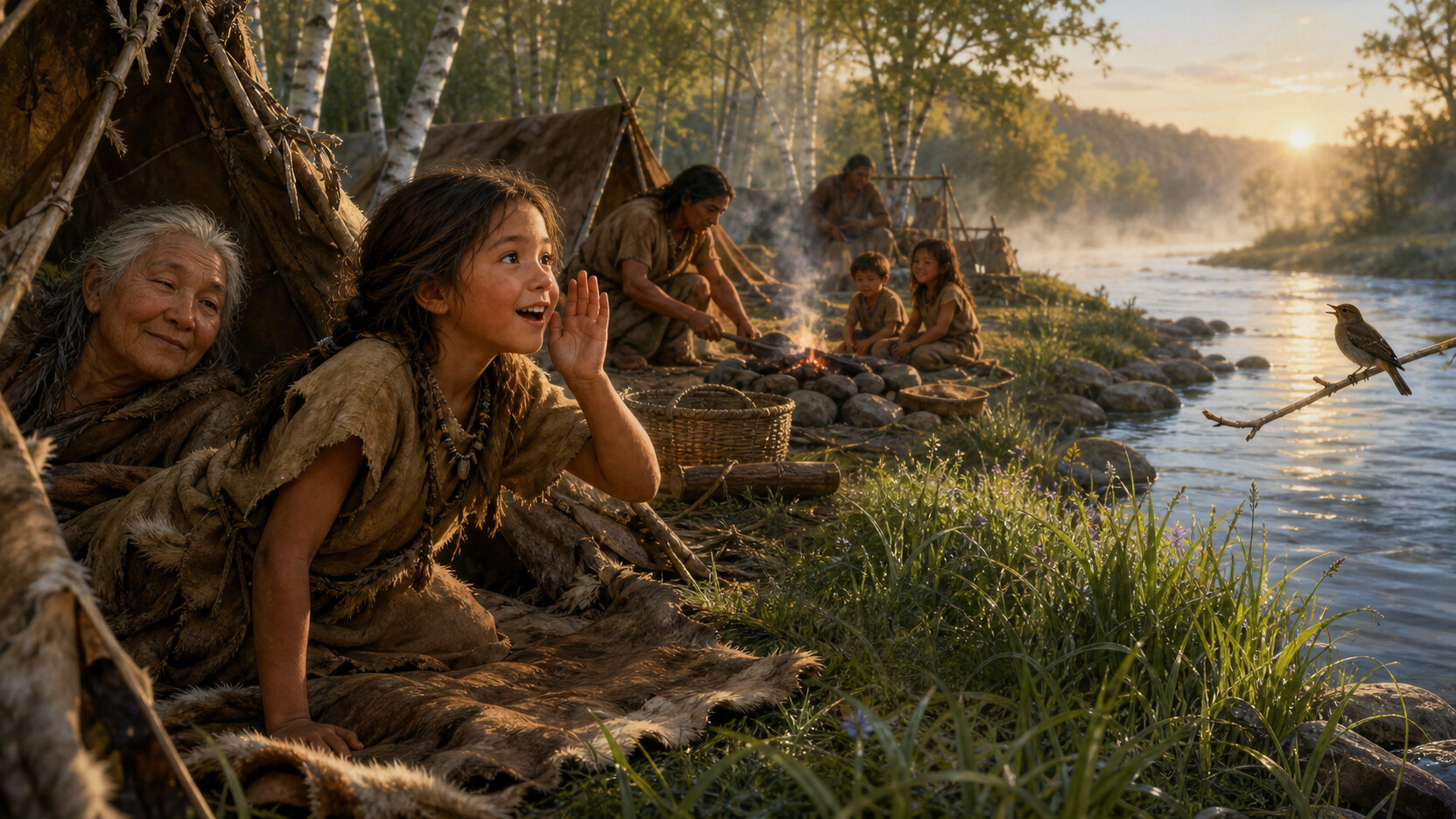
The first person awake was a child.
Tala slipped from beneath the sleeping hides and stood at the edge of the camp, where the grass still held the night in silver drops. Across the river, a bird made three rising calls. Tala answered with four. The bird tried again. Tala grinned.
Behind her, Grandmother Eri opened one eye.
“You have already confused it,” she said.
“It started.”
“That is what birds always say.”
Soon the camp was moving. Someone stirred yesterday’s embers beneath fresh twigs. Two women walked toward the berry slope with baskets against their backs. A man sat cross-legged beside the fire, showing a boy how to press a flint edge through a strip of hide without cutting it. The boy cut it. The man inspected the crooked opening and nodded.
“Now it is a bag,” he said.
Tala’s mother handed her a digging stick, and they followed the river until the ground softened beneath a stand of tall leaves. Tala knew the place. She pushed the stick into the earth, leaned her whole weight upon it, and tumbled backward when a pale root came free.
Her mother raised both hands as if Tala had pulled up the moon.
By midday, the baskets held roots, berries, green shoots, and three eggs discovered under a bank. Tala ate one berry for every five she collected. Her mother pretended not to notice until Tala’s lips turned purple.
The hunters returned while the sun was still high. They came through the birches singing the unsuccessful-hunt song, loudly and with great ceremony. The camp answered with groans and laughter. Then one hunter stepped aside and revealed the deer carried behind them.
Everyone ran forward.
Work passed from hand to hand. Stone blades flashed. Water came up from the river. Children gathered fallen branches and argued over whose bundle was largest. Eri saved a smooth piece of antler for a needle. Tala’s uncle painted a red line across the youngest hunter’s forehead, then added a second when the young man complained that the first was not straight.
At dusk, strips of meat hissed above the coals. Fat fell into the fire and lifted sparks among the trees. Tala sat between her mother and Eri, chewing a roasted root while the hunters performed the day’s journey. In their version, the deer had crossed two rivers, climbed a mountain, defeated a bear, and stopped to insult each hunter by name.
When the laughter settled, Eri took a coal-black stick and drew seven marks on a flat stone: one for each person who had gone out and returned.
Tala pointed toward the brightening moon.
“Does it have a camp?” she asked.
Eri looked up. Around them, people ate, sharpened tools, nursed babies, traded jokes, and fed branches to the fire.
“Of course,” she said. “Where else would it go at night?”
2. The Grain That Could Be Counted
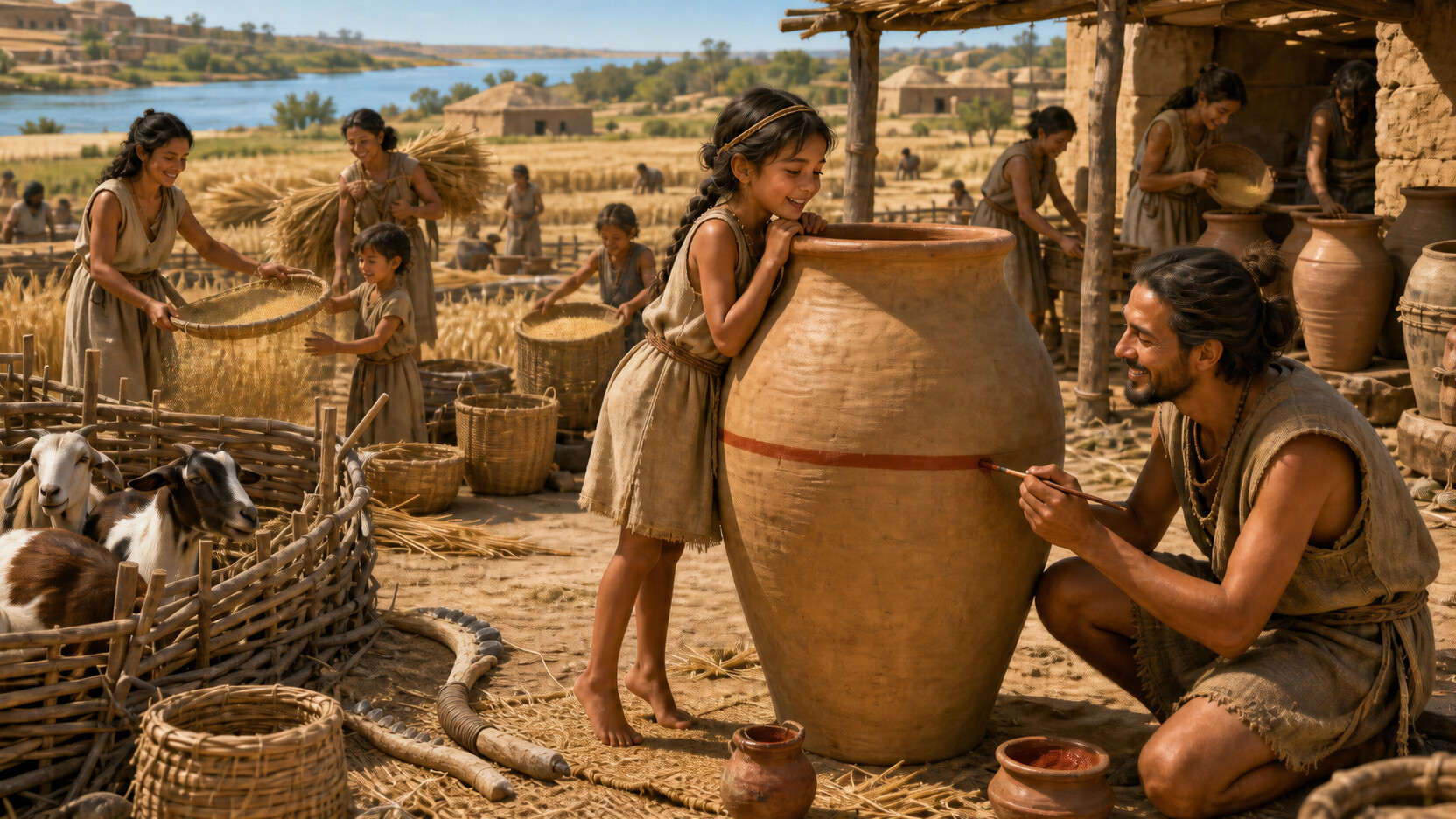
The new jar was taller than Nami.
She stood on her toes beside it while the potter painted a line around its belly with red clay.
“Up to here,” he said. “That will feed a household through the rains.”
Nami put both hands on the jar and tried to imagine eating so much porridge. “Even Uncle Kesh?”
The potter considered this. “A smaller household.”
Outside, the harvest moved toward them in golden armfuls.
The fields began beyond the last mud-brick wall and ran down to the river in narrow strips. Men and women cut the grain with flint-toothed sickles, gathering the stalks against their knees. Children carried bundles to the threshing ground. Goats watched from their enclosure with the injured patience of animals excluded from a feast.
Nami’s bundle was not the largest, but she had tied it herself. She dropped it beside the growing stack and returned to the field at a run.
“Walking saves breath,” her brother called.
“I have more breath!”
By midday, the village hummed from one end to the other. Stalks cracked beneath wooden sledges. Grain rattled through woven sieves. Chaff rose in pale clouds whenever the wind came down from the hills. Everyone became the same dusty color, except for their teeth.
Under the granary awning, Tarek kept the count.
For every basket poured into a storage jar, he rolled a small piece of clay between his fingers and set it on a board. A round piece marked barley. A long piece marked emmer. A tiny clay goat waited at the edge for the herders’ share.
Nami delivered a basket with both arms wrapped around it.
Tarek shaped a round counter and handed it to her.
“You count this one.”
She placed it carefully beside the others. There were so many that the board looked like a little village of seeds.
Some grain went into jars for the rains. Some filled smaller sacks for planting when the river withdrew. A basket went to the potter, whose new jars stood drying against the wall. Two went to the family repairing the eastern channel. One was set aside for travelers who would return with salt, black stone, and stories from beyond the hills.
The final basket went to the bakers.
They had been waiting for it.
Before sunset, the smell of warm flatbread reached every courtyard. Nami carried the first stack to the threshing ground, where reed mats covered the dust and someone had already begun tapping a drum. The potter arrived with a jar of date drink. The channel diggers washed their hands at the well. Even the goats received a heap of fresh stalks and stopped looking offended.
Tarek brought out the counting board. He and Nami checked each clay piece while the last light touched the filled jars inside the granary.
“Did we make enough?” she asked.
He pointed to the bread, the seed sacks, the jars, and the people settling onto the mats.
“We made tomorrow,” he said.
Nami took a hot piece of bread, burned her fingers, changed hands twice, and laughed all the way back to her family.
3. A Place Beneath the Gods
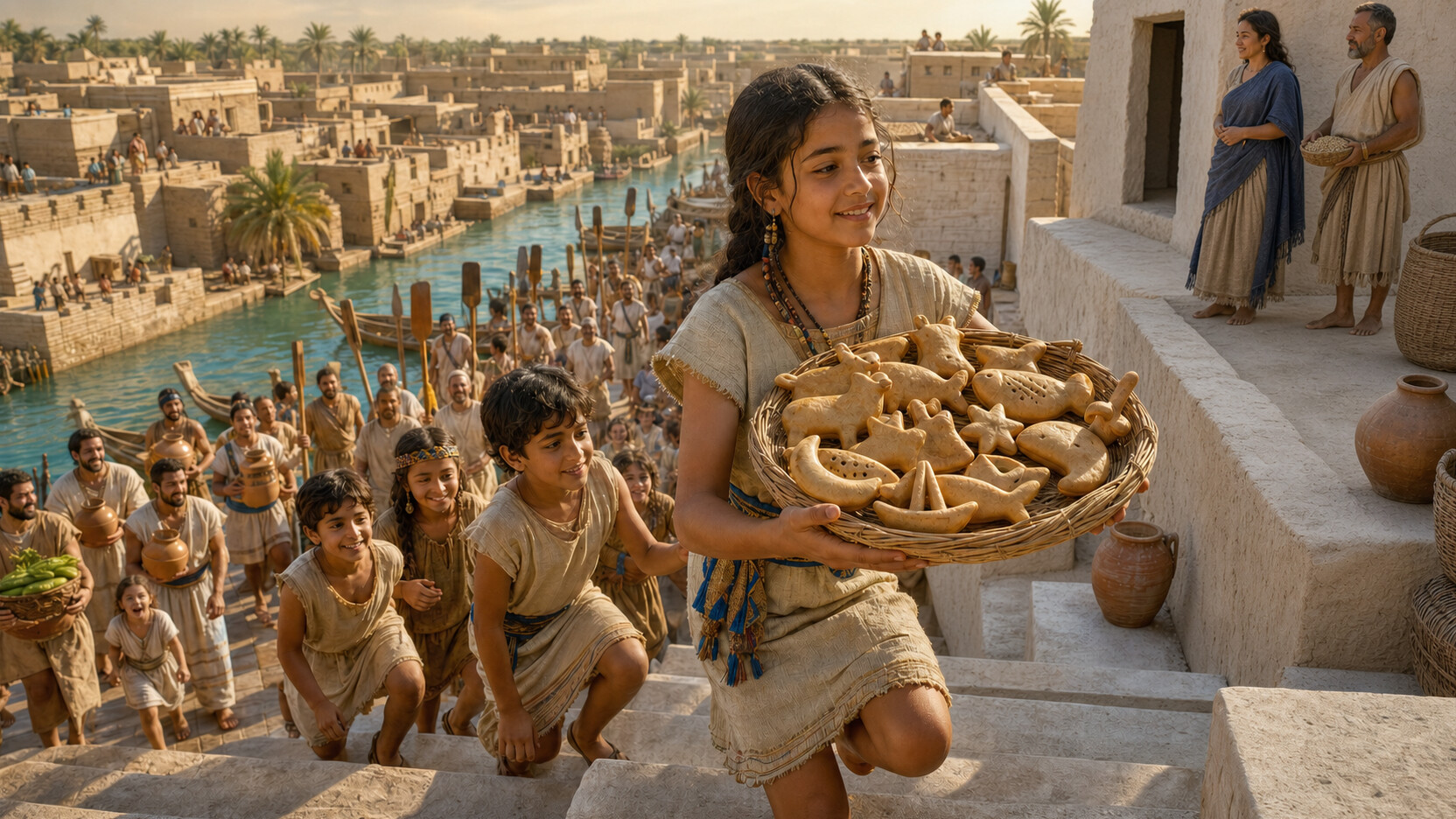
Amat knew the city by its smells.
Near the river gate, it smelled of wet rope, fish scales, and the black mud scraped from the bottoms of reed boats. The potters’ lane smelled of smoke. The copper yard smelled sharp enough to taste. At the bakers’ courtyard, where her father worked before sunrise, the air smelled of sesame, hot brick, and the flat loaves she had been told not to touch.
She touched one.
“That loaf belongs to the goddess,” her father said without turning.
Amat put it back. “She can have the next one.”
“The goddess ordered first.”
Today everyone had orders.
The river had begun to fall, leaving fresh silt along the fields, and the city was preparing the procession that opened the canal gates. Sweepers cleared the broad road to the temple platform. Brewers rolled jars into the shade. Gardeners arrived carrying onions, dates, and the first cucumbers of the season. Two scribes sat beneath an awning with clay tablets on their knees, recording each delivery while arguing about whose reed stylus had disappeared.
Amat’s mother came from the weaving house with a folded length of blue wool balanced on her head.
“Straight from the dye bath,” she said. “Do not touch it.”
Amat showed her blue fingers.
Her mother sighed. “At least now they match.”
Amat’s own task was to carry a basket of small bread figures from the bakers’ courtyard to the temple kitchen. There were cattle, fish, moons, stars, and tiny boats with sesame seeds for passengers. She counted them at every corner because children followed her through the lanes offering to guard the basket.
“From what?” she asked.
“Us,” they said.
The temple rose above the flat roofs in bright tiers of whitewashed brick. From its stairs, Amat could see the whole city moving toward the processional road. Brickmakers came with red dust in the lines of their hands. Boat crews carried polished oars. The reed cutters wore new belts. Soldiers stood at the gate with clean spearheads and flowers tucked behind their ears.
In the upper courtyard, the ruler waited beside the high priestess. He wore a wool skirt heavy with fringe and looked hot. The priestess wore Amat’s mother’s blue cloth across one shoulder. It shone like river water.
A kitchen steward took the bread figures from Amat and arranged them around a large round loaf. One little sesame passenger had lost its head.
The steward looked at Amat.
“Dangerous river,” she said.
He placed the headless passenger at the back of the boat.
When the drums began, the city answered.
The ruler lifted a basket of seed. The priestess poured river water into a stone basin. Below them, workers pulled the wooden gate lever, and water rushed into the first canal with a brown flash. People cheered from the banks. Children ran alongside the new current until the guards shouted and then ran faster.
At sunset, the temple servants returned the offered bread to the courtyards in great baskets. Amat found her family on the roof, where neighbors had spread mats between cooling jars. Her mother tore the goddess’s loaf into pieces and passed the first one to Amat’s father.
“Did she like it?” Amat asked.
He tasted the bread with great concentration.
“She left us the best part.”
Below them, lamps appeared one by one along the canal. Above them, the first stars took their places.
4. Bread and Games
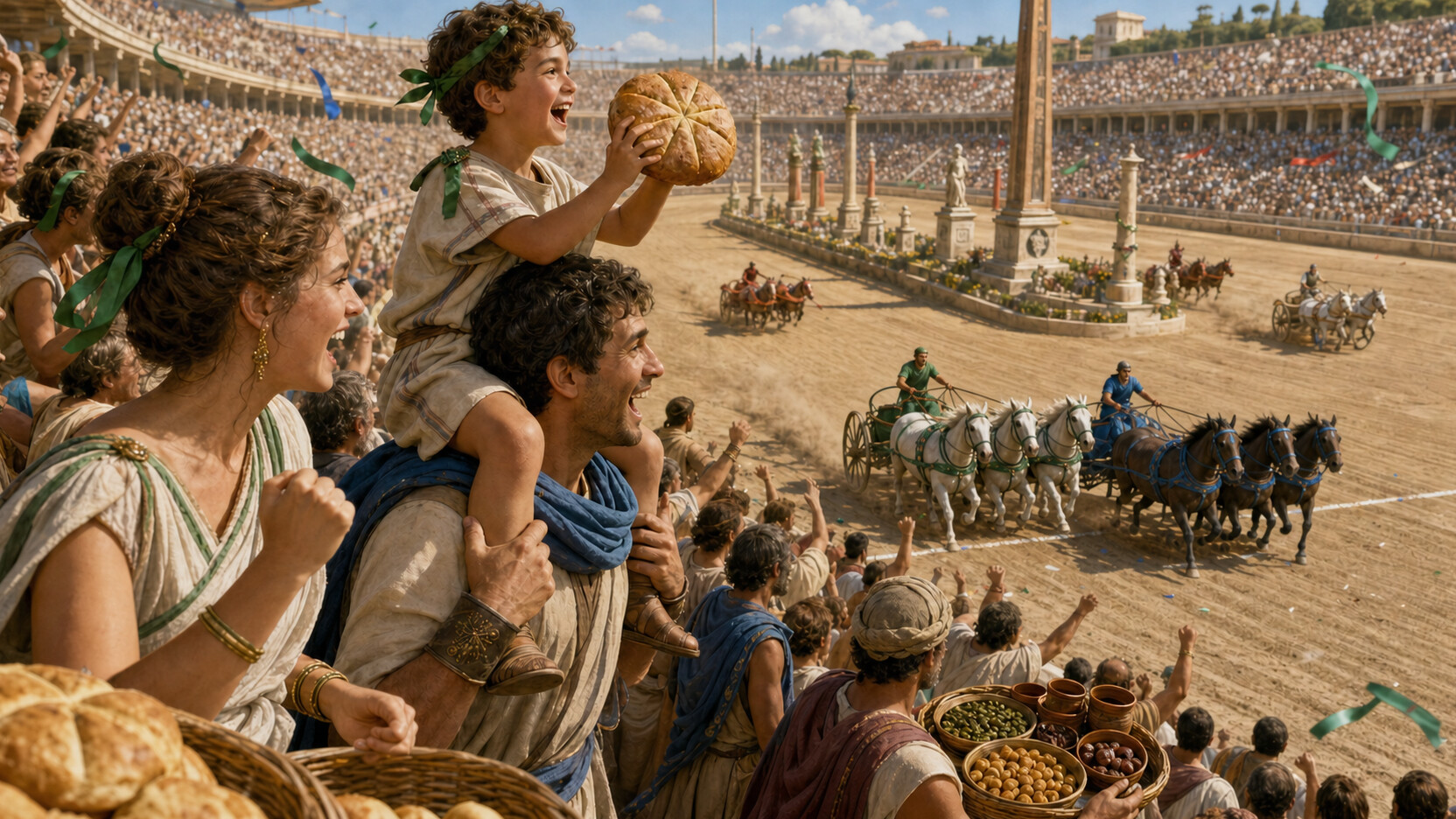
The bread arrived before the emperor.
Porters carried it through the Circus gates in baskets wide enough to bathe a child. Each round loaf bore the mark of the public bakery. The smell traveled up the stone seats faster than the porters did.
Junia held the family’s bread token in one hand and her son’s wrist in the other.
“Green!” Lucius shouted at everyone wearing green.
“Green!” they shouted back.
Her brother Marcus walked behind them in a blue scarf.
“Do not answer him,” Junia told Lucius. “He is confused.”
Marcus lifted the end of his scarf with dignity. “Some of us support experienced drivers.”
At the distribution arch, a clerk took their token and dropped it into a bronze bowl. A baker handed Junia two warm loaves. She passed one to Marcus, although he was Blue, and tucked the other beneath her arm.
Inside, the Circus was already a city of its own.
Vendors climbed the aisles with dates, chickpeas, sausages, watered wine, lucky ribbons, and tiny clay horses painted in faction colors. Children traded driver names. Sailors from the river docks argued with soldiers on leave about the condition of the sand.
Junia’s family squeezed into a row between a fishmonger and three sisters from the Aventine. The sisters wore green flowers in their hair. The fishmonger supported Red but had brought a green cushion because, he explained, comfort had no faction.
Trumpets sounded.
The emperor entered beneath a canopy at the far side of the track. The crowd rose in a rolling wave. Lucius stood on the seat and waved both arms as if the emperor had come specifically to find him.
Then the gates opened.
Four chariots burst onto the sand.
The first lap was noise. The second was dust. By the third, everyone around Junia had become an expert on reins, wheel angles, horse temperament, track moisture, and the moral character of each driver. Green held the inside. Blue stayed half a length behind. Red and White fought for space near the turning posts.
Marcus leaned so far forward that Junia caught the back of his belt.
“Sit.”
“I am helping.”
“Your driver cannot hear you.”
“Then why is he going faster?”
On the final turn, Blue moved outside. Green answered. They came down the straight together, horses stretched flat and wheels flickering in the sun. The whole Circus rose.
Lucius climbed onto Marcus’s shoulders. Junia forgot to tell him to get down. The fishmonger crushed his green cushion against his chest. The three sisters screamed the driver’s name in perfect harmony.
Green crossed first by the width of a horse’s nose.
The Circus became thunder.
Junia hugged the fishmonger. Marcus hugged a stranger in blue and then denied doing so. Lucius threw half a loaf into the air, caught it badly, and ate the part that landed on his uncle.
Below them, the winning driver lifted his wreath. Green ribbons poured from the upper seats. Blue supporters announced that the turn had been illegal. Red supporters announced that both teams had been lucky. The emperor applauded. The horses trotted a victory lap beneath a rain of flowers.
Junia broke the remaining bread along its scored lines and passed it down the row.
“Green tomorrow?” Lucius asked his uncle.
Marcus handed him the largest piece.
“Not even for bread.”
5. The Bell, the Field, and Heaven
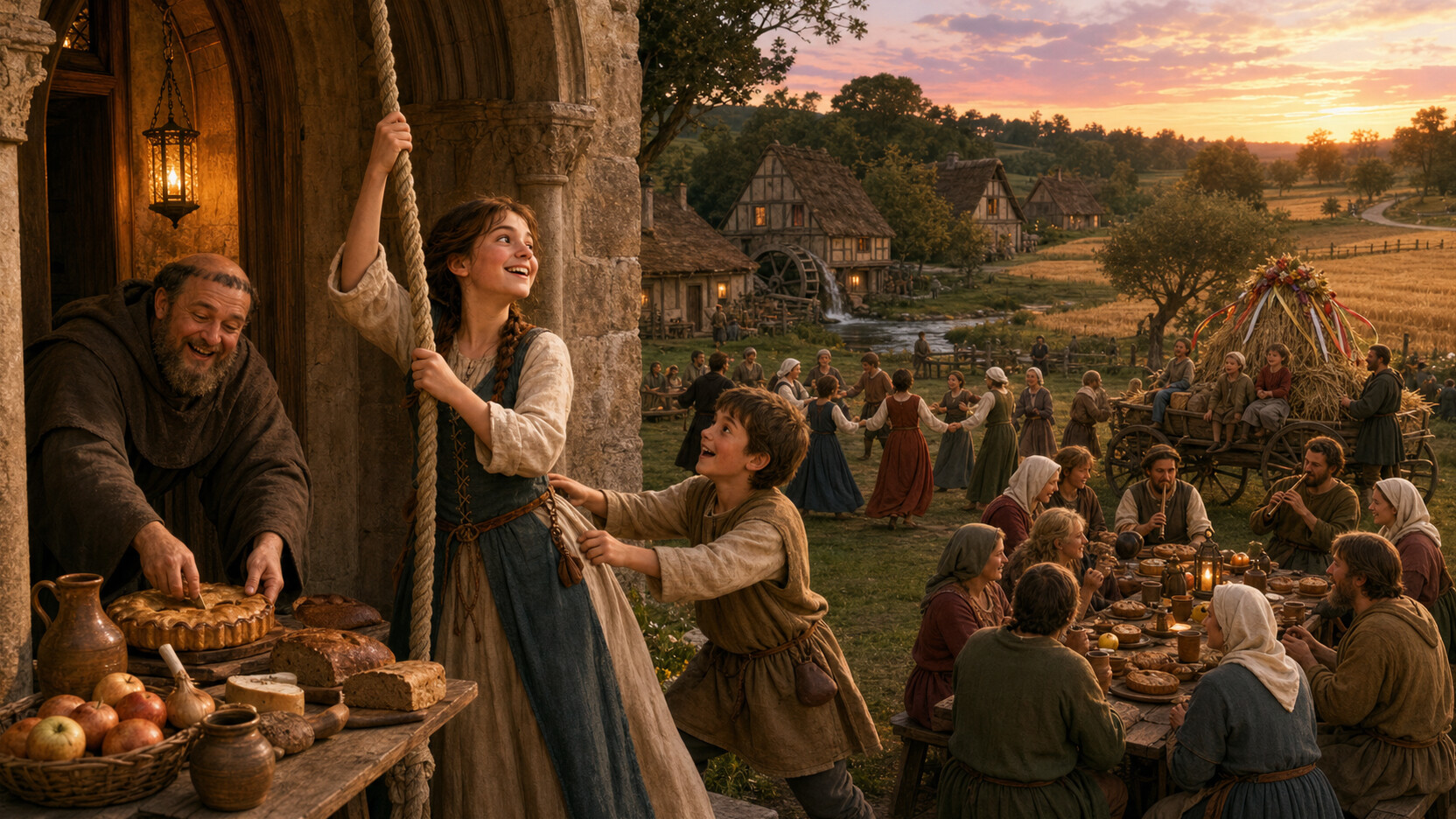
The bell was late, and everyone noticed.
Aveline stood in the rye field with her sickle resting against her shoulder. The sun had cleared the alder trees. The mill wheel was already turning. Even the baker’s chimney had begun to smoke, but the church tower remained silent.
“Perhaps morning has been canceled,” her little brother said.
Then the bell gave one enormous, surprised clang.
A flock of rooks rose from the roof. The oxen looked up. Across the field, every head turned toward the tower.
Two smaller notes followed, then a pause, then another wild blow.
“That is not morning,” Aveline said. “That is either a wedding or Brother Tomas falling down the stairs.”
It was the rope.
By the time Aveline reached the churchyard, half the village had gathered beneath the tower offering advice. The bell rope had looped itself over a roof beam. Brother Tomas stood on the ladder while the priest held the bottom and objected to every movement.
“Left,” called the blacksmith.
“His left or ours?” asked the miller.
“The Lord’s left,” said Aveline’s grandmother.
Nobody knew which side that was.
The rope came free at last. Brother Tomas rang the proper morning pattern, and the village returned to work as if the sun had received permission to continue.
It was the final day of the rye harvest.
Families moved down the field in a broad uneven line, cutting and binding. Aveline’s father sharpened sickles on a stone. Her mother tied sheaves faster than anyone else and placed the crooked ones in a separate row for her husband. Children carried water, chased mice from the stubble, and gathered every fallen stalk into small bundles of their own.
At noon, the bell crossed the fields again.
The sickles stopped. People stood among the sheaves while the priest’s voice drifted from the lane, saying the familiar prayer. Aveline heard only every third word, but everyone knew where to answer. Then they sat in the shade of the hedge and opened cloths filled with brown bread, hard cheese, onions, and apples.
Her grandmother broke an apple with both hands and gave Aveline the larger half.
“I saw that,” her brother said.
“Grow older,” said Grandmother.
By evening, the field stood golden and bare. The last sheaf was dressed with ribbons and carried to the church porch. One cart went to the mill. One portion filled the parish store. Seed grain was lifted into the driest loft. The rest traveled home in wagons with children riding on top and singing verses that became less respectable with every repetition.
The harvest supper filled the green after sunset.
The baker brought pies from the common oven. The shepherds played pipes. The carpenter turned two benches into a table and complained when dancers used it as a bench. Lamps shone in the church doorway, where painted saints watched the feast with bright round eyes.
Brother Tomas found Aveline beside the bell rope.
“You counted every ring today,” he said.
“You rang one extra at dawn.”
“The bell was clearing its throat.”
He placed the rope in her hands.
Aveline rang for the dance.
The first note rolled over the roofs, the harvested field, the millstream, the orchard, and the road disappearing into the dark. Everyone on the green cheered. The musicians began before the echo had faded.
Her brother pulled her toward the circle.
“Who rings the bell in heaven?” he asked.
Aveline looked back at Brother Tomas, who was already reaching for a pie.
“Someone with better timing.”
6. When the Clock Entered the Body
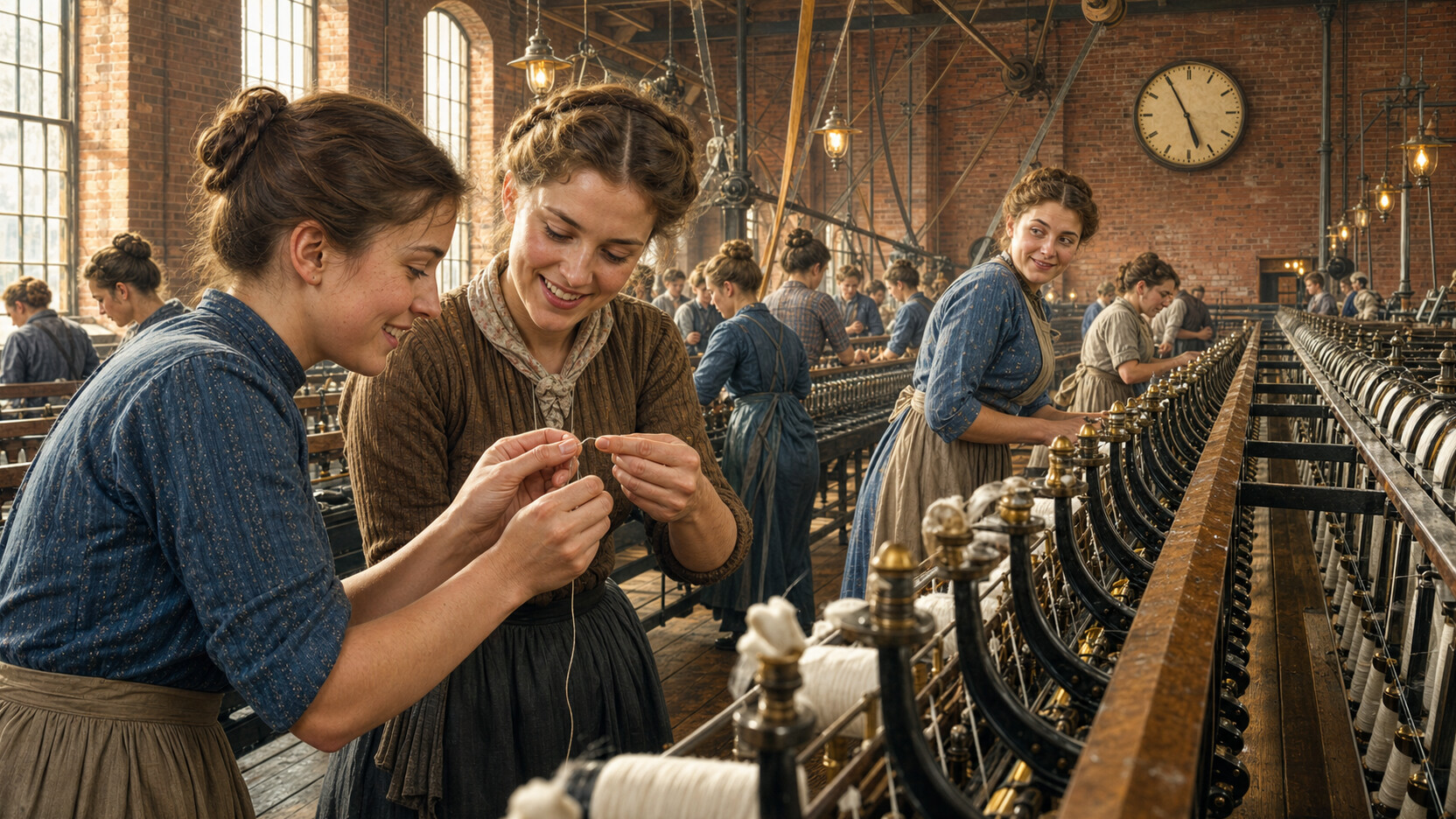
The factory clock ran four minutes fast.
Mr. Bell called this efficiency. Everyone else called it four minutes.
Nell Foster reached the gate while the minute hand still trembled below six. She held up her worker token for the porter, hurried across the brick yard, and joined the stream of women climbing the spinning-room stairs.
“Three minutes to spare,” said Ada beside her.
“Seven by the church clock.”
“The church does not pay us.”
At six, the steam whistle sounded.
The mill woke floor by floor. Shafts began to turn beneath the ceiling. Leather belts caught, slapped once, and settled into motion. Rows of frames shivered into life. Hundreds of bobbins spun beneath the gas lamps, pulling clean white thread from soft clouds of cotton.
Nell tied back her sleeves and walked her section.
She tended two spinning frames, each longer than her family’s kitchen. She knew their voices: the smooth humming run, the dry chatter of a hungry bearing, the quick tick of a thread about to break. Her new assistant, Rose, heard only noise.
“Number twelve is unhappy,” Nell said.
Rose leaned closer. “Which one is twelve?”
“The unhappy one.”
A thread snapped.
Rose caught the loose end on her second attempt. Nell showed her how to twist the fibers between damp fingers, join them without a knot, and return the spindle before its neighbors gained too much distance. By the fourth break, Rose no longer needed help. By the sixth, she was correcting Nell’s reach.
The room moved by bells.
One bell opened the windows. Two called the mechanic. At eight, a short ring sent the first group for tea. At noon, the frames coasted to silence, leaving everyone’s ears full of a ghostly hum.
The workers carried lunch into the yard. Nell had bread, cheese, and an egg. Ada had pickled onions and enough opinions for the entire spinning room. Rose had forgotten her spoon, so they passed one around while a brass band practiced beyond the warehouse.
The band belonged to the mill. Its cornet player worked in packing, its drummer fired the boilers, and its conductor kept the accounts. They were preparing for Saturday’s contest against the railway works.
“We need another alto horn,” Ada told Nell.
“I do not play.”
“Neither does Walter, and that has never stopped him.”
The afternoon brought a rush order: blue sewing thread for a uniform maker in Leeds. The foreman brought new counts. The mechanic adjusted the gearing. Nell divided the frames with Rose and Ada, and they kept the bobbins moving while carts crossed the floor collecting each finished row.
At five forty-eight, the final cart left their section.
At six, the whistle released them.
Outside the pay office, Nell exchanged her token for a paper envelope. She counted the coins beneath the yard lamp: rent, coal, food, a little for her mother, and sixpence for the evening arithmetic class at the Mechanics’ Institute. Two pennies remained for Saturday.
“Alto horn,” Ada said.
“Seed cake.”
“You cannot march with seed cake.”
“Then I will eat while standing still.”
They walked home with the crowd, past foundries, warehouses, chapels, shops, and rows of lit windows. Behind them, the night shift entered through the same gate. Ahead, the church clock struck six—four minutes after the factory had already done so.
Nell smiled.
“Slow,” she said.
7. The Career and the Good Life
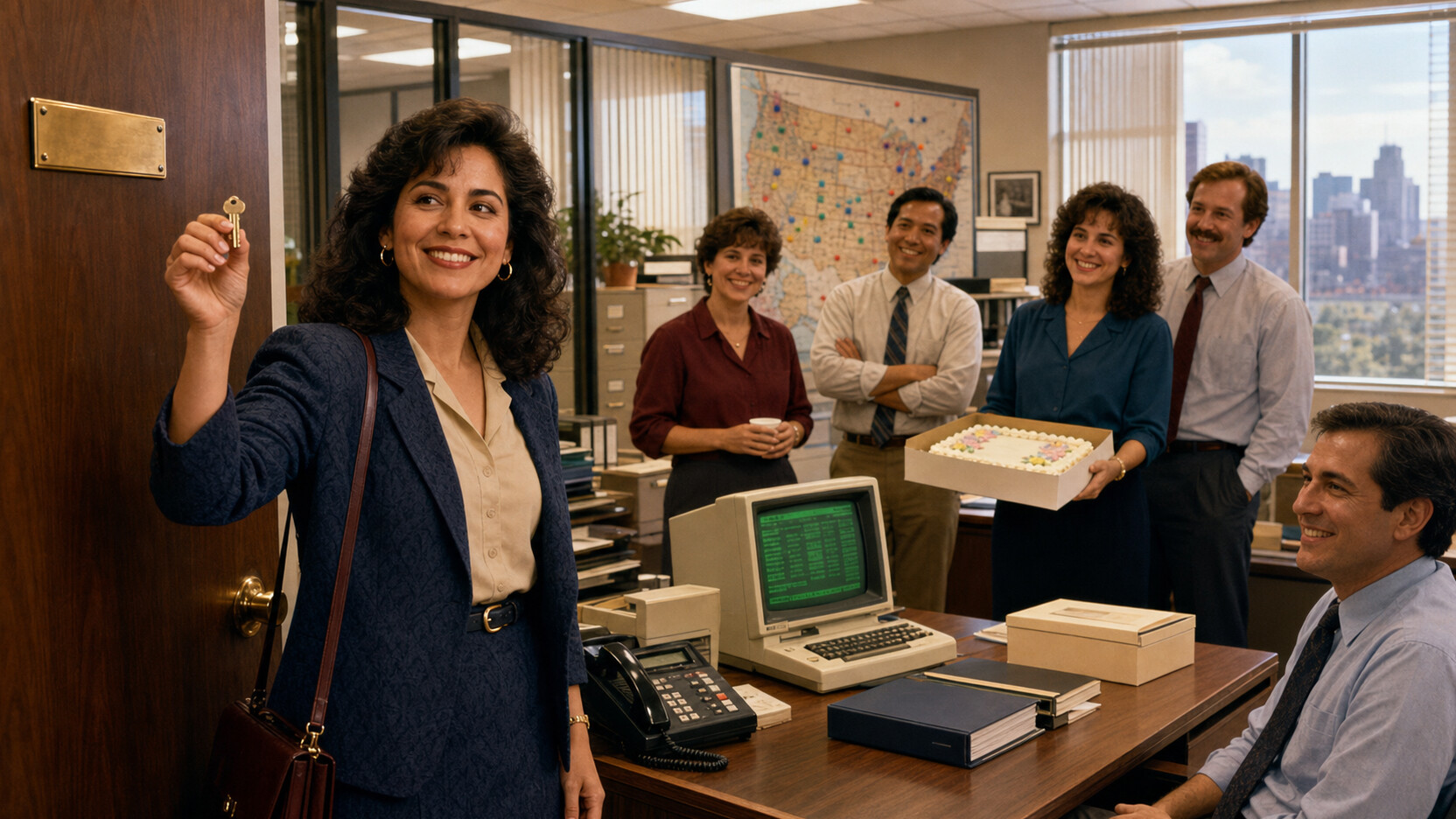
The promotion came with a key.
Teresa Alvarez turned it over in her hand while Mr. Hanley explained the new position, the new salary, and the new office on the seventh floor.
“It has a door,” he said.
“I saw.”
“And a window.”
“I was hoping the salary might have one too.”
Mr. Hanley laughed, then checked the paper again and added twelve hundred dollars.
Teresa had joined the company in 1974 with a business diploma, two navy skirts, and strict instructions from her mother never to volunteer for making coffee. Twelve years later, she knew every warehouse, delivery route, supplier, sales territory, and seasonal disaster in the home-appliance division. She could look at a production schedule and tell which truck would arrive late before the truck had left Ohio.
By nine thirty, a brass plate on the seventh floor read REGIONAL PLANNING. Her name appeared on a box of new business cards. A computer terminal hummed on the desk, its green letters waiting patiently beneath the window.
Her team welcomed her with a sheet cake from the cafeteria.
CONGRATULATIONS TER—
The decorator had run out of room.
“Very efficient,” Teresa said.
Her first meeting began at ten. Sales wanted more washing machines in the Northeast. Production wanted fewer changes. Transport wanted everyone to remember that snow existed. Teresa moved colored magnets across a wall map, shifted two warehouse deliveries, and found three thousand units sitting in the wrong forecast.
At noon, the numbers balanced.
“How did you do that?” asked Peter from sales.
“I asked transport about the snow.”
During lunch, Teresa took the elevator to Personnel. Her new packet included health coverage, a larger retirement contribution, four weeks of vacation, and a small booklet showing how compound interest could turn years into a house by a lake.
She called her husband from the lobby pay phone.
“We can replace the furnace,” she said.
David was quiet for a moment. “That is the least romantic celebration I have ever heard.”
“We can replace it romantically.”
“Dinner first.”
“And the furnace.”
At five fifteen, Teresa closed her office door for the first time. She carried the unfinished cake to the parking lot, where colleagues were changing shoes for the company softball game. They persuaded her to play one inning. She hit the ball directly at Mr. Hanley, who dropped it with admirable loyalty to management.
Home was a brick house twenty minutes away with a mortgage payment pinned beside the refrigerator. David had set the dining table with candles. Their daughter Elena had drawn a sign that said BOSS MOM in purple marker. Their son Michael wore one of Teresa’s old college mortarboards and demanded a speech.
Teresa placed the new business cards beside each plate.
They ate roast chicken, cake, and the ice cream David had hidden behind the frozen peas. After dinner, they opened the road atlas across the table. Four weeks of vacation became a route through national parks, a rented cabin, three nights beside a lake, and a promise that nobody would discuss washing machines after crossing the state line.
Michael tapped the retirement booklet.
“What happens when you finish working?”
Teresa looked at the little illustrated house by the water.
“First,” she said, “we fix the furnace.”
8. Everyone in the Arena
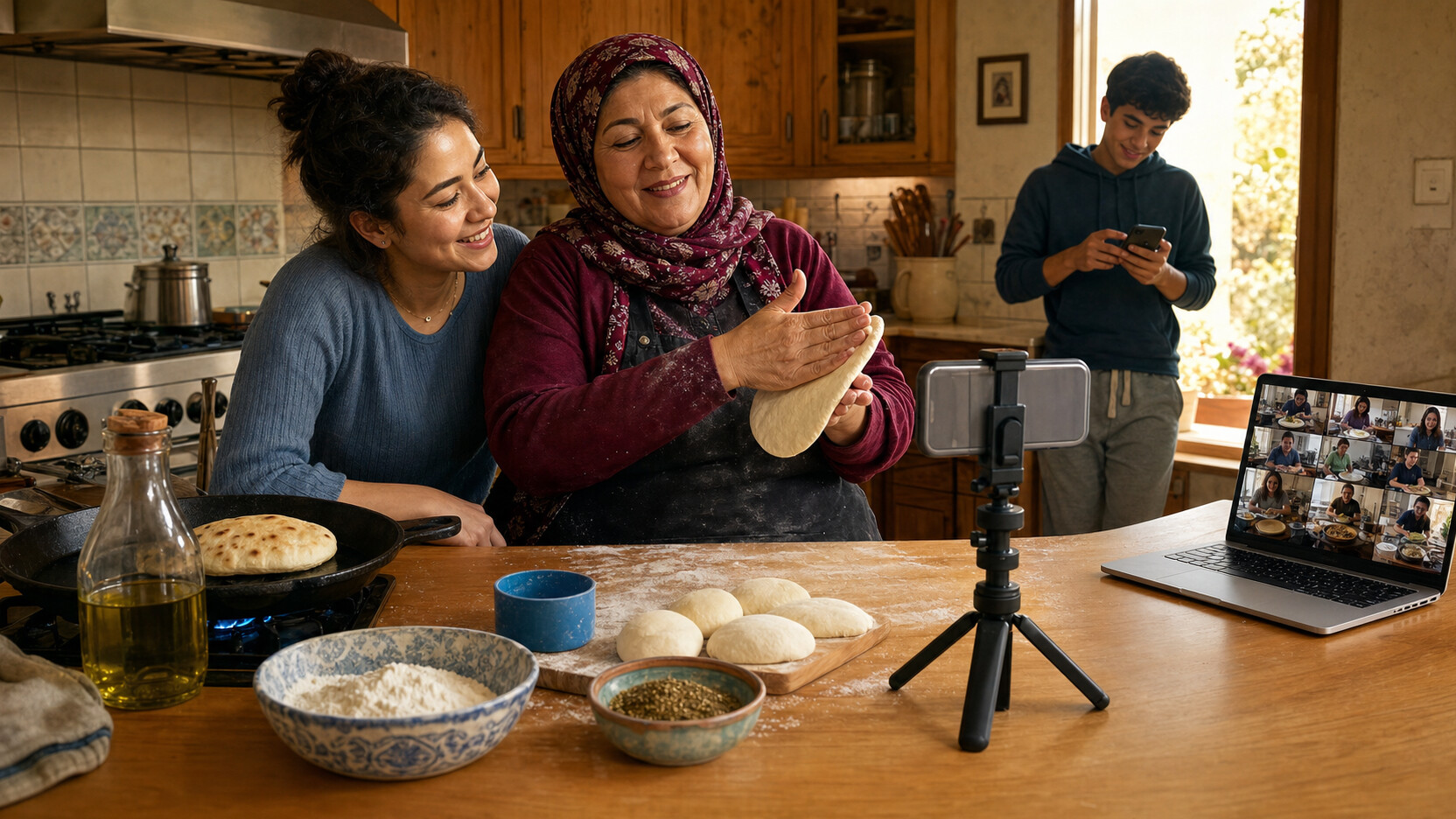
The first viewer arrived before the dough had risen.
Nadia propped her phone against the sugar jar and waved at the screen.
“Hello, Cousin Rami.”
A small heart floated past her face.
Her grandmother Salma looked over from the kitchen table. “Is he inside the telephone?”
“He is watching from Montreal.”
“Then tell him he still owes me a visit.”
Rami had asked for Salma’s flatbread recipe. Nadia could have written it down, but Salma measured flour with a blue cup that had lost its handle, water with her palm, and yeast by saying enough. A live video seemed easier.
At first there were twelve viewers. Nine were relatives.
Nadia introduced the ingredients while Salma corrected her.
“Two cups of flour.”
“Three.”
“You put in two.”
“The cup is larger when I hold it.”
The viewers sent laughing faces. Rami shared the video with friends. Someone asked whether the recipe worked without a stone oven. Salma leaned toward the phone until one eye filled the screen.
“Bread works where people are hungry.”
The viewer count climbed to eighty-seven.
A baker in Marseille asked about the flour. A student in Manila wanted to know whether she could use a frying pan. A man waiting for a bus in Toronto sent a picture of the blue cup his own grandmother used. Salma forgot that she had objected to the broadcast and began addressing the phone as if it were a crowded table.
“Not so much water,” she told Manila. “Marseille, your dough is too cold. Toronto, that cup is for coffee.”
Nadia’s younger brother joined from the living room, although he was six meters away. He added a row of fire symbols and denied it when Salma called his name.
By the time the dough was ready, four hundred people were watching.
Nadia divided it into balls. Salma flattened each one with quick turns of her hands and laid it on the hot pan. The bread swelled at the center. Comments moved too quickly to read.
Then the first reply video appeared.
A woman in São Paulo held up a round of dough and copied Salma’s wrist movement. Two children in Dublin tried it and dropped theirs on the floor. A restaurant cook in Seoul flipped a perfect bread into the air. The student in Manila showed a small pan on a dormitory stove and shouted when her bread puffed.
Nadia placed the replies beside the live video. Soon the screen became a wall of kitchens.
People compared flour, pans, fillings, grandmothers, and the correct way to rescue dough that had attached itself to a ceiling. Someone added music to Salma’s kneading rhythm. Someone else turned her larger cup explanation into a twelve-second song.
Salma watched herself sing from Nadia’s phone.
“I do not sound like that.”
“That is your voice.”
“The telephone has made it taller.”
When the final bread came from the pan, Nadia brushed it with oil and za’atar. She broke it open close to the camera. Steam clouded the lens.
The viewer count passed thirty thousand.
“How many?” Salma asked.
Nadia turned the screen toward her.
Salma looked at the number, then at the empty flour bowl.
“Rami invited too many people.”
She reached for the large cup.
“We make another batch.”
9. 2026: What If We Are Not Needed?
On Monday, Mara’s new AI assistant completed the week’s work before anyone had finished breakfast: interviews summarized, prototypes compared, estimates checked, presentation drafted, and the launch announcement translated into twelve languages.
Dev refreshed the board.
“Do it again,” he said.
“That is not how finished works.”
They checked everything. The figures added up. The translations read naturally.
At ten, Mara closed the presentation.
“We are going outside.”
The assistant prepared directions, appointment notes, and questions. Mara added tape, markers, cardboard models, and a blank page.
At the community center, Mr. Benítez showed them that the device screen disappeared in sunlight. Two teenagers redrew the menu buttons. A baker tested the controls with flour on both hands. Dev dropped a cardboard model, and the teenagers improved it by stepping on the remaining pieces.
By four, they had a brighter screen, larger buttons, and twelve new problems that had not appeared in any summary.
Their manager called while Dev was losing at table tennis.
“The board says the project is finished.”
“The board has not met Mr. Benítez,” Mara said.
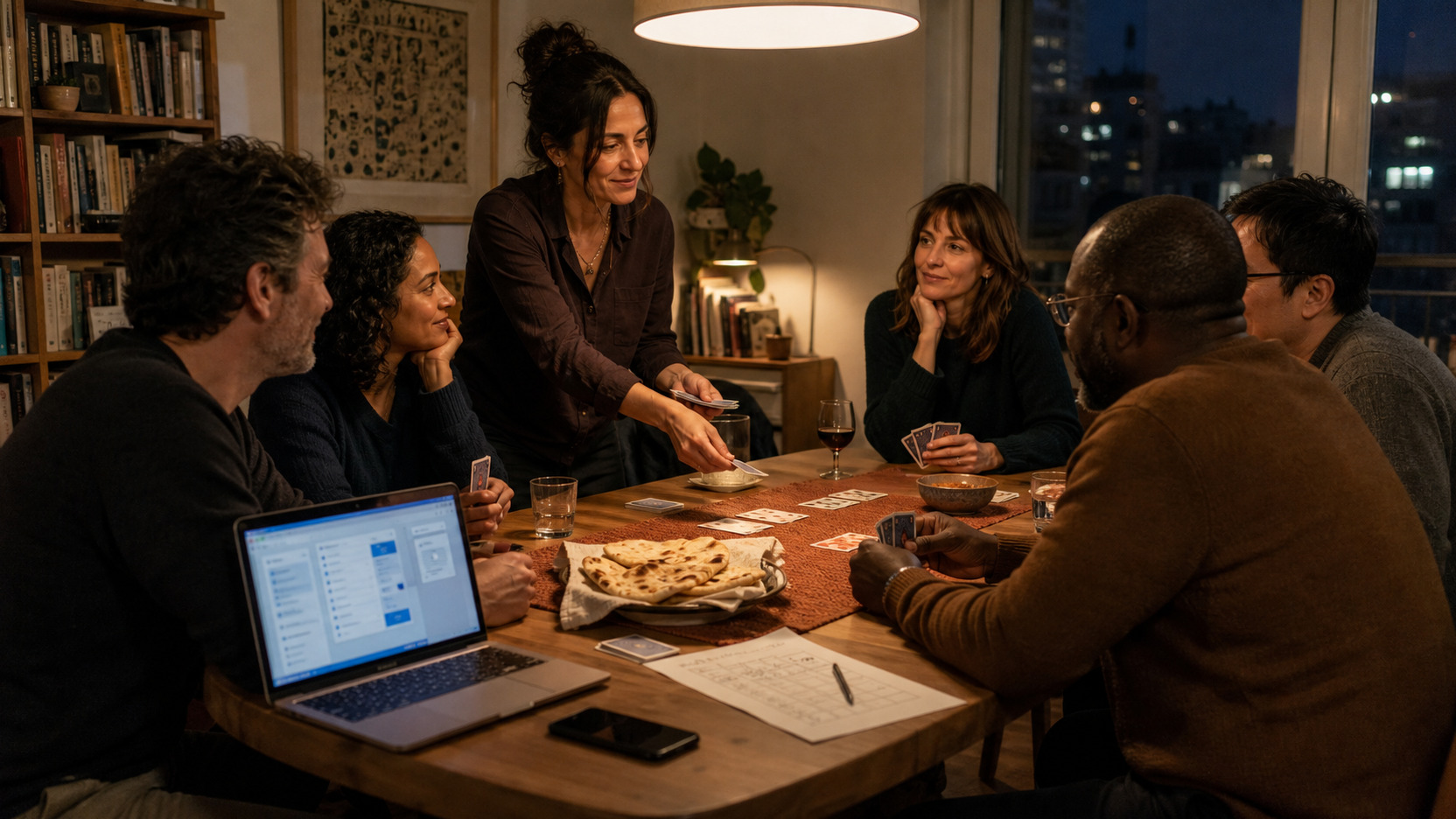
That evening, she took warm flatbread to the Thursday table at Lina’s apartment.
The six friends had met every Thursday since university. They ate, played games, and complained about people who scheduled Friday morning meetings.
This Thursday, three of them no longer had Friday morning meetings.
Lina had translated medical and legal documents for sixteen years. Last spring, her company had sent her to a conference as an expert. In February, it kept two reviewers and released the other forty-one.
Owen had trained junior programmers. There were no junior programmers in his department now. Cass had illustrated schoolbooks until a publisher generated an entire reading series during a Tuesday demonstration.
“The dragon had six fingers,” Cass said, opening the flatbread. “But it was delivered early.”
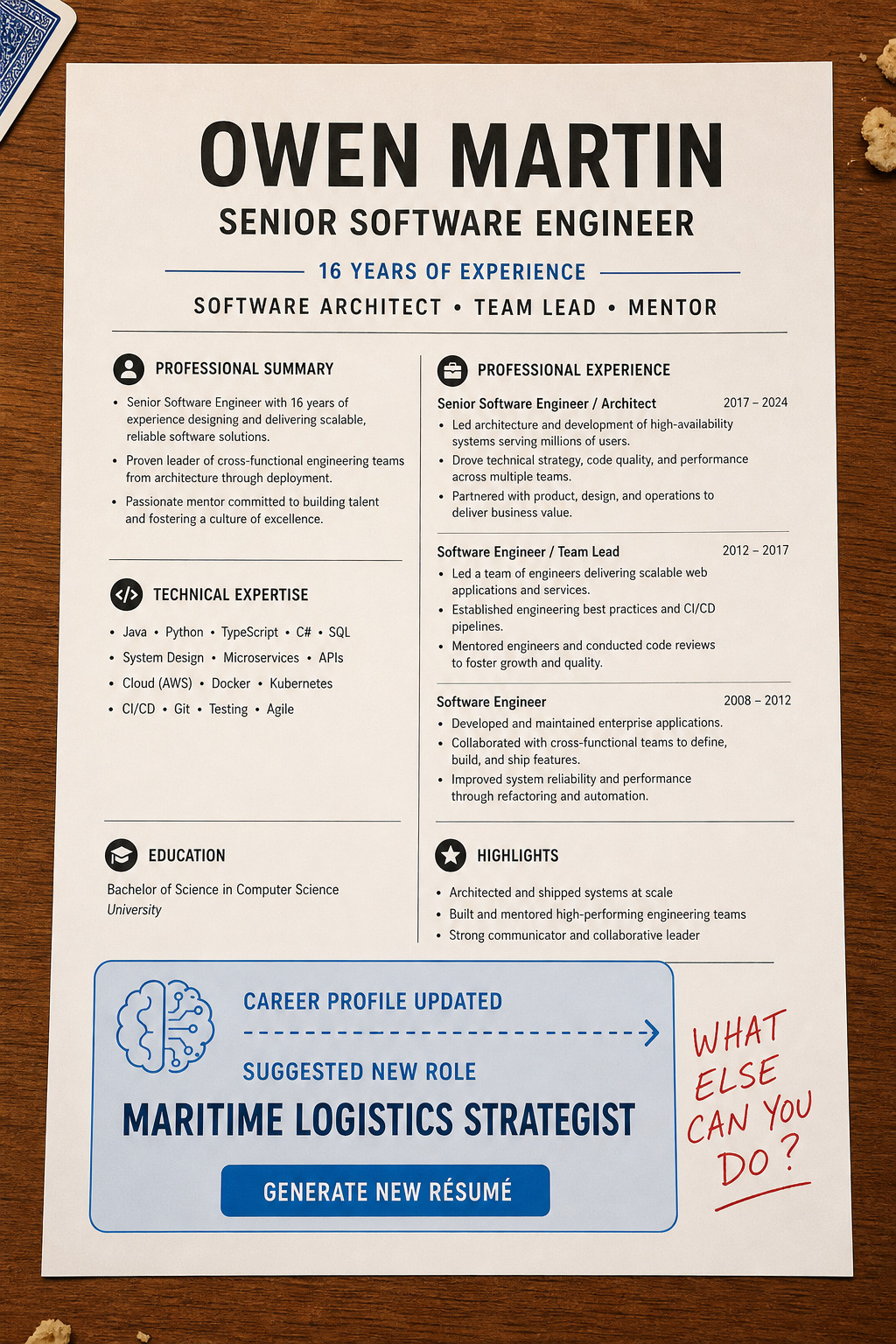
Owen dealt the cards while an AI service rewrote his résumé for careers he had not known existed.
“It believes I could become a maritime logistics strategist,” he said.
“Can you sail?” Mara asked.
“It did not mention sailing.”
Lina’s phone chimed with a rejection. She turned it face down and explained the rules of the game in half the time Owen had taken the previous week.
They played. Cass drew a better score sheet. Owen repaired the loose table leg. Lina caught Mara cheating accidentally and Dev cheating with concentration.
Between rounds, they opened the job spreadsheet.
Last year it had tracked promotions and salaries. Now it held application dates, automated rejections, insurance deadlines, and a column titled WHAT ELSE CAN YOU DO?
Lina tapped her row.
“I know three languages, two legal systems, medical terminology, and the difference between a sentence that is accurate and one that will frighten a patient.”
“Put that in the column,” Mara said.
“It does not fit.”
They ate the last bread while Mara described the sunlight problem. Her friends listened, asked questions, and rearranged the whole project between them. Cass sketched a folding shade. Owen suggested using the light sensor already inside the device. Lina pointed out that brightness meant little if older users could not understand the warning messages.
Mara added everything to the project board. The gold circle sorted their ideas and produced a plan before the next hand was dealt.
“Your manager will like that,” Dev said.
“He told me I see the whole system.”
“You always did.” Lina gathered the cards. “They just have a name for it now.”
For a moment, nobody spoke.
Then Owen looked around the table.
“What do we call the rest of us?”
Cass placed the repaired score sheet between them. Lina held the deck. Owen’s résumé continued improving itself on the counter.
Mara had known them as a translator, a programmer, and an illustrator for almost twenty years. None of those answers seemed to work anymore.
Lina began dealing the next round.
“Tonight,” she said, “you are all on my team.”
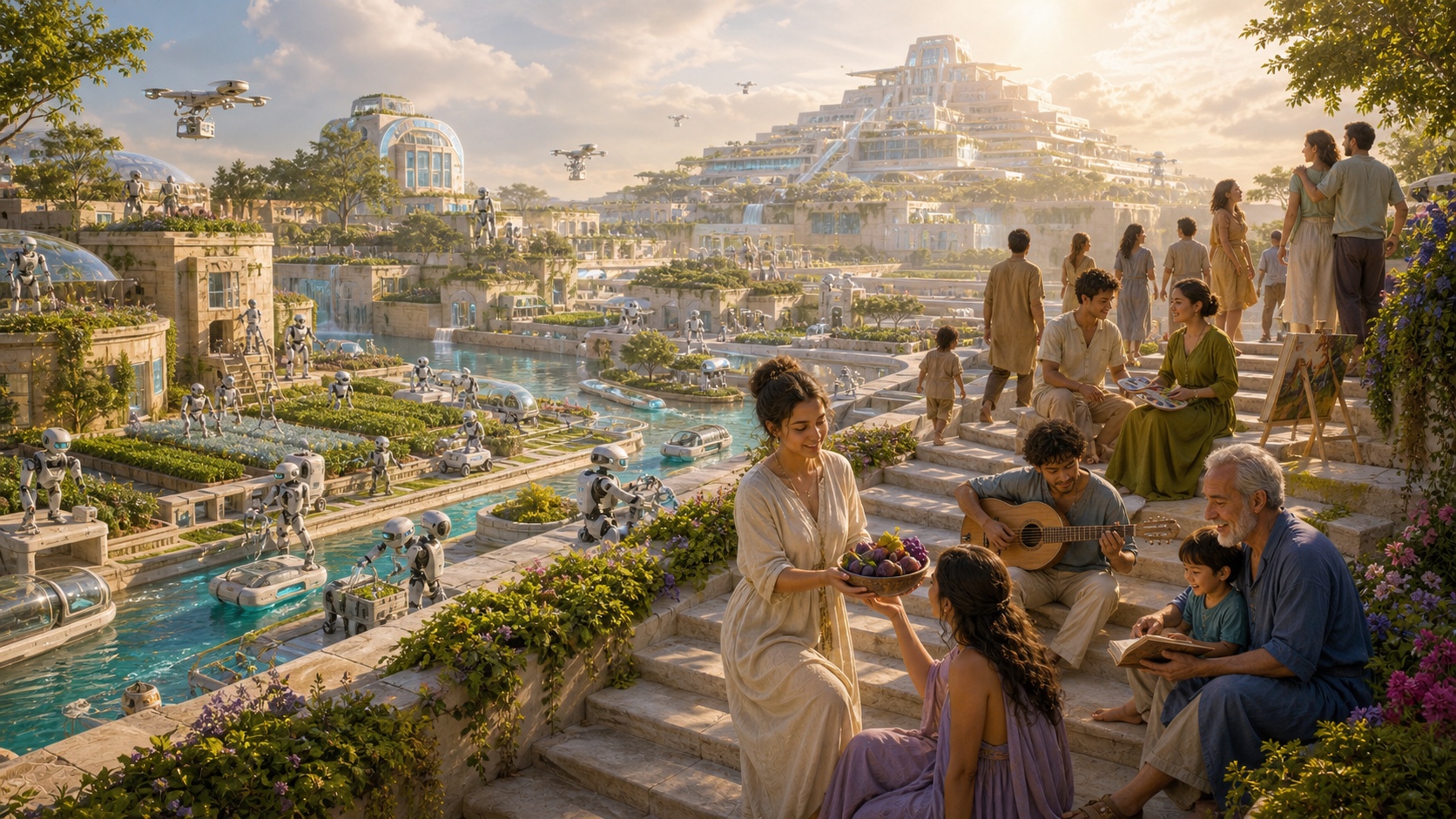
What waits for us when work is gone?
| Previous | 06 Aug 2026 | Next |



About me
Hello! My name is Stephan Schwab.

I build and rescue software, and I write fiction about the human side of how it gets made. Here you’ll find my stories and novelas, notes on craft, and field notes from a life lived across several worlds.
Working with software teams is what I do professionally — see how on caimito.net. You can also read about my experience since 1986.