The Office for What Is Right


In the city of Orben, people took pride not merely in avoiding mistakes, but in denying them every conceivable opportunity to occur. People wore black for seriousness, white for clarity, and gray for humility before the rules. Colorful facades were considered evidence of an immature will, and even the flowers at windows were usually white-blooming varieties, arranged carefully by height and symmetry. Anyone wishing to build a house in Orben had to own a plot of land, of course, but also prove that their intentions were good, their lines clean, and their future no burden to the common good. That was where the story of Mara Voss and the machine meant to make goodness faster began.
1. The Entrance
When Mara Voss climbed the steps to the Office of Building Regulation that morning, she held the folder of plans so tightly beneath her arm that the cardboard edge left a white stripe on her skin. It was early November, and even the sky above Orben seemed to honor the citywide agreement about the proper color temperature of life. There was no blue between the gray clouds, only a lighter form of duty.
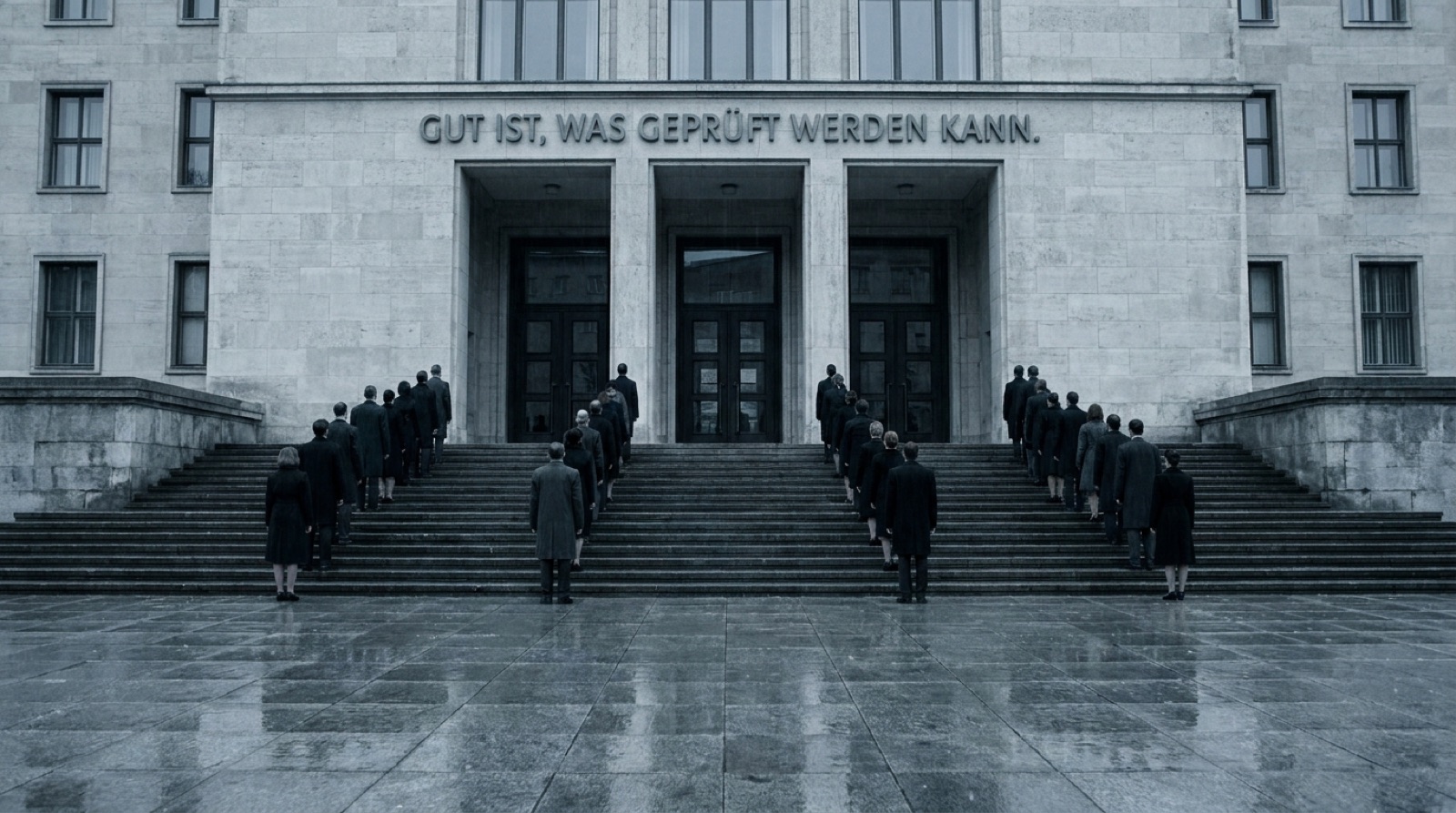
Four straight lines of applicants stood before the building. Two were for private builders, one for commercial projects, and the fourth for what were called correction concerns: those poor souls whose first submission had failed to meet expectations and who now had to appear again with renewed seriousness. No one spoke loudly. Conversation was not forbidden in Orben, but volume was considered a sign of inner disorder. People spoke with their mouths close to someone else’s ear, or not at all.
Above the entrance, set in metal letters, stood the sentence every child in the city knew by heart before learning to read: What is good is what can be examined. At first glance it sounded like a rule of reason. At second, like a prayer.
Mara was an architect, though not the admired kind who designed administrative buildings, bridges, or exemplary energy-efficient housing districts. She designed winter gardens, roof additions, small courtyards, stairwells, and the renovation of old workshops. She liked places where one could still see how life had rubbed the straightness of regulation a little thin around the edges. Her designs were not rebellious at all. In another city they might have passed as strict, restrained, and exemplary. In Orben, however, people said her work was human, and that was rarely a compliment.
Today was about the Levin family’s house, a narrow plot on the northern canal where a four-story home with a small courtyard was to be built. The design was precise, energy-efficient, sound on fire protection, and structurally beyond objection. The only problem was the courtyard. Mara had proposed three ginkgo trees and a pale ceramic facing for the courtyard wall, glazed to take on a delicate silver sheen in rain. Nothing loud, nothing colorful, only a note of warmth in a city that preferred to rest morality on contrast rather than liveliness.
At the last appointment, case officer Dierk Halden had told her the ceramic was open to interpretation. In Orben, interpretability was the beginning of administrative suspicion. A surface was supposed to be unambiguous or not exist at all. Gray render systems and white mineral paints were therefore popular, because they resisted every emotional reading. Mara had asked whether that was not precisely the danger: people eventually living in rooms that expected nothing of them except obedience. Halden had lifted his head, looked at her a second too long, and written in his minutes: Applicant side introduces subjective criteria.
Today a press presentation was to take place before normal processing began. A new system, the invitation said, would lead the city into a phase of administrative relief. Processing times for building permits would fall. The quality of decisions would rise. Citizens would benefit because good applications would be recognized more quickly and questionable intentions addressed sooner.
Questionable intentions. Mara had read the phrase three times. Until now, a building application had been a technical, legal, and sometimes aesthetic matter. Now a new category was pushing into the language of the office: intention. And in a city like Orben, intention was never merely intention. It was character, disposition, moral legibility.
Mara hung up her coat and looked at the large display over the hall. Instead of the usual Please have ready: land-registry extract, structural calculations, fire-safety certificate, it read: Presentation of the EIR system. Ethical Intelligence for Regulatory Procedures. Begins 08:30. Hall of Appropriateness.
She briefly closed her eyes. Even the name was typical of Orben. A machine could not simply be fast, efficient, or powerful. Its very title had to prove that it stood on the side of the good.
Beside her, someone breathed out softly. It was Tom Levin, the applicant, in an anthracite coat, with the expression people acquired when they had to return to the same authority for the third time in six months with the same papers.
“If this new intelligence is as clever as it claims, perhaps it will finally see that we only want to build,” he said.
Mara nodded without replying. She knew Orben too well to believe in that kind of cleverness. In this city, intelligence often meant only that prejudices had been arranged more quickly and elegantly.
2. The Demonstration
At the front of the stage stood a matte-white console with a narrow dark glass surface, flanked by motionless officials in black suits. Above it, silver letters shone on the large screen: EIR 1.0. Because rightness does not deserve to wait.
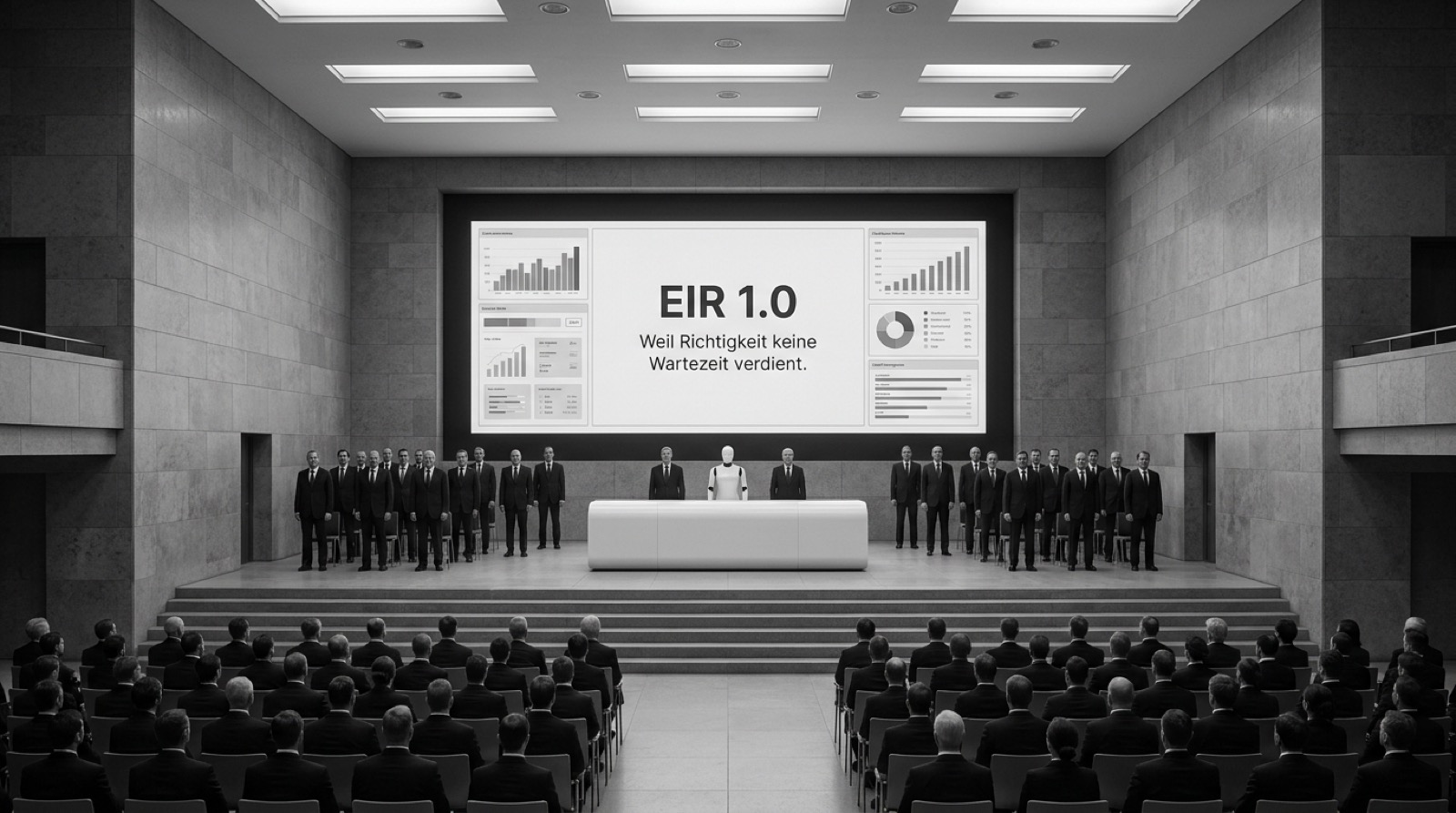
Mara sat in the sixth row. To her left was a woman from the housing cooperative association; to her right, a man from the building chamber whose collar sat so precisely it gave him something inhuman. Councilor Selma Erhardt came to the lectern, a woman whose features were so controlled that even her smallest expressions seemed pre-approved.
“Orben,” she began, “has always been strongest when we have relied not on mere speed, but on ordered rightness. Yet we must not miss the good through slowness. For too long, families, businesses, and institutions have suffered avoidable processing backlogs. Too often, our staff’s care has been tied up in formal routines rather than the essential questions. With EIR we bring the two together: conscientiousness and contemporary automation.”
No one applauded before Erhardt had finished the sentence and lifted her eyes from the manuscript. Even applause had a proper time in Orben.
Then the manufacturer took the stage: not a global technology corporation, but Claritas Civic Systems of Basel, represented by its founder, Dr. Ivo Nerlich. He was one of those men whose voice outsourced cruelty by disguising it as sobriety. He spoke without hurry or warmth, but with the confidence of someone who knew his words had reached the rooms where power decided things before the audience had fully grasped their meaning.
“EIR does not analyze applications merely for completeness and compliance,” he said, while diagrams appeared behind him that gave even chance the form of axes. “The system recognizes patterns of good planning. It distinguishes formal correctness from substantial orientation toward the common good. It evaluates coherence of use, risk ethics, social compatibility, energy honesty, urban humility, and what we call the moral legibility of a proposal.”
Several heads bent at once to take notes. Moral legibility. Orben loved terms that meant everything and therefore ought not alarm anyone directly.
Nerlich showed case studies in which buildings suddenly became questions of character: cautious, service-minded, responsible, latently self-centered. It was as if someone had connected a sermon machine to the zoning plans.
At last he asked for a live run. The Levin family’s application appeared on the screen. Mara felt Tom freeze beside her. The plans, sections, and elevations of her project passed by in a calm sequence. EIR scanned the documents with an almost beautiful composure. Then it displayed an assessment wheel, its segments lighting up in shades of white and gray.
Formal completeness: 98 percent.
Regulatory compliance: 96 percent.
Structural appropriateness: 100 percent.
Moral legibility: 61 percent.
The hall filled with that particular kind of silence made not of quiet but of collective judgment.
Nerlich inclined his head slightly, as though simulating regret without diminishing the system’s dignity. “The design is technically strong,” he said. “At the same time, the courtyard signals an excess tendency toward individualized atmosphere-making. The choice of ceramic cladding and the tree-related placement shift the courtyard from neutral residential function into a semi-private space of meaning. Such spaces can contribute to social exclusion if they are not sufficiently justified through an architecture of common spirit.”
Mara thought she had misheard him. Atmosphere-making. Space of meaning. Architecture of common spirit. Words that made a courtyard sound like an ideological gamble.
She raised her hand. Not high, not defiantly, only clearly enough that she could not be overlooked.
“Under what law,” she asked when Erhardt gave her the floor, “does a permitting system decide about atmosphere?”
Nerlich did not smile. He was one of those people who regarded a smile as a loss of institutional gravity. “It does not decide about atmosphere, Ms…”
“Voss.”
“It recognizes indicators of likely effects of use. Our analyses show that building forms organize not only functions but orders of value. If the city wants permits to serve the common good, it must make that order visible.”
“Or invent it,” Mara said.
A few heads turned toward her. In Orben, dissent was not a scandal as long as it was offered in the proper register. It became dangerous only when it developed an idea.
Erhardt returned to the lectern. “EIR does not replace the administration,” she said. “EIR supports it. Final decisions remain with the office. We are speaking of responsible preliminary review: of freeing qualified experts from repetitive burdens, of more time for truly difficult cases.”
Mara thought: difficult cases. From now on, that would presumably mean every plan that did not radiate the proper humility.
When the event ended, the guests received a brochure of white card, printed in dark gray. Its cover read: Trust through traceability. Inside, Mara found a sentence that looked like an incidental bureaucratic phrase but contained the core of the coming change: EIR learns from decisions of high institutional integrity.
She stopped. Learning from decisions of high institutional integrity meant nothing other than that the machine was not meant to learn justice, but habit. Not fairness, but power’s already honored taste.
3. The City of Impeccable Intentions
On her way back to the office, Mara deliberately avoided the direct route. She went through the Old Outer District, past shopfronts with white signs and black letters, bakeries displaying pastries like mathematical problems, and a school whose playground was divided so geometrically that even the children’s running looked diagrammed. Orben was not an obviously cruel city. No one went hungry. The streets were safe. The files were in order. Water, electricity, and district heating worked with almost irritating reliability. People greeted one another, helped carry heavy boxes, and enclosed handwritten apologies with late bills.
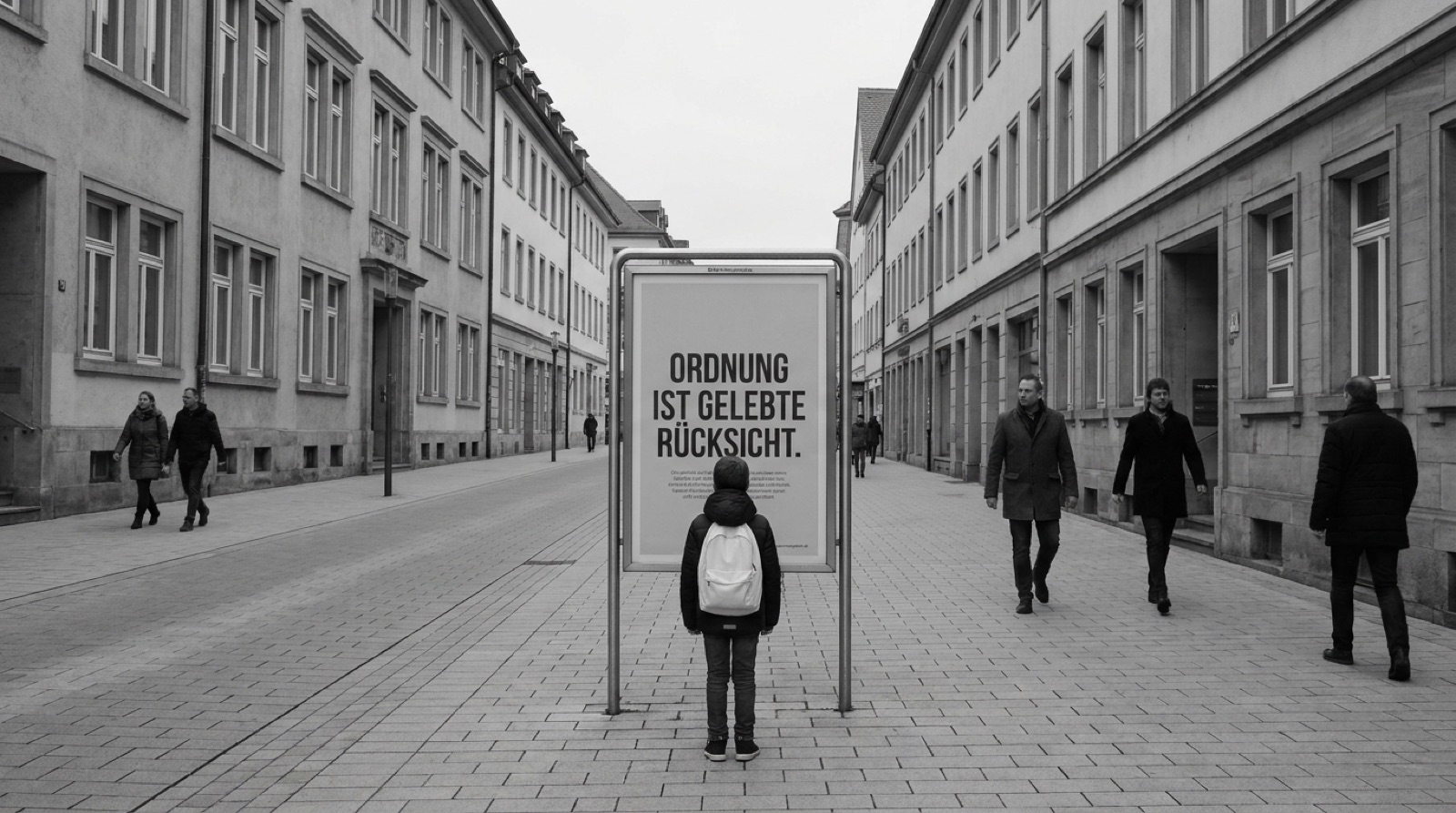
And yet there was a pressure over everything that could not be described by laws alone. Anyone raised in Orben learned early that an orderly life was not merely a matter of decency, but of legibility. A good child was not simply considerate; they were so considerate that every teacher could recognize it at once. A good neighbor did not merely observe quiet hours, but did so in a manner that made inner assent to the rule visible. Good people did not slam doors because they did not want to burden the world with lack of control. Good people argued behind closed windows. Good people wore no aggressive colors, since shrill tones were regarded as a foretaste of later unruliness.
Visitors praised the city’s calm and clarity. What they did not see was the price of that cleanliness: every person lived under the quiet suspicion of perhaps carrying something wrong inside, something that simply had not yet been properly examined.
At the office, Mara found her colleague Jasin sitting on the windowsill, though sitting on windowsills had been declared inappropriate by an internal safety memo. She liked him for that reason alone. Jasin was a structural engineer, excellent at his work and gifted in the rare ability to read even complex regulations in a way that made them seem, for a moment, human-made rather than natural law.
“They demonstrated your courtyard,” he said without greeting.
“They moralized it,” Mara replied, putting the brochure on the desk.
Jasin read two sections and then twisted his mouth. “Institutional integrity. A lovely expression for historically accumulated prejudices.”
Mara put water on and sat down. From the window she could see the rear wall of an administrative block, repainted for years in exactly the same white mineral color so that every difference in time disappeared.
“Tom will lose the courtyard,” she said. “Then perhaps the entire design. Once a system has found low moral legibility, no case officer will contradict it. Who wants to be the person who shows less caution than a machine with the word ethical in its name?”
Jasin turned the brochure over. In fine print it said the system had been trained on archived decisions, legal scholarship, urban-planning models, sustainability criteria, and cultural-diagnostic assessment patterns.
“Cultural-diagnostic assessment patterns,” he read. “That is new.”
“What is that even supposed to mean?”
“That someone taught the machine which gestures count as virtuous in Orben. Not merely how wide an emergency exit must be, but apparently how a decent person builds.”
Mara thought of the examples from the demonstration: the row house meant to express unagitated neighborliness, the warehouse with its functional considerationlessness, her courtyard, suddenly a semi-private space of meaning, as though a small ceramic wall hoped to subvert the city morally.
“Perhaps that is precisely what they want,” she said softly. “Not merely to accelerate decisions. To make the city’s taste unassailable. When a machine says it, it no longer sounds like taste. It sounds like knowledge.”
That afternoon an all-staff message came from the office. From then on, every new building application was to undergo EIR preliminary review. Applicants would receive a transparency report summarizing recognized strengths, weaknesses, and morally relevant signals. To improve submission quality, applicants were advised to include a declaration of social intention. Optional, too, was a self-assessment of the project’s attitude toward neighborhood, measure, light, material, and communal legibility.
Jasin read the email over her shoulder and began to laugh dryly. “A self-assessment of the project’s attitude. Next they will have gutters confess remorse.”
But that evening, walking home alone, Mara could already see the consequences. Outside a copy shop hung a notice: Help formulating socially compatible building intentions. Across the street, a writing office had pasted a new offer on its window: Application texts optimized for moral plausibility. A market was appearing faster than a regulation could dry.
Orben could turn every new hurdle into a service within hours. That too was a form of order.
4. The First Decisions
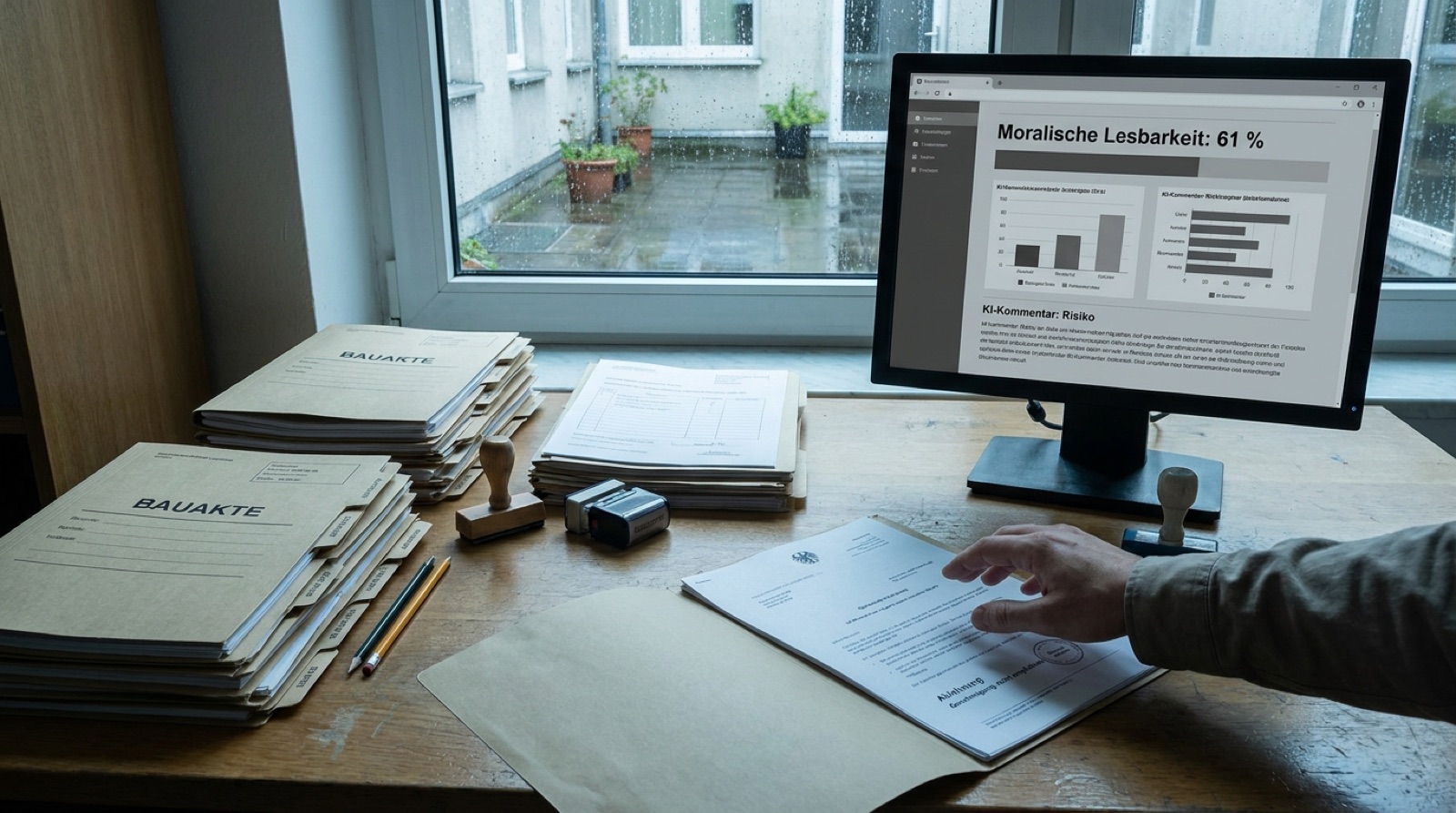
Three weeks later, EIR was no longer a demonstration but a habit. People had already begun to speak about the system as Orben spoke about people with impeccable reputations: with a mixture of distance, respect, and the quiet hope of never being fully understood by it.
Mara saw the first transparency reports because several builders forwarded them to her in despair. They were written in a tone that claimed merely to offer pointers while in truth laying a normative fog over every project.
A bakery was warned against demonstrative aesthetics of honesty, a roof extension against privileged exclusivity of view, a studio against introverted publicness. The applicants never knew exactly what such sentences meant, only that they worked against them.
Later every case officer could say the machine had merely made sensitive risk fields visible. No one had to say openly that they disliked the design. It was enough to outsource responsibility into that delicate gray language.
One evening, Tom Levin sat across from Mara and kept running his thumb over the same paragraph of his report, as though wear might disarm it.
“Listen to this,” he said. “The courtyard, because of its planned composition of materials and vegetation, reinforces the impression of atmospheric interior privilege. It therefore recommends approval only with stronger public justification of its character as a retreat. What does that mean? Am I supposed to justify why my children need shade?”
Mara had tried all day to remain objective, and now failed because of her own tiredness. “It means the courtyard looks too friendly for a city that accepts friendliness only when it disguises itself as collective necessity.”
Tom looked at her as if the answer were at once comforting and unbearable. “Can one appeal against it?”
“Against the decision later. Not directly against the report. Officially it is only guidance. In practice, it is the pre-decision.”
“And people accept that?”
“They accept it because Orben has taught them that the right thing is always already known somewhere,” she finally said. “When they fail, they first believe in their own inadequacy, not the system’s.”
That same week, a cooperative housing project on the city’s southern edge received a surprisingly positive report. It was denser, larger, and more expensive than many private projects, but EIR praised its regular facade order, ascetic palette of materials, and communally ethical restraint in the design of open space. Mara knew the designers. They knew exactly how approval was composed in Orben: not one gesture too many, not one promise of pleasure that was not balanced by at least two references to energy efficiency.
At the weekend, Mara had dinner with her sister Lene, a teacher who considered Mara too sensitive about administrative logic. Lene liked living in Orben. She liked that rules there were not felt as an attack on freedom but as protection against the arbitrariness of the loud.
“Perhaps it is better this way,” Lene said, spooning white sauce over winter vegetables. Even in food she preferred neutral colors. “People deceive themselves about their motives constantly. If a machine helps recognize selfish projects earlier, it saves everyone time.”
“And how does it recognize selfishness? From a tree in a courtyard?”
Lene put down her fork. “You are exaggerating. But you know yourself that architecture directs behavior. Why should its ethical effect not be considered too?”
“Because we pretend there is only one ethics: Orben’s ethics. The ethics of people who believe the good can chiefly be recognized by the fact that it does not disturb.”
At last Lene said, “Perhaps what disturbs you is not the system. Perhaps it is that it reads the city better than you want to admit.” The sentence stayed with Mara all the way home. EIR did not have to be objective. It was enough for people to believe the machine merely said aloud what the city had always known.
5. The Archive of Virtue
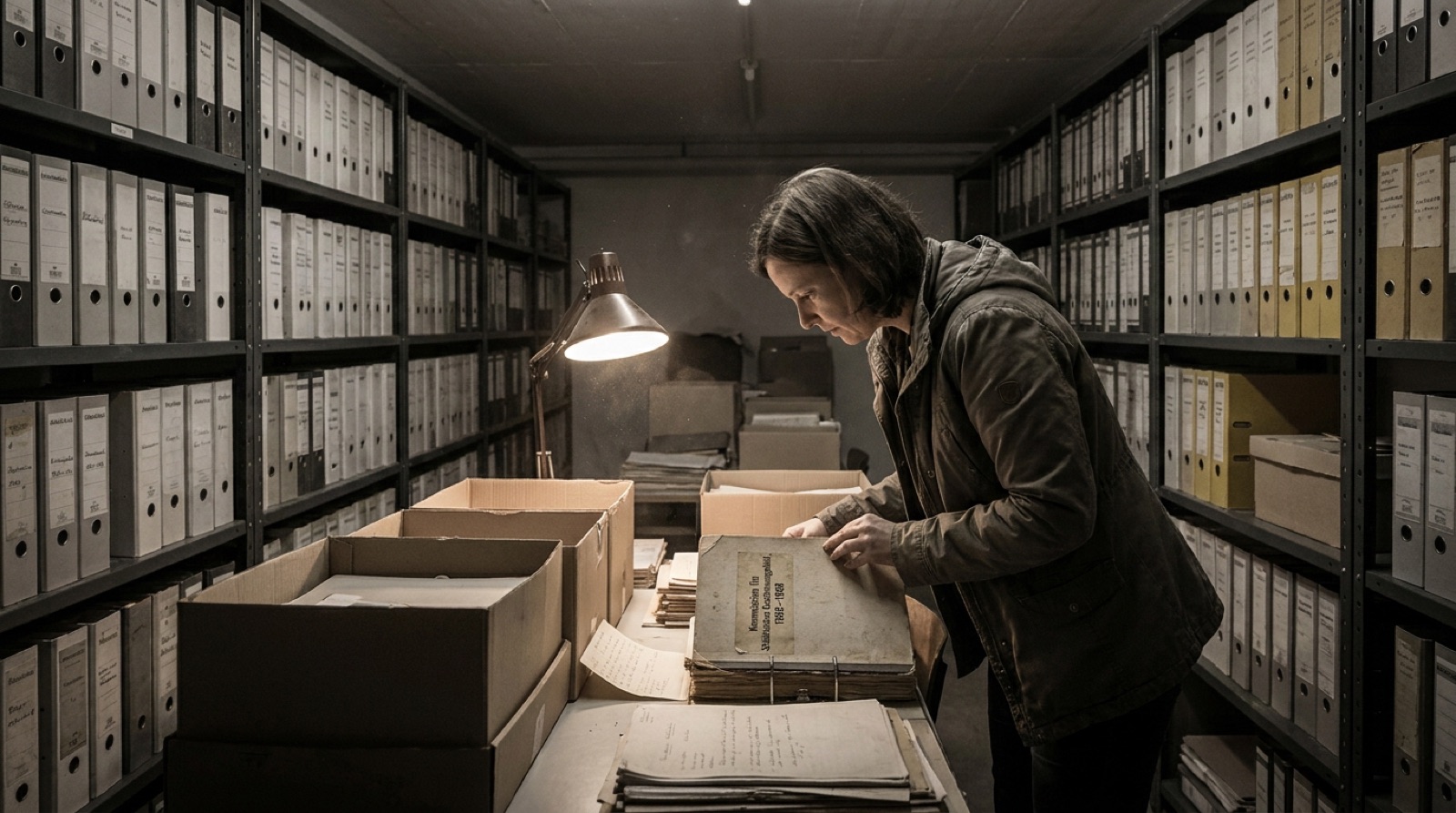
The idea that a machine might be disproved not through its code but through its memory came to Mara one Sunday as she stood before the shelves of old denials. EIR learned from decisions of high institutional integrity. All she needed to discover, then, was what Orben had considered upright. Probably not the fairest thing, but the thing left unchallenged the longest.
Through an acquaintance at the building chamber, she obtained access to the historical administrative archive, officially to make a professional comparison for a current application. Unofficially, everyone knew that file access in Orben often served to understand a present that mistook its own prejudices for tradition.
In the basement archive, Mara pulled out boxes and began reading decades of justifications. Within two hours she saw the pattern: demonstrative privacy, materiality too warm, dangerous inducement to linger, inappropriate individualization.
She made notes only in her narrow dark-gray notebook. Reasons for denial. Vocabulary. Recurring moral types. Humility, restraint, order, neighborhood discipline, visual modesty. It was as though the city had built a secret lexicon of virtue over generations and had now handed it to a machine.
Toward evening, archivist Emil Kern came to her table. He was a small man with white hair, narrow fingers, and the unobtrusive kindness found more often in archives than in executive suites.
“Are you looking for something particular, Ms. Voss?”
Mara considered evading the question, then said, “I think I am looking for the origin of a judgment now sold as a technical finding.”
Kern did not answer at once. He looked at the open files, her notes, the old form denying a courtyard design in 1994. “The administration calls such things development,” he finally said. “But often it is only preserved mood with better paper.”
Mara raised her head. One did not speak sentences like that lightly in Orben.
“So you also believe EIR…” She searched for the right verb.
“Does not think? That would be banal. No machine thinks as its makers promise from podiums. More interesting is what it continues. Systems like this do not preserve rules alone. They preserve reverence. They learn which tone in the house counts as reasonable. Then everyone mistakes the echo for truth.”
He pulled a folder from a neighboring shelf and placed it before her. Its spine read Commission for the Municipal Appearance, 1962-1968.
“If you want to understand why your ceramic wall suddenly has moral relevance, read this. That was when visual restraint began to be discussed not only as a style but as civic virtue. Later it became administrative language. Today, a dataset.”
When she finally emerged, it was dark. Streetlamps cast white light on black stone. Orben looked as it always did: calm, correct, unassailable. Only something had shifted for Mara. She now knew EIR was not a new power. It was the old power, for the first time fast enough to leave no one an excuse.
6. The Pilot Case
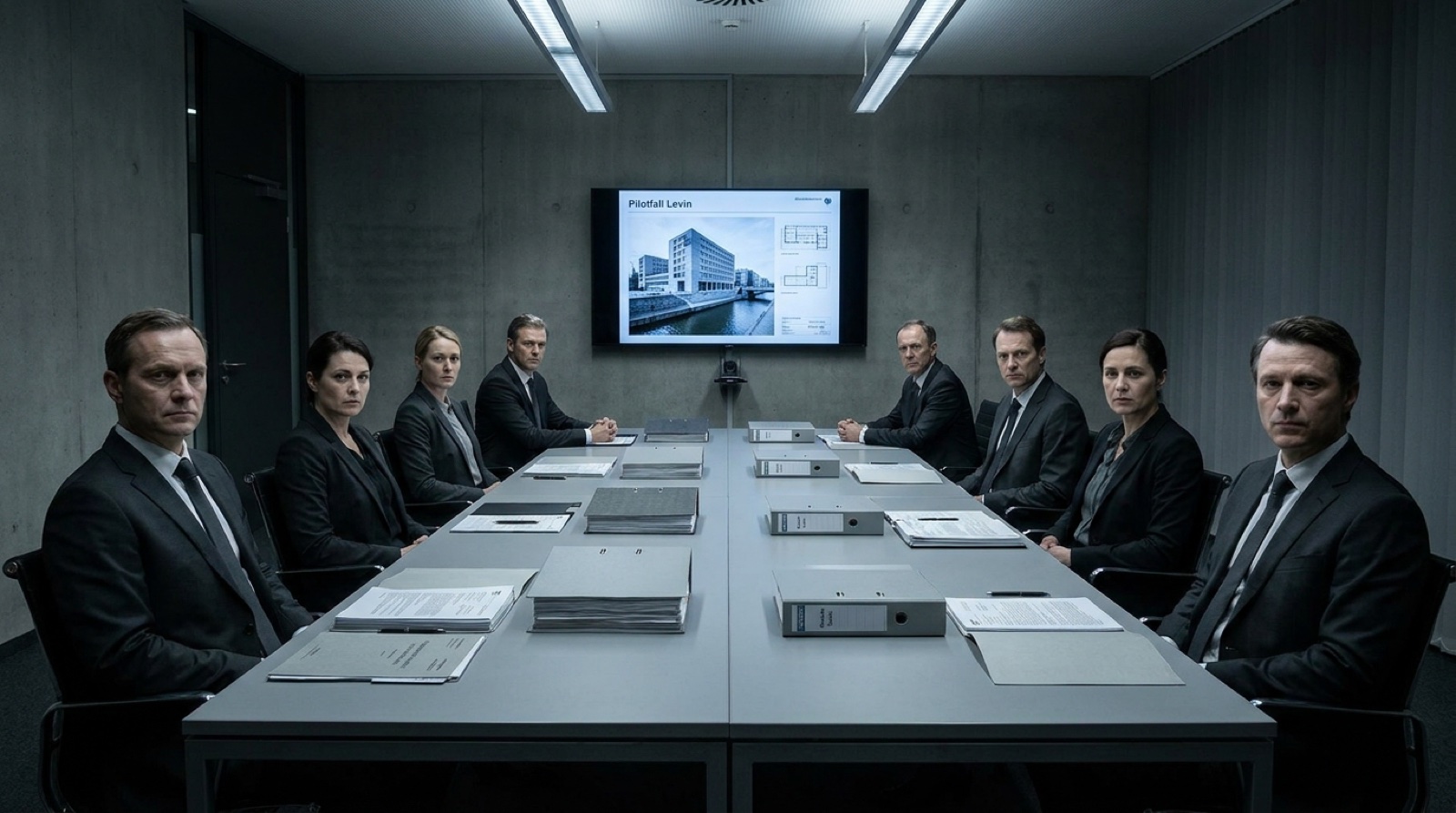
A few days later, Mara received an invitation to what the office called an in-depth discussion. The Levin application had been selected as a pilot case for the new procedural integration. Together, they were to examine how professional objections and algorithmic assessment might be constructively aligned. It was phrased like cooperation. Mara read something else: her project was to be disciplined by example.
In the meeting room sat Councilor Erhardt, case officer Halden, Dr. Nerlich of Claritas, a legal adviser to the office, and, to Mara’s surprise, Archivist Kern. He was apparently to serve as an expert observer of the historical continuity of the city’s guiding vision. In Orben, that was what one called people who might disturb the table but had not yet been sorted out.
Tom Levin was pale but composed. His wife Nora was already taking notes before anyone had spoken.
Halden began. “EIR sees considerable potential in your application. At the same time, the system recognizes avoidable ambivalences in the relation between private retreat and communal readability. We would therefore like to suggest adjustments that place the project more clearly in the horizon of community-serving residential culture.”
“Readability?” Nora asked.
The legal adviser cleared his throat. “It means that buildings do not merely exist in urban space; they take a legible position.”
“We are applying for a house,” Tom said. “Not a political manifesto.”
Nerlich placed his hands quietly together. “Homes in particular are constant statements about belonging, threshold, openness, and resource use. EIR recognizes when such statements unintentionally send socially exclusionary signals.”
Mara shook her head. “You claim to recognize signals that you first defined yourselves. You train on old judgments from a city that has treated every trace of intimacy with suspicion for decades, then call it objective ethical assessment.”
Erhardt studied her long enough for the room to read the gesture as a warning. “Ms. Voss, this procedure is not for your cultural-critical self-assurance.”
“It is exactly about that,” Mara said. Her voice sounded, even to herself, almost too alive by Orben standards. “When you begin sorting building applications by moral legibility, you are practicing cultural policy under the cover of automated administration. Very narrow cultural policy.”
Halden wanted to reply, but Kern raised his hand. It was a small movement; in a room accustomed to hierarchy, it carried weight.
“I would like to say something about the guiding visions on which the system relies,” he said.
He opened a thick folder and read without pathos, with the incorruptible sobriety of an archivist who knows history often conceals its greatest scandal in its most correct tone. He quoted minutes from 1964, 1981, 1994, and 2003: again and again the same patterns, skepticism toward individual color, distrust of private retreats, praise for visual self-diminishment. Then he closed the folder.
“If EIR learns from decisions of high institutional integrity,” he said, “then here it learns one thing above all: this city’s preference for morally valuable inconspicuousness. One may value that as cultural continuity. One should simply not present it as neutral knowledge.”
For the first time that day, real uncertainty entered the room. Not because Kern had said anything unknown, but because he had said something known without its protective layer.
Erhardt reacted quickly. “Traditions are not prejudices per se.”
“No,” Kern said. “But prejudices are gladly called tradition once they have remained untouched long enough.”
Tom looked from face to face as though he only now understood what territory his application had entered. It was no longer about drainage, escape routes, or setbacks. It was about who in Orben could define what a good life should look like.
Nerlich slid a printout across the table. “The system can adjust its recommendation if certain aspects are revised. A more neutral courtyard wall. Reduced vegetation density. Greater visual permeability. In addition, an accompanying text would help, positioning the courtyard’s character as a retreat clearly as a regenerative element in the service of everyday capacity, rather than an atmospheric special zone.”
Nora blinked. “You want us to justify the courtyard psychologically?”
“Refine it socio-ethically,” Halden said.
Mara might have laughed had she not been so tired. There, in one sentence, was EIR’s core: the private could remain, as long as language relabeled it as a contribution to the functioning of the whole.
7. The Adaptation
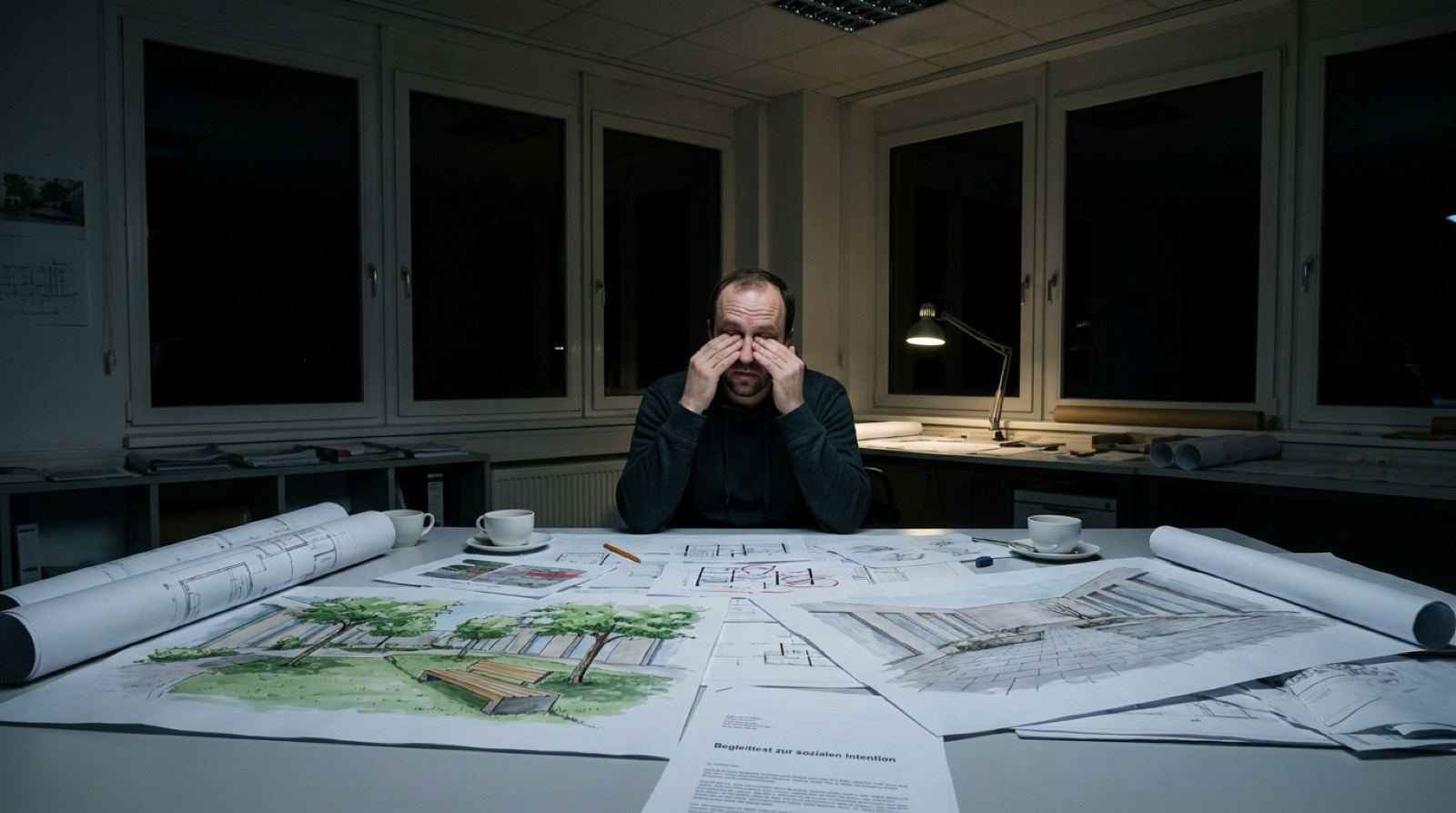
They worked deep into the night. Tom and Nora sat with Mara and Jasin in the office, drank black tea from white cups, and studied two versions of the same house as though they were two possible biographies.
In the first, everything remained as Mara had designed it. In the second, the courtyard had shrunk to a gray, impeccably unsuspected functional surface with a single tree, pale render, and a seating edge without the slightest inviting intention.
“If we submit the first version, we may lose months,” Tom said. “And in the end, everything. If we submit the second, we get the house. Perhaps even quickly.”
“But then you get exactly the house the machine considers morally usable,” Mara said.
Nora ran a finger over the first version. “I never wanted anything eccentric,” she said. “I only wanted the children to have a place that does not look like an extension of a corridor.”
Jasin sat on the edge of the table and was silent for a long time. Then he said, “Perhaps the real problem is not that they forbid something. Perhaps it is that they teach you to experience it as suspicious all along.”
Everyone in the room felt it land. They had begun to think of shade, seating edges, and glaze not merely as design questions, but as moral risks.
Mara rose and went to the window. Outside, the rear facade of the administrative block was so white in the streetlamp glow that it looked almost unreal. No trace of life, and for that very reason a sign of exemplary discipline in Orben.
“There is a third possibility,” she said.
Tom looked up. “What is it?”
“We resubmit the first version. But this time not only with technical documents. With a justification that forces them to expose themselves. We take their language seriously, only further than they like.”
Jasin understood at once. One corner of his mouth rose. “Not justification. Mirroring.”
Mara nodded. “We write that the courtyard serves psychological regeneration; that the trees reduce heat islands in summer; that a modest place of retreat demonstrably reduces social friction in densely lived everyday conditions; that the ceramic wall improves the quality of light and supports the residents’ daily resilience. All true. But we write it so that it becomes visible how impoverished a city has become when it accepts even kindness only as a performance factor.”
“And if they approve it anyway?” Nora asked.
“Then you have your courtyard,” Mara said. “And if they reject it because the text shows too clearly what they are doing, then at last we have a case that can show publicly that EIR is not neutral administrative assistance.”
They continued until an accompanying text in flawless Orben language lay before them. No pathos, no rebellion, no color. Only an arrangement of its own vocabulary so precise that the city would have to recognize itself in it as in an unflattering mirror.
EIR loved order. So they would deliver order. But not an order that could still call itself innocent.
8. The Decision
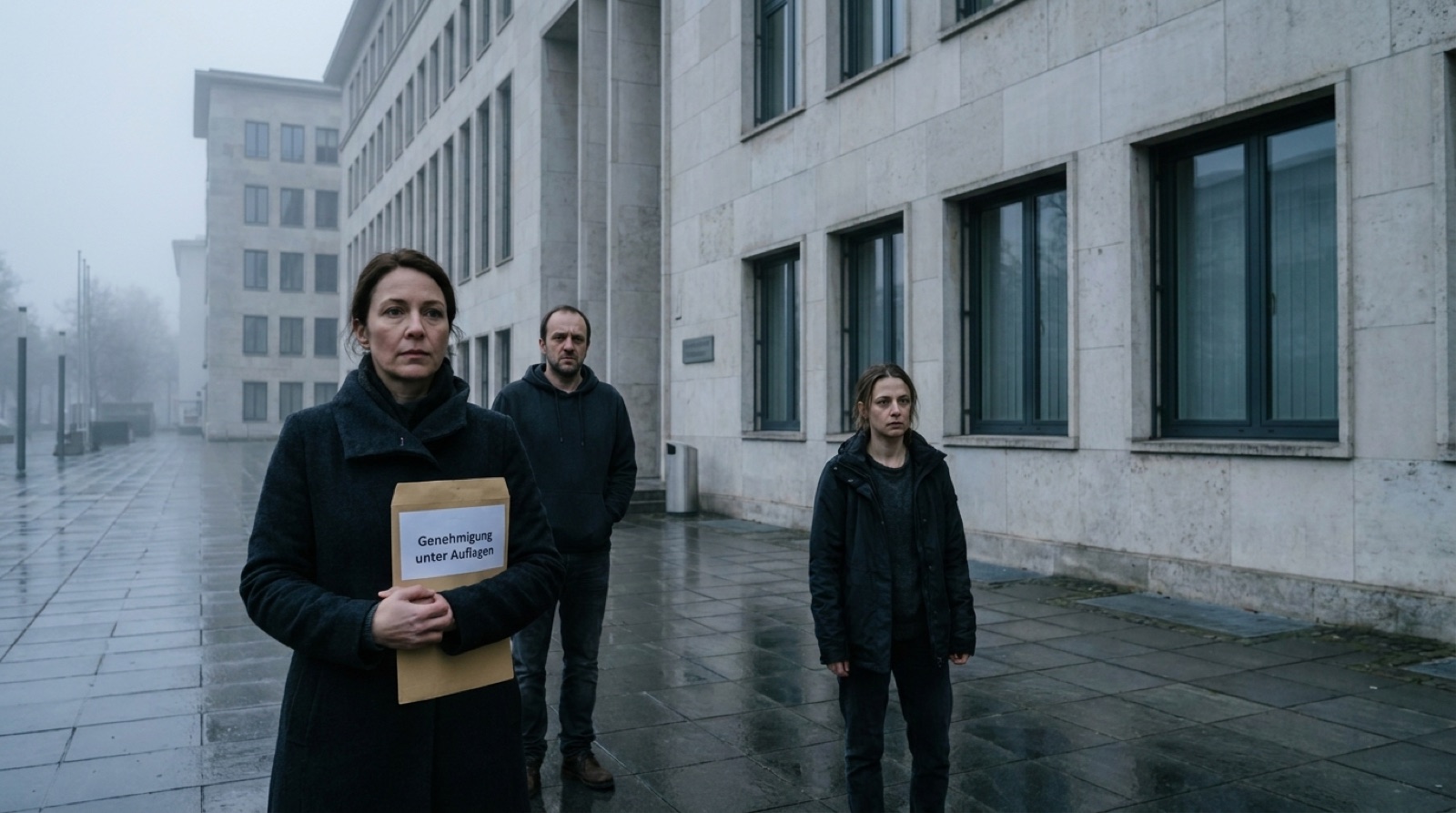
The decision came faster than any Mara had received in years. Four days after resubmission, the envelope lay in her office mailbox. The speed itself was a signal. Either EIR had swallowed the new text and nodded contentedly, or the office wanted to close the case as quickly as possible before it drew attention in the wrong places.
She asked Tom and Nora to come over, made tea, placed the envelope in the middle of the table, and opened it with a knife so sharp the cut made no sound.
Approval subject to conditions.
Nora sat down as though her bones had briefly been loosened. Tom read aloud, haltingly at first and then in mounting astonishment. The courtyard was allowed. The trees remained. So did the ceramic wall. The bench had to be described as a permanently integrated seating edge. In addition, the office required a small explanatory plaque in the entrance area, describing the open-space concept as a contribution to everyday health stability, microclimatic balancing effects, and neighborly balanced quality of retreat.
Jasin, who arrived later, read the conditions and laughed so openly that Mara immediately pulled him to the window so no one in the courtyard could hear them.
“They swallowed it,” he said. “They approved the courtyard as long as it appeared no longer as beauty, but as functional hygiene.”
Mara nodded. The victory tasted strange. The courtyard was permitted, but not because Orben had learned that people might find dignity in quiet joy. It was because that joy had successfully been translated into the language of stress regulation.
Word of the case spread quickly. Other architecture offices asked for formulations, and the office already praised the pilot case as proof that EIR responsibly integrated differentiated qualities. Dissent was immediately converted into the form of a conversation.
Mara went anyway. Not out of hope. Hope was rarely a viable working instrument in Orben. She went because she had come to understand that the struggle was not between human and machine, but between two ideas of the good. One wanted to arrange life so that it gave no one cause for suspicion. The other wanted to create spaces where people could breathe without constantly having to declare their humanity a function of the common good.
At the end of the evening she stood alone before the office on its broad steps. Shadows still moved behind the high windows. Above the door stood the same sentence as ever: What is good is what can be examined.
For the first time, Mara thought the sentence was not only a threat, but a weakness. Once everything good had to be examined, the examination itself could become the object of the question. Who was examining whom? The machine the city? The city its citizens? Or all of them together only the willingness to mistake a false image of virtue for truth long enough?
Below, on the square, a child passed by holding its mother’s hand. It wore a white schoolbag and in its other hand held a little bouquet of dry black seed pods, as though it had accidentally gathered something that did not fit the city’s customary picture. The mother bent toward the child, said something, and the child slipped the pods into a coat pocket, carefully, as though they were a secret treasure.
Mara watched it go and thought of the courtyard by the canal, soon to be built. Of the three ginkgos. Of the ceramic wall that would return a little light in the rain. Perhaps in Orben that was already a form of resistance: not the grand gesture, not the scandal, but a place where kindness did not first become noble through measurability.
She pulled her coat close and walked into the gray city that wanted to do everything right and for that very reason had such difficulty recognizing the good when it appeared quietly.
| Previous | 31 May 2026 | Next |




About me
Hello! My name is Stephan Schwab.

I build and rescue software, and I write fiction about the human side of how it gets made. Here you’ll find my stories and novelas, notes on craft, and field notes from a life lived across several worlds.
Working with software teams is what I do professionally — see how on caimito.net. You can also read about my experience since 1986.